COSTUMES CRUCIAL TO HALLOWEEN SAFETY, ADVISE AMR MEDICS
Just how safe is your child’s Halloween costume?
Paramedics at American Medical Response have specific advice for buying or creating costumes that help kids avoid injury while trick-or-treating. Remember: Some researchers have said children are more likely to be struck by a vehicle on Halloween than any other day of the year.
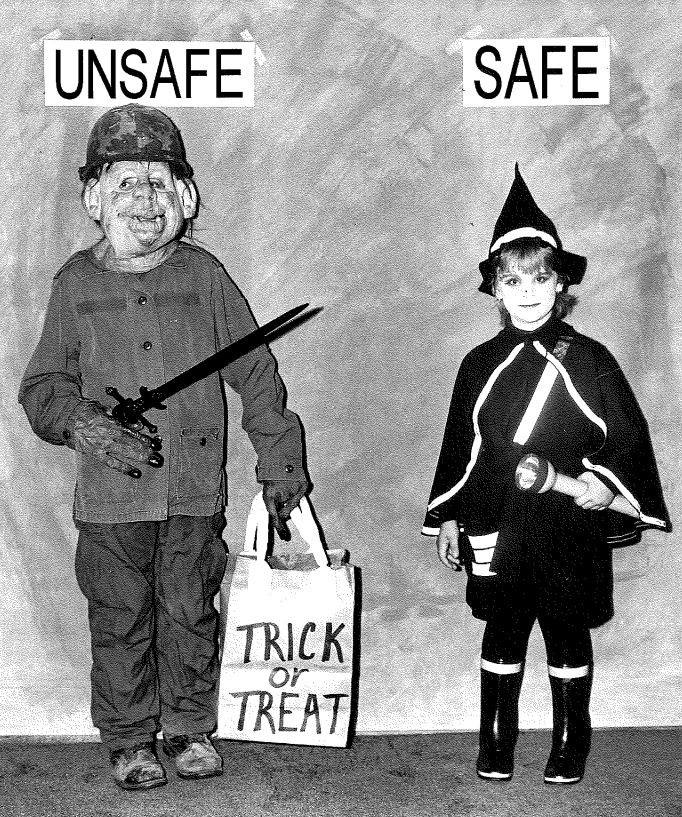 This photo compares a trick-or-treater dressed safely with one dressed unsafely, namely, a commando ghoul and a witch.
Starting at the goblins’ heads and going to their feet, notice that the safe little witch has a hat that leaves the face unobstructed while the commando wears a heavy helmet that is too large, could fall off or otherwise become a distraction.
The witch wears make-up on her face, while the commando has a mask he cannot see, hear or breathe through well.
Avoid wigs, beards and loose hats.
The witch’s cape, though black, is striped with highly-reflective tape front and back, making her much easier to see in the dark than the commando’s camouflage. Her goodie bag is also striped with reflective tape.
In one hand, the witch carries a flashlight. Never let a child carry a candle. It’s scary to see the commando carrying, of all things, a sharp sword.
The commando’s other hand is occupied with a large trick-or-treat bag, which could trip him. The witch has a smaller bag hung by a shoulder strap, leaving her second hand free.
Plastic monster gloves hinder the commando from using either hand freely.
Knit stockings protect the witch’s legs from the chill and from briars, but the commando’s pants are so loose they will easily snag on bushes, fences or other objects.
The witch wears sensible shoes without heels, but, if the commando’s pants don’t trip him, his oversize shoes will.
Be sure the costume is made of flame-retardant material and is warm and sturdy enough to take lots of activity.
AMR says, “Boo!” to you, too!