CHS Spanish students earn Seals of Biliteracy
By Katie Tracy
In addition to their caps and gowns, several Advanced Placement Spanish students at Clinton High School (CHS) will have a new distinction on graduation day next year – the Seal of Biliteracy on their diplomas.
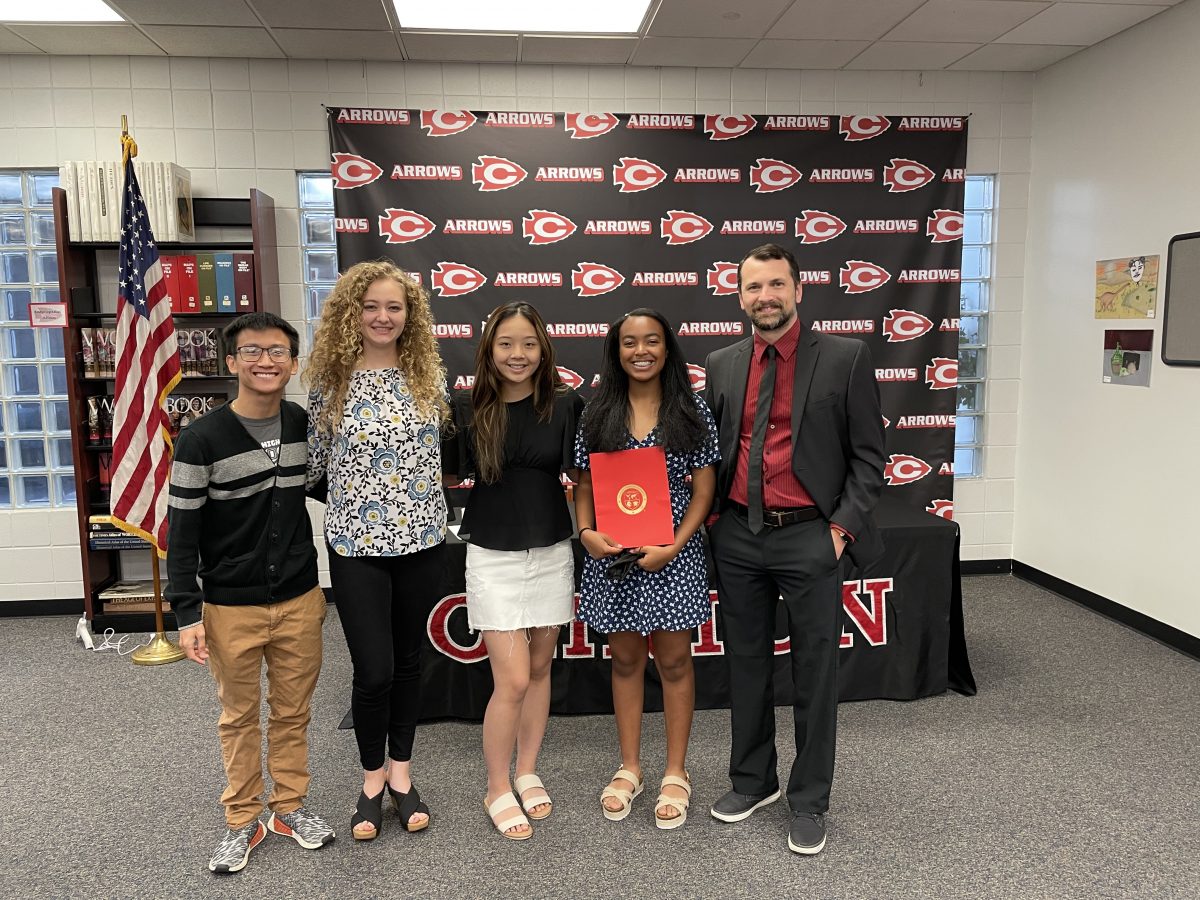
Four CHS juniors – Mikayla Bibb, Katie Tracy, Khai Truong and Kristine Van – recently became some of the school’s first-ever recipients of the Seal, which is awarded by the Mississippi State Board of Education to recognize students who have demonstrated mastery in two or more world languages by high school graduation.
Mississippi began participating in the national program, which began in 2008 as a grassroots movement in California, in the 2019-2020 school year, and the Clinton Public School District (CPSD) adopted the program in 2020. Only ten other school districts in the state currently participate. According to the 2020 National Seal of Biliteracy Report, as of last year, all fifty states and the District of Columbia are or have been working toward implementing a State Seal of Biliteracy program.
To receive the recognition in Mississippi, students must demonstrate mastery of English and another world language. The Spanish students did this by taking the AVANT test, which tests students for proficiency in the areas of reading, writing, listening and speaking. Testing was coordinated by Clinton High School teacher Julie Roberts, who oversees the school’s English Language Learners (ELL) program.
All four students scored high enough on each section of the test to earn the highest distinction, the gold seal. In addition, Truong had an additional achievement: he not only received the gold seal of biliteracy for Spanish, but for Vietnamese, as well, becoming the first and only student at CHS to earn the honor – and one of the first in the state of Mississippi to do so, as well.
Clinton High School Advanced Placement Spanish teacher Bradley Freeny says he is very proud of his students and the efforts they have made this year to push themselves towards mastery of the Spanish language.
Freeny said that in order to determine how to help his students prepare for the AVANT test, he took the test himself.
“I found that a lot of the things we were already doing in class are things that would help prepare my students for the test – things like practicing conversations, listening, reading and writing are all the things we’ve [already] been doing to prepare for the AP exam.”
Bibb agrees, specifically crediting the mock conversations that Freeny has arranged for his students to have routinely with Spanish-speaking students in Roberts’ ELL class.
“For me, speaking is the hardest part of becoming proficient in Spanish,” said Bibb. “The confidence it takes to speak aloud is immense, and the conversations that we do in class help me build up that confidence.”
Truong, who knew no English when he moved to the United States from Vietnam at age eight, began his time with CPSD as a student in the district’s second grade ELL program. He says the opportunity Freeny’s AP Spanish students have to work with Spanish-speaking ELL students doesn’t only benefit Freeny’s students.
“Non-native English speakers are thrown into an environment where most of their peers only speak English, and they speak none,” said Truong. “I know how comforting and relaxing it is to be able to communicate with someone who actually understands what you are saying, and I am happy to be able to be that person for someone else who speaks Spanish.”
With the AVANT test measuring proficiency in not only listening and speaking, but writing and reading, as well, the students say they are excited about the recognition the seal can lend to their future endeavors.
Both Bibb and Van identify the long-term benefits that their work toward receiving the Seal will have for them. Bibb recognizes the diversity of the world today, saying, “I feel like sometime in the future, it is likely that I am going to run into somebody who only speaks Spanish, and I feel like it would be really helpful and empowering to be able to converse and communicate with them.”
Van says she expects that her Spanish fluency will benefit her in her future career in the medical field.
“Knowing a second language such as Spanish could help me connect with patients who might not speak English and help them get the care they need,” she said.
Freeny says he looks forward to the benefits his students will experience because of their proficiency in the Spanish language.
“I feel that [the Biliteracy Seal] gives students a boost of confidence, giving them an assessment that shows them what they have accomplished; and, hopefully, that will give them the confidence they need to continue in using the language.”
In addition to the immediate benefits the Seal provides students, Freeny also recognizes the usefulness of the accomplishment in students’ professional lives.
“It’s just a really good thing that students could use to put on college applications and job resumés that will help them stand out from other people who are applying to the same things,” said Freeny.
For more information about Mississippi’s Seal of Biliteracy program, visit www.mdek12.org/ese/Mississippi-Seal-of-Biliteracy.
EDITOR’S NOTE: Some CHS students in Roberts’ ELL class also took tests for biliteracy for their native languages, but their results were not available ahead of the writing of this article.