Nunnery releases book heralding state’s football stadiums
By Danny C. Davis

Nash Nunnery
Nash Nunnery played football for the Clinton Arrows from 1970 to 1972. He loved the sport and was a starter on the offensive line for the Arrows for the 1972 season, which was the first year under the legendary Coach James Sloan.
He was also a writer for the Clinton High School newspaper and kept a daily journal of games and practices that 1972 season, when the Arrows went 10-1 and won their first Overall Little Dixie Conference Championship.
About a year ago, Nunnery found the fifty-year-old journal, and he started thinking about writing a pictorial book on famous high school stadiums.
“I went to the last football game at Roy Burkett Field, when all the players and cheerleaders were honored on the field for having played there,” said Nunnery.
“It was really an emotional night back in November 2006.There were 5,000 fans there that night. A lot of my friends were there that I played football with, and it brought back a lot of good memories of Coach Burkett, whom I played for in 1970 and 1971.”
So, last July, Nunnery started to work on a book about old high school stadiums.
“Football stadiums are the tie that bonds the communities – it’s a connection almost like a church to the people who live in the town,” said Nunnery.
Before Nunnery began the interviews for his book, titled Magnolia Gridiron Cathedrals, he identified the forty-seven historic “cathedrals” for the book and mapped out the state into five geographical sections: Central, The Delta, Northeast, Pine Belt/Gulf Coast, and Southwest.
Each stadium had to be at least fifty years old to be included and have a lot of historic significance or unique features.
Then, Nunnery set up interviews and a travel plan with his wife, Vicki, who was the photographer, along with Nash’s good friend Freddie Rainer, also a member of the 1972 championship team and a standout lineman at Mississippi State.
“We called or emailed the school’s head coach or principal, and they gave us the names of big supporters or fans who knew the history of each stadium and then set up the interviews.”
“We made the appointments, and then hit the road,” said Nunnery, who, with wife Vicki, traveled 3,626 miles, conducted 94 interviews, and took 1,578 photos – of which 246 were used in the book.
“We wanted to visit the stadiums in the daylight hours, so we could see the stadium better and take better pictures.”
Nunnery, a former sports writer for The Clinton News and other newspapers, does an excellent job finding local fans to tell interesting stories about the cathedrals – or local stadiums.
The first trip was to the Delta area, where sixteen stadiums were visited.
After each section was completed for interviews and pictures, Nunnery would work the next two weeks on writing essays for each school, before hitting the road again for more interviews.
Two of the stadiums included are over one hundred years old. One is Harpole Stadium at Philadelphia High School, where the home concrete bleachers are embedded in the red clay soil, with the bleachers curving back towards the end zone and field house.
Also over the century mark is Henley Field at Forest County AHS in Brooklyn, Mississippi, about twenty miles south of Hattiesburg. It is a unique football field, with a pond and pastures all around the stadium.
Nunnery has captured many unique stories in the 200+ pages of his first book.
One of the most storied stadiums included is Dutch Binion Field at War Memorial Stadium at Pascagoula High School. The stadium was built in 1948 to seat 5,900 fans and was expanded to 9,000 seats in 1967. The ashes of long-time supporter Walter Thornton, “Mr. Pascagoula Panther,” are said to be buried under the artificial turf.
And, of course, Clinton’s historic Roy Burkett Field, where the Arrows played from 1970 until 2007 – and the field that Nunnery and Rainer played on – is in the book. A few years ago, Nunnery was instrumental in getting a historic marker erected at the stadium site, which sits next to the current Clinton Jr. High School.

Marshall Ramsay’s illustration of Clinton’s Roy Burkett Field is included in Nunnery’s book.
Fields from the old Little Dixie Conference that Clinton traveled to every other year are included, like Louis G. Strickland Field at Brandon, Trojan Field at Magee, Tiger Stadium at Mendenhall, and L. O. Atkins Field at Forest.
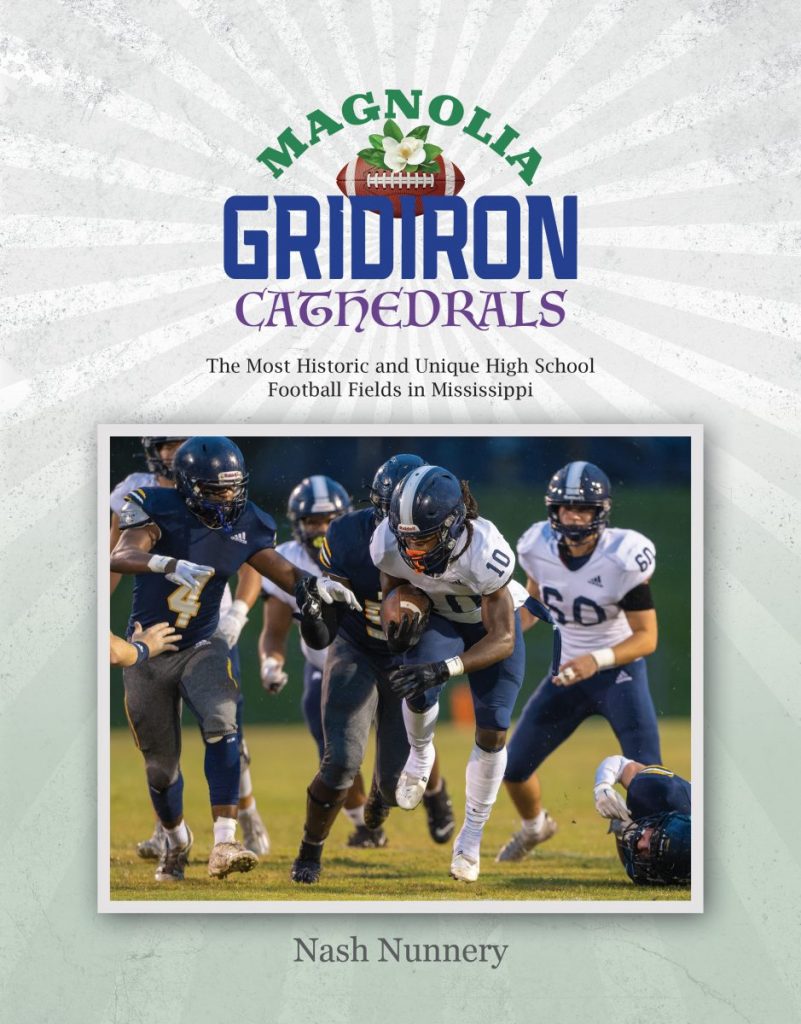
Nunnery’s book is available at Lemuria Books
Once the interviews were finished and typed up, Nunnery teamed up with X.M. (Mike) Frascogna, Jr., who has published many Mississippi sports books, to get the book published.
Frascogna’s team also included local Mississippi artist Marshall Ramsey, who did illustrations of each of the forty-seven stadiums from Vicki Nunnery’s and Fred Rainer’s photos.
The Frascogna team also included well-known book designer Joe Lee and proof reader Cindy Clark.
“I cannot thank Mike Frascogna and his team of Marshall Ramsay, Joe Lee and Cindy Clark enough,” said Nunnery. “This type of book would not been possible without their help.”
The beautiful coffee table-style book has now been released and will be available statewide. Locally, Lemuria Books in Jackson will carry it, and the store will host a “sneak preview” book signing on Saturday, August 5 from 2 – 4 p.m.
Nunnery’s book will also be featured at the annual Mississippi Book Festival on August 19 at the Mississippi State Capitol. Also that day, Nunnery will be on a panel discussion at the Capitol with other Mississippi authors.
This book is a must-own for Mississippi high school football across the state.