NORAD OKs Rudolph’s Christmas Eve flight plan
By Katherine R. Dougan
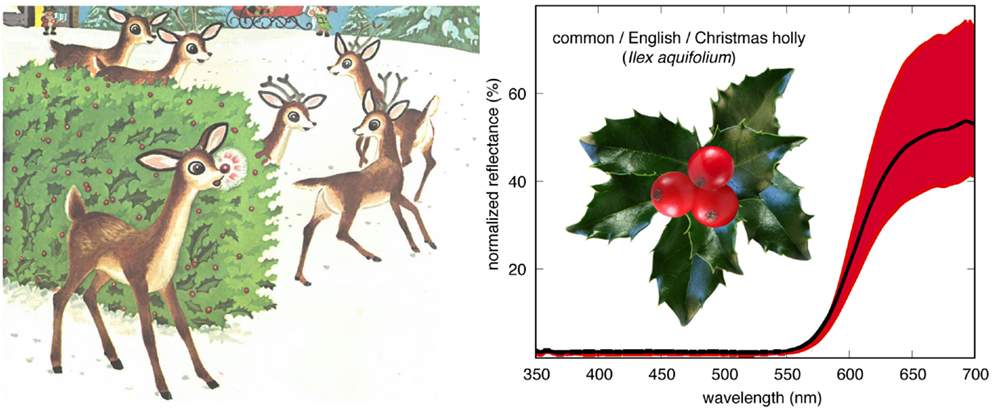
A later version of Rudolph the Red-Nosed Reindeer [10] discussed the similar color of ripe holly berries and Rudolph’s nose. The illustration by Richard M. Scarry is shown, together with an image of ripe holly fruits (common name: English / Christmas holly; scientific name: Ilex aquifolium). The graph shows the reflectance spectra of the berries, which basically describes the redness and brightness of their color. The red-shaded region represents the variation, and the black line represents the average in a sample of ten berries.
Before this year’s Christmas Eve flight, however, safety during the journey prompted a meeting at the North Pole with scientists from the North American Aerospace Defense Command, or NORAD, which uses satellites to track Santa’s position by detecting Rudolph’s nose, which emits an infrared signature similar to that of a missile. With more than 8,000 satellites and all the junk in space, including defunct satellites and exploded fragments whirling around in the night skies, sky traffic is a legitimate concern.
Writer’s Note: Our Clinton Courier readers know that Santa and I have a long-standing friendship, based on his absolute coolness and our shared love of cookies and Christmas. Santa shared the meeting transcript with me, and I now share it with you.
NORAD: Mr. Claus, I respect the years you have successfully operated your worldwide Christmas delivery system to bring love, joy, hope, sweets and gifts for everyone.
SANTA: Ho, ho, ho and thanks! That’s the way we roll here at the North Pole!
NORAD: Surely, you must share our concerns about the increased danger of your Christmas Eve mission. Our scientists estimate there are more than 30,000 pieces of space junk bigger than ten centimeters, or about four inches in orbit around the Earth, and numbers shoot into the millions when you count all the tiny bits and pieces floating about.
SANTA: Oh, not at all. The infrared signature from Rudolph’s nose can be seen through space and time, no matter the weather, obstacles or junk in the skies.
NORAD: Respectfully, Santa, with modern navigation systems available in all vehicles, phones, tablets, iPads and other devices, why not utilize updated technology for your important journey?
SANTA: Ho, ho, ho! Trick question, Mr. Science. Navigation tools are designed for use on Earth, and won’t help a bit with directions in space. And sometimes the navigation tools don’t work like they should here on the ground. [Santa knows this firsthand when he traveled in his red Cadillac to Atlanta and tried to find an address on Peachtree Drive. Santa found the same street number on FOUR streets ALL named Peachtree Drive. Egads! Santa circled Georgia’s capital city for hours, throwing his phone out the window in disgust.]
A wheezy, whistling sound filled the air from the back of the conference room. Once he had the attention of everyone, Rudolph, who is shy and never talks to strangers, clacked over to Santa on his tiny hooves, and whispered in Big Elf’s ear. Handing Santa a thumb drive for his laptop, Rudolph clacked to the back of the room and motioned to Santa with his foreleg in a circle, to fire up the computer and play a PowerPoint presentation.
The presentation was based on a scientific paper published by Frontiers for Young Minds, an open-access academic journal that publishes articles “edited by kids for kids.” The paper explains how Rudolph’s amazing red nose is more than equipped to handle navigation, as he has done for many, many years.
Frontiers for Young Minds covers STEM research and allows young scientists, from ages eight to fifteen years old, to participate in the publishing process. The paper explains that Arctic reindeer, like Rudolph, have reflective tissue in their eyes that changes color with the seasons. The eye tissue turns a deep blue in the winter, which is believed to help animals see blue light and gives them night vision.
Rudolph’s unusually large, red nose, which is described in Robert L. May’s classic story, “Rudolph the Red-Nosed Reindeer,” as luminescent (glowing) and the same shade of red as a holly berry. Red light travels best in fog, explaining why reindeer, more than other mammals, would benefit from a nose that produces red light. [We all know that at least one reindeer is reported to have a luminescent (glowing) nose that operates well under foggy conditions!]
Additionally, reindeer are able to see ultraviolet light, which helps during winter months when the sun is low on the horizon and light is scattered high in the atmosphere, making the UV light blue-purplish.
A large, red luminescent nose is an anomalous, or extremely unusual, condition. Scientists generally avoid studying anomalous traits. Lucky for us is that kid scientists have studied and written about this phenomenon.
That level of red is quite possibly the maximum redness that the eyes of mammals are able to see. In other words, Rudolph’s nose is perfectly engineered for the task at hand.
A perfect silence, like the soundlessness after fresh-fallen snow blankets the ground, fills the room after the presentation concluded. Clacking as he crossed the tile floor and approached the conference table, Rudolph commenced with blowing, whistling and tapping his front hooves on the table for attention. Santa and Rudolph conversed, as elves and deer outside the closed door pressed water glasses against the door and up to their ears, leaning close to hear what was going on. The scientists then approved Rudolph’s flight plan, and everyone enjoyed coffee, cocoa and cookies, which Mrs. Claus carried in on a large tray.
Scientists might never completely understand how Rudolph navigates around satellites in space, but it is possible that he has some advanced technology at his disposal. For example, spacecraft navigators use radiometric tracking data received from the Deep Space Network to determine the spacecraft’s position and velocity. They also use optical data, where the spacecraft takes a picture of the star background to help refine the spacecraft’s trajectory 3. It is possible that Santa has access to similar technology to help him navigate around satellites in space.
My theory? Christmas magic helps Rudolph make the journey, year after year.
Please enjoy the magic, joy and beauty of the holiday season. And, of course, have a very Merry Christmas!
EDITOR’S NOTE: The Clinton Courier is deeply appreciative of Ms. Dougan’s personal friendship with Mr. Claus and their willingness to share their thoughts each year with our readers. This is the tenth exclusive interview Dougan has completed with Claus on behalf of the Courier since 2011.
SOURCES CITED:
· May, R. L., 1939. Rudolph the Red-Nosed Reindeer. Chicago, IL: Montgomery Ward.
· Hogg, C., Neveu, M., Stokkan, K.A., Folkow, L., Cottrill, P., Douglas, R., et al. 2011. Arctic reindeer extend their visual range into the ultraviolet. J. Exp. Biol. 214:2014–9. doi: 10.1242/jeb.053553.
· Hazen, B. S., 1958. Rudolph the Red-Nosed Reindeer. New York, NY: Golden Press.
· Dominy N., 2015. Reindeer Vision Explains the Benefits of a Glowing Nose. Frontiers for Young Minds. 3:18. doi: 10.3389/frym.2015.00018.
· North American Aerospace Defense Command (NORAD)