FBC Forever Young hears from cardiology nurse practitioner
By Carole Kelly
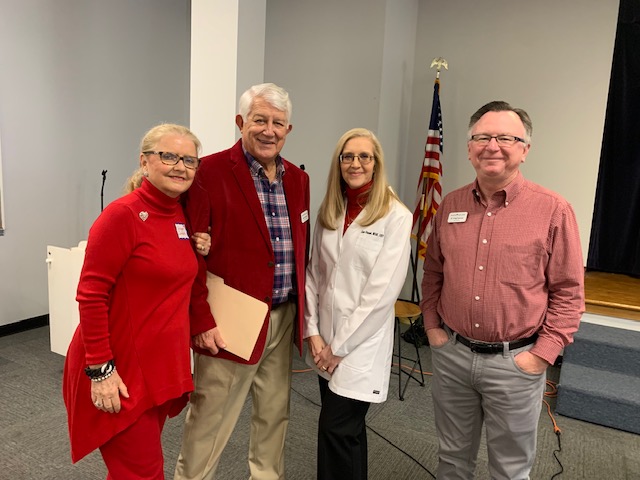
The Forever Young senior adult organization of Clinton First Baptist Church celebrated the February Valentine theme with the presentation of “Living with a Healthy Heart” by cardiology nurse practitioner Lynn Vincent. Pictured (l to r) are Ginger Daniels, Lynn Vincent, senior-adult pastor Dennis Daniels and lead pastor Dr. Greg Pouncey.
Cardiovascular health was the subject and heart the key word when Lynn Vincent, MSN, ACNP, cardiology nurse practitioner, recently spoke on “Living with a Healthy Heart.” A nod to the February observance of American Heart Month included discussion about healthy heart habits and symptoms of heart disease for senior adults at First Baptist Church.
Dennis Daniels, senior-adult pastor, introduced Vincent to the audience, many of whom were dressed in red in deference to the “wear red” theme associated with heart awareness. Vincent moved from Illinois to Mississippi in 1981 and graduated from St. Joseph High School. She earned a Bachelor of Science degree in nursing from Mississippi University for Women and has a Master of Science in nursing degree from University of Mississippi Medical Center (UMMC). She worked in the UMMC Coronary Care Unit and joined the Jackson Heart Clinic in 1995.
Vincent pointed out that the focus of February as American Heart Month began in 1964 with a proclamation by President Lyndon Johnson, who had heart problems. The month spotlights awareness, emphasizing education in an effort to prevent the disease and decrease the statistics.
“Unfortunately, heart disease is still one of the leading causes of death,” Vincent noted, with coronary artery disease and atrial fibrillation two major problems. Atrial fibrillation is a form of arrhythmia or abnormal heart rhythm and is more common with the older population, and coronary artery disease is the condition of major blood vessels being blocked, reducing the flow of blood, oxygen and nutrients to the heart.
She said that heart disease has been and remains the number one killer of Americans, for both men and women, among all ethnicities. She showed a map that demonstrated southern states have the highest risk of mortality. The cost of heart disease amounts to some $219 billion yearly, encompassing personal loss, treatment, medication and lost productivity.
Dangers to the heart include problems with blood pressure, smoking, cholesterol, diabetes, obesity, physical inactivity, dietary habits, hypertension and family history. Although genetics and family history cannot be changed, actions and choices that can make a difference are cholesterol monitoring, exercising, losing weight through a healthy diet, smoking cessation and stress management.
Vincent stressed that good dietary habits particularly include moderation when it comes to eating fast-food fare.
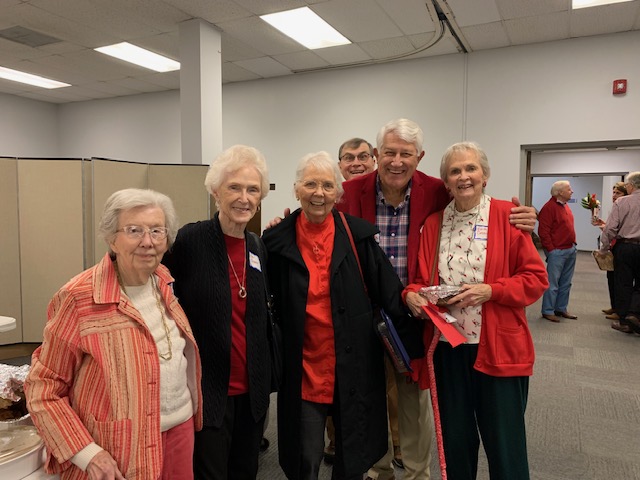
Wearing various shades of red in observance of February as Heart Month are (l to r) Mittie Kay Smith, Gail Jabour, Margarita Stanford, Tom Sims, Dennis Daniels and Edith Cassibry.
Warming signs including chest pains, pressure or heaviness (“an elephant on my chest”), shortness of breath with exertion, perspiring, dizziness, fainting, and fatigue and are signs calling for immediate medical attention. Women often have more vague, undiagnosed issues, such as pain in arms, nausea, neck and jaw discomfort, and shortness of breath.
New treatment options continue to be developed, and tests to help diagnose heart disease include the electrocardiogram (EKG), echocardiograms, the exercise stress test and the nuclear stress test, CT scan, and cardiac catheterization and angiogram.
Atrial fibrillation affects some three million persons in the country, with costs running into $6 billion. Common conditions associated with the disease include hypertension and diabetes. Medications prevent blood clots, lower the possibilities of stroke, slow the heart rate and control heart rhythm.
Vincent works to achieve the “best quality of life when a patient leaves her office … to be able to do the things they can do!”