Contractor chosen for 80/20 infrastructure work
By Randy Bell
The price tag for building streets, installing water and sewer lines and putting up lights for Clinton’s major economic development project between I-20 and Highway 80 is still expected to be over $25 million. But because, at this point, the 80/20 Project has secured only $16 million in funds for that infrastructure work, some changes had to be made in the way things are being handled.
The new arrangement calls for the contractor chosen to do the first phase of the infrastructure to work for the City of Clinton, instead of being hired by a company serving as the project’s construction manager.
The Board of Aldermen at its April 2 meeting adopted a resolution ratifying the process that was used previously to award Joe McGee Construction, Inc. a $4,676,982 contract. The Board also approved a purchase/sales agreement for some Mississippi College land to be used for streets in the 80/20 development.
“The college will sell the roadbeds to the City based on the average of two appraisals,” says MC’s Chief Financial Officer Laura Jackson. “The City will use project funds to purchase that portion of our property. We will then use the money from the sale of the property and reinvest it in the overall project. [This] protects us all from the appearance of using public money on private land. The work for the roads and infrastructure will be done on property owned by the City.”
Hiring a contractor to begin the site work is a major step for the development. Much of the land was cleared in 2022, but comments posted on social media have cited a lack of visible progress since then. Jackson points out that there’s been plenty of behind the scenes work and that the public will begin to notice construction activity at the site soon.
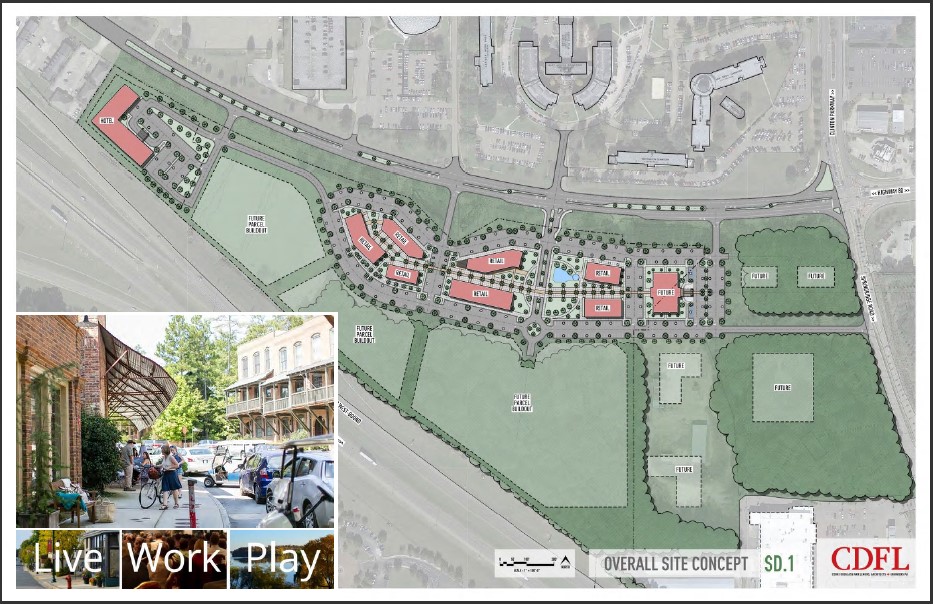
“Lots and lots of dirt work to begin with is what people will see,” Jackson says. “It starts up on the hill at Springridge [Road], which is not college property, but it goes down the hill sort of parallel to Highway 80 and goes down into the college property. There will be a new entrance off of Springridge, a spine road that runs parallel, basically, to Highway 80, and then three entrances into Highway 80.”
According to Jackson, the project has been moving forward over the last several months with design work and permitting.
“You had to get a wetlands permit from MDEQ [Mississippi Department of Environmental Quality],” she says. “We had to get MDOT [Mississippi Department of Transportation] to do roadway permitting.”
The entrances into Highway 80 will initially handle construction traffic, but their future design is unclear.
“We’re continuing to work with MDOT as to what those intersections into Highway 80 will look like. Will they be roundabouts, will they be red lights? That’s what we’re working through with MDOT right now,” Jackson says.
Efforts have been made to preserve historic Robinson Spring, which lies on the property.
“That’s been part of all the wetlands permitting and all that, so it is a complicating factor,” Jackson admits. “But it’s been a primary focal point. So, if you see any conceptual design drawings [for the project], that spring and that water feature are clearly part of what the end product will be.”
Around the time of Clinton’s founding, the spring served travelers along the old Natchez Trace. Now, it’s set to become a centerpiece for the City’s most anticipated mixed-use development, which still doesn’t have an official name.
Jackson emphasizes they’ve gone to great pains to save the spring.
“Through the years, as you can imagine, with its proximity on the property, there’s a lot of residue that’s flowed down into the spring,” she says. “So, we did some exploration work to dig out the muck, for lack of a better term, that had collected at the bottom of the spring; and it actually increased the water flow. The historic bricks around the top of the cistern have all been salvaged and will be used somehow in the new feature.”
The initial infrastructure work should begin this month, weather permitting, with completion expected next January.
“So, about nine months to finish phase one’s work,” Jackson says. “And, hopefully, by that point, phase two will be decided, and it’ll just continue on. It’ll seem seamless to people at that point.”