Why Cleaning and Changeover Design Matter in Regulated Pharmaceutical Manufacturing
Every pharmaceutical plant eventually faces the same practical question: how quickly and how reliably can a line move from one product to the next? Cleaning and changeover are often treated as routine tasks that happen between production runs. In regulated manufacturing, they are design decisions that shape product quality, compliance, and output for the life of the equipment.
This article explains why these factors deserve attention early, what regulators expect, and how manufacturers can evaluate equipment with cleaning and changeover in mind.
Why Equipment Design Shapes Cleaning Outcomes
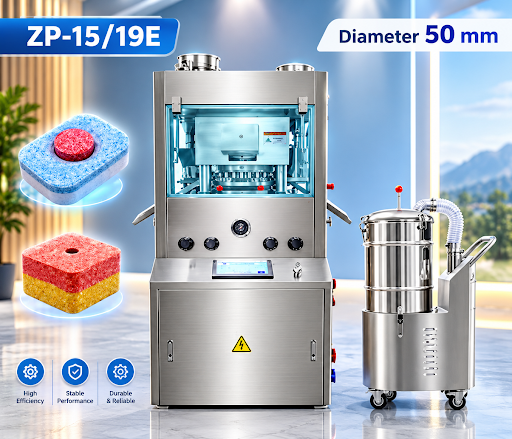
Cleaning performance is largely decided before a machine arrives on the plant floor. Surface finish, the number of crevices, the accessibility of internal parts, and the choice of materials all determine how easily residues can be removed and how confidently that removal can be demonstrated. A tablet compression machine, for example, handles fine powders that migrate into dies, turrets, feeders, and dust extraction paths. If those areas are hard to reach or hard to disassemble, even a well written cleaning procedure will struggle to deliver consistent results.
Regulations place this responsibility squarely on the manufacturer. In the United States, 21 CFR 211.67 requires that equipment be cleaned, maintained, and sanitized at appropriate intervals to prevent malfunctions or contamination that would affect the safety, identity, strength, quality, or purity of a drug product. In the European Union, Chapter 3 and Chapter 5 of the EU GMP Guide discuss equipment suitability and the prevention of cross contamination, while Annex 15 addresses qualification and validation, including cleaning validation. Taken together, these documents expect equipment that can be cleaned effectively and verified through documented evidence.
The Link Between Changeover Time and Cross Contamination Risk
Changeover is more than a scheduling issue. Each time a line switches products, there is a chance that residues, particles, labels, or components from the previous batch remain behind. A rushed or poorly designed changeover increases that risk, and a risk that cannot be controlled usually leads to longer holds, extra testing, or rejected batches.
Several factors influence how safe and efficient a changeover is:
- Number of change parts. Fewer and simpler components reduce handling errors and shorten cleaning time.
- Toolless disassembly. Quick release fittings and handles allow operators to remove parts without improvised tools that could scratch surfaces or introduce foreign material.
- Clear line clearance steps. Equipment that supports visual inspection makes it easier to confirm that no stray tablets, blister foil, or printed materials remain.
- Dedicated versus shared parts. Some facilities assign dedicated components to high potency or allergenic products to limit contact.
The European Medicines Agency guideline on setting health based exposure limits for shared facilities encourages manufacturers to assess the toxicological risk of each product and to base cleaning limits on science rather than fixed numerical habits. That approach means equipment design and product risk should be considered together, not separately.
Designing for Cleanability: Practical Decision Factors
When evaluating or specifying equipment, engineering and quality teams can use a set of practical questions. They help translate regulatory expectations into purchasing and design choices.
Materials and Surface Finish
Stainless steel grades such as 316L are common in product contact areas because of their corrosion resistance and cleanability. Smooth, polished surfaces with minimal weld ridges limit residue retention. Gaskets and seals should be compatible with the cleaning agents and temperatures used, since degraded elastomers can trap material.
Accessibility and Disassembly
Can an operator reach every product contact surface without contorting around guards or frames? Sloped surfaces, rounded internal corners, and removable covers help prevent pooling of cleaning solution and dead zones. Parts that require several tools and long disassembly sequences tend to be cleaned less thoroughly under production pressure.
Cleaning Method Compatibility
Some lines are designed for manual cleaning, others for wash in place or automated systems. The right choice depends on product characteristics, batch frequency, and facility utilities. Manual cleaning offers flexibility but depends heavily on operator technique, which makes training and clear procedures essential. Automated cleaning improves repeatability but requires validation of spray coverage, flow rates, and drainage.
Verification and Documentation
Cleaning validation typically combines visual inspection with swab or rinse sampling and validated analytical methods. Equipment that offers designated sampling locations and easy visual access makes validation more straightforward. Records should link each cleaning event to the specific equipment, product, and operator involved.
Real World Examples of Design Driven Improvements
Consider a plant producing several oral solid dose products on a shared line. Operators noticed that powder frequently collected beneath a feeder housing that required a long sequence of fasteners to remove. Cleaning was inconsistent, and swab results occasionally exceeded limits. By switching to a housing with quick release clamps and a smoother internal profile, the team reduced disassembly time and improved first pass swab results. The gain came from design, not from adding more cleaning steps.
In packaging, a similar principle applies. Changing format parts on a blister line can involve dozens of components. Color coded or keyed parts reduce the chance of installing the wrong tooling, and documented changeover checklists reduce the chance of leftover foil or cartons from the previous product. Reduced changeover time then follows as a benefit of better organization, not of rushing.
Building Cleaning and Changeover into the Lifecycle
Good practice treats cleaning and changeover as part of the full equipment lifecycle. During design and selection, cross functional teams should review user requirement specifications with quality, engineering, operations, and maintenance input. During qualification, installation and operational checks should confirm that cleaning related features work as intended. During routine use, periodic reviews of cleaning data, deviations, and operator feedback can reveal problems that justify design modifications.
ICH Q9 on quality risk management offers a useful framework here. By identifying where residues are most likely to remain, assessing the consequence of carryover, and applying controls proportional to that risk, manufacturers can focus effort where it matters most instead of applying uniform procedures everywhere.
Conclusion
Cleaning and changeover design influence far more than housekeeping. They affect compliance with GMP expectations, the credibility of cleaning validation, the risk of cross contamination, and the time a line spends producing rather than waiting. Equipment such as a tablet compression machine illustrates the point well, because fine powders, tight tolerances, and multiple product contact surfaces make cleanability a central part of its performance. Manufacturers that evaluate accessibility, materials, change parts, and verification methods before purchase, and that revisit those factors throughout the equipment lifecycle, are better placed to protect product quality and keep production schedules reliable.
Read more: How Much Does Flow Meter Calibration Cost?
Read more: Peptide Purity Explained: What Buyers Should Look For in a Supplier
Read more: Hollow Fiber Spinneret: The Core of Precision in Membrane Manufacturing