Work could begin next year on Olde Towne housing development
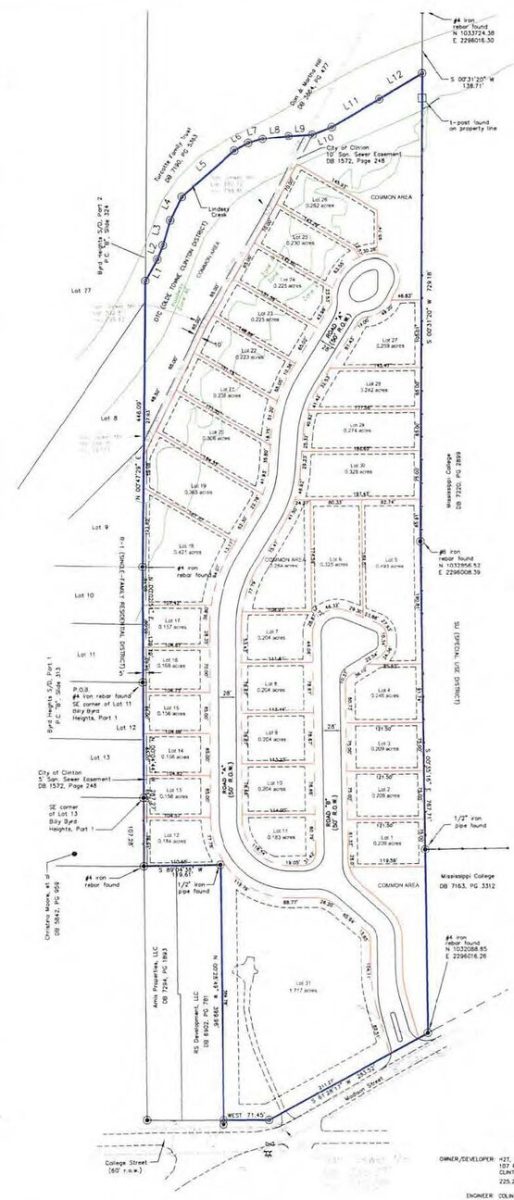
A preliminary plat for the development was presented to the Board of Aldermen on October 6.
By Randy Bell
A new residential development which has been in the works for about five years will focus on conservation as construction gets underway, possibly in the spring of 2027. The project, in Clinton’s Olde Towne district, will be built on roughly thirteen wooded acres on Madison Street across from the Mississippi Christian University’s tennis courts. It’s often referred to as the Albritton property.
The Board of Aldermen, at its October 6 meeting, approved a certificate of appropriateness for the development and dimensional variances dealing with lot widths and setbacks. Director of Community Development Roy Edwards told the Board that, originally, the developers wanted to include single-family homes, townhouses and some commercial lots on the property, but have decided to limit it to about thirty single-family homes. Several Board members said they were pleased that those changes had been made.
The new neighborhood doesn’t have an official name yet, although it’s referred to on the preliminary plat as The Trees of Olde Towne.
Colin Baird is the subdivision’s engineer and surveyor.
“It’s not going to be a zero-lot-line-type development,” he says. “It’s going to be an urban development that has space.”
Underscoring the conservation theme, Baird says many of the trees on the land will be undisturbed.
“We’re trying to keep the trees and the keep the contours of the property, because I think that’s what people want.”
Baird says there’s some preliminary work that has to be done before the project can move ahead.
“We’ve got a design phase, an approval phase to go through with the City and the Mississippi Department of Environmental Quality (MDEQ). It may take two or three months to do that. Then, we’re in the rainy season. And maybe after that, sometime, [construction can begin] if things progress.”
According to Baird, stormwater runoff from the development and from neighboring property will be routed through a detention pond.
“The way we’re planning on designing this is to take [stormwater] flow off an adjacent neighborhood,” said Baird. “And we’re going to stop a lot of that flow and route it through the pond. We’re not going to let anything off the site that’s not going off there now. So, we’re not going to add to the [stormwater] problem, but I think we could help it.”