Olde Towne development entering crucial phase
By Randy Bell
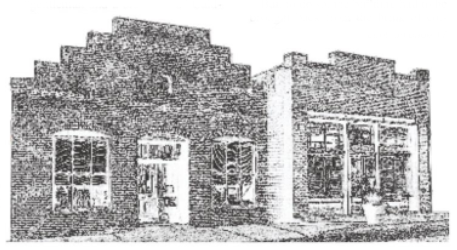
There’s no artist’s conception of Tim Parkman’s latest project in Clinton’s Olde Towne District. But, in his mind, he’s sketched out the details for a business which combines food, drink, music and history and could serve as a magnet for continued development along the city’s brick streets.
“We’ve got so many good things going on here in Olde Towne Clinton, we need to take advantage of it and take care of it,” Parkman said, while giving a tour of the two historic buildings on West Leake Street that he’s saved from the ravages of neglect. “I want to bring something in that complements the other businesses that are here.”
Parkman’s concept, which he admits is subject to change, is a restaurant called Chilton’s that would be located in a building that housed a store by the same name some 150 years ago, using the adjoining building for additional space. A stairway would lead to a speakeasy-type tavern in the basement, the scene of one of the most significant post-Civil War events in Mississippi history. It’s where influential Republican Senator Charles Caldwell was ambushed and shot in the head on December 30, 1875, a month and a half after encouraging fellow Blacks to vote in a crucial election despite intimidation by white Democrats. He was carried out of the basement into the street where, in his dying words, he told his assassin and his accomplices they had killed a “gentleman and a brave man.” Caldwell admonished them, “Never say you killed a coward.” His death was soon followed by the end of Reconstruction in Mississippi.
It’s a moment in history that Parkman hopes to capture by naming the tavern in Caldwell’s honor if his family approves the idea.
“It’s the most historically significant building in Clinton,” he said. “We want to continue to tell the story.”
But, to do so, the building had to be brought back from the brink of collapse.
“The roof was falling in,” Parkman said. “The building was in really, really bad shape. It had been condemned and, honestly, it was questionable whether or not it would survive.”
But the work that began last fall has been successful.
“I can say with about a hundred per cent [certainty] that we’ve saved the building at this point. It’s been stabilized. We’ve still got some issues, as you would imagine. With a building so old, in such bad shape, you really don’t know until you start opening things up what needs to be repaired. It’s a lot easier to build something new than to restore something.”
Add to that the pandemic-related logistical challenges that all builders are facing. Parkman said it may take six months to get supplies that would normally arrive in thirty days. Then there’s the availability of labor. He had hoped, initially, that the restoration could be completed within a year, with the restaurant and tavern ready to open this fall. Now, he’s not sure.
“The best-case scenario would push it probably into later in the year.”
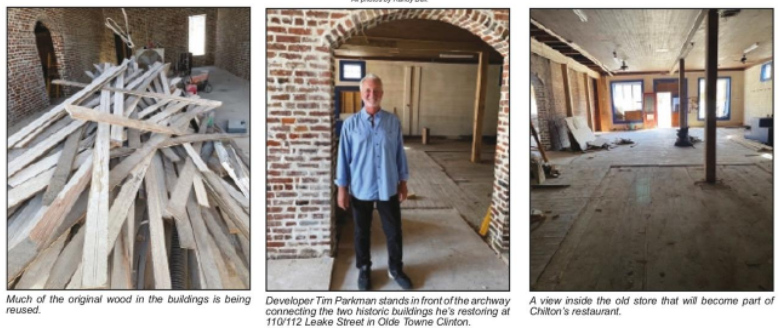
Parkman hopes to preserve the exterior look and the interior shell of the two buildings with original brick and wood.
“We’re working with the Department of Archives and History to make sure we’re doing everything properly and to bring it back to the standards that it should be.”
In the old Chilton’s store, there would be a kitchen, bar and tables, with additional dining space in the adjoining building accessible through a brick archway, along with a small stage for live music on most nights with “plenty of room for a lot of people to get in and have a good time.”
As to what type of restaurant Chilton’s would be, Parkman said, “It would be food that’s complementary to the area. It’s hard to say. This is not a franchise that we’re coming in with. We’re building it from scratch.”
But he has a general idea of what the menu might look like.
“I would say pub-type food, small plate-type stuff, craft beers.” Part of the building would be set up like a sports bar with TVs, so customers could watch their favorite teams play.
Chilton’s restaurant and Caldwell’s tavern are just part of Parkman’s vision for Olde Towne. He already owns the buildings where two other restaurants—303 Jefferson and The Bank—are located, as well as the building where the hair salon, The Vault, recently opened. Add to that six storefronts along the eastern side of Jefferson Street, now with fresh paint and copper awnings, where he’s finding tenants to occupy those previously-vacant buildings. And he’s doing it with the same philosophy he’s using in bringing in Chilton’s and Caldwell’s—choosing businesses that fit well with the ones already in Olde Towne.
Parkman said ten years ago, there wasn’t much traffic along those brick streets.
“Now, it’s much different than it used to be, and we want to keep building on that—but take our time and do it right. I feel like it’s my job to make sure we get the right folks in here.”
But he’s in no hurry to lease one vacant space at the southeast corner of Leake and Jefferson.
“I’m holding out…because I would love to have an Italian concept restaurant move in here.”
Parkman said that could be the key.
“If we could get four restaurants in this area and [additional] retail, it’ll build upon itself.”
Tara Lytal thinks five might be the magic number for Olde Towne. The director of Main Street Clinton said Parkman’s plans are helping to achieve the city’s goal of revitalizing the historic district but, “we really need about five restaurants in our little area to make them all successful. If you get five, you’re a destination. You get in the car and you say, ‘Where do you want to eat?’ And it’s like, ‘I don’t know, but let’s go to Olde Towne.’ You know there are several options there.”
Lytal remembers the way it used to be.
“When we started [Main Street Clinton] in 2007, you could shoot a cannon down Jefferson Street and not hit a soul. We have come a long way.”
She understands that developing an area that’s only four half-blocks in size can create challenges.
“In five years, I hope we have parking problems. If you don’t have a parking problem, you’ve got a problem. Because you have nobody in your downtown.” Lytal said they’re already looking at capturing small pockets of parking spaces in Olde Towne. The long-term solution could be some type of parking garage.
Restaurants are crucial in creating traffic, but Lytal said retail is important, too.
“We need a good mix.”
A children’s shop specializing in monograms called As You Wish has moved across Jefferson Street to a larger location in one of Parkman’s buildings. A nutrition store is another new tenant. And Brick Street Pops has relocated from the corner of Leake and Monroe streets to its new home on Jefferson.
Lytal said Parkman’s investment in Olde Towne has been “huge,” but there are others, like local watercolor artist Wyatt Waters, who’ve been advocates for the historic district for years.
“Wyatt has been down here for decades now. He believed in this area and fought for this area and tried to recruit other businesses to the area,” she said. Waters has a studio located on Jefferson Street. As Lytal puts it, “You need more Wyatts and Tims.”
But, more than anything else, Olde Towne needs the public’s support. Lytal says she still hears about Clinton residents who don’t know the city has a quaint brick street area.
“I think a lot of times, people from outside our community appreciate this more than those who actually live here.”
And, in addition to creating more local awareness about Olde Towne, there’s the potential to pull in more visitors. Lytal said older people who travel a lot like to stop in small downtowns to explore the history. She said while the city’s brick streets may not be unique, “there are not a lot of them, and we have more square feet of bricks than anybody around for sure. What you can find down here is authentic.” Lytal would like to see a small boutique hotel in Olde Towne or a bed and breakfast to accommodate overnight visitors.
And for Tim Parkman, who points out that 303 Jefferson is “the only former livery stable in the country where you can get a fine meal,” continuing to carefully develop the treasure known as Olde Towne is well worth the effort.
“We’ve got an asset here. We’ve got a history.”