A book review of Robert E. Lee: A Life, by Allen C. Guelzo
By Guest Contributor Carl White
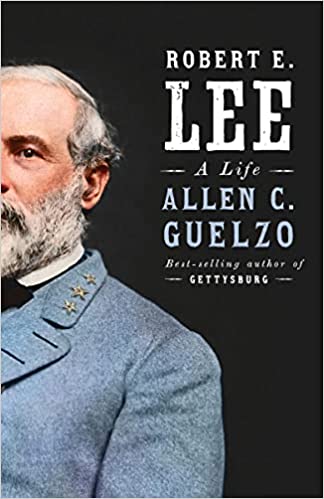
Allen C. Guelzo is Senior Research Scholar at the Council of Humanities at Princeton University and the director of the James Madison Program’s Initiative on Politics and Statesmanship. He is the author of numerous books, including Gettysburg: The Last Invasion (2013).
It seems an odd time for a new biography of Robert E. Lee. The fatal rioting in Charlottesville, Virginia, the summer of 2017 between members of the Ku Klux Klan, neo-Nazi thugs, and black-clad members of Antifa took place before a twenty-six-foot-high statue of Robert E. Lee on horseback. The image of Lee became a symbol in the minds of many of the rise of a new white supremacy movement. As a result, many statues of Lee were defaced, covered or removed. This is the cultural moment that Guelzo presents a new biography of Lee.
Robert E. Lee: A Life is thoroughly researched and written. Guelzo does not deify Lee, nor does it seek to cancel Lee. Rather, he presents a needed correction of both extremes. Guelzo carries us to a well-researched middle ground, allowing the reader to see Lee as he really was – a complicated man with a deep desire to overcome the failures of his absentee father, “Light Horse” Harry Lee – one of General George Washington’s most important generals – and an equally deep desire for peace and perfection. As a result, Lee had many insecurities, which influenced his many fateful decisions in an accomplished life.
Lee was full of contradictions, as Guelzo points out so successfully. He was a peaceful, Christian gentleman, yet he was a fearsome warrior. He did not support slavery, yet he led an army that supported the institution of slavery. He opposed secession from the union, calling it rebellion. Yet, when Virginia seceded, he went with his state and against his oath as an officer in the Army of the United States.
Guelzo makes sure the reader knows that Lee was a good man, but not a saint. He committed crimes, but in defeat Lee used his considerable influence to bind the wounds and reunite the nation. Guelzo states that Lee’s single most important act was to surrender his Army at Appomattox intact, thus preventing the launch of guerilla war.
Though Guelzo considers Lee a traitor, he cannot bring himself to condemn Lee. As a Christian, he looks at Lee with mercy. George Will wrote that this book is “exactly what the nation urgently needs right now – an example of mature thinking about complex, flawed people.” May we have mercy, as God has mercy on us.
EDITOR’S NOTE: Carl White, now a Clintonian, is a native of Jackson. He served for forty-two years as a pastor and a denominational editor. His spouse, Cheryl, is a professor at Mississippi College. He is a graduate of USM and Southern Seminary.
Are you reading a book that you want to share your thoughts about? Write a review of 300-450 words, and email it to Carole Kelly at:
Submissions@TheClintonCourier.net.
If your review is selected to run in a future print issue of The Clinton Courier, you’ll be rewarded with a prize from your hometown
paper! All ages are welcome and encouraged to submit reviews, just please keep them family-friendly.