Simulation training prepares MC nursing students for real-life patient encounters
Special to The Clinton Courier
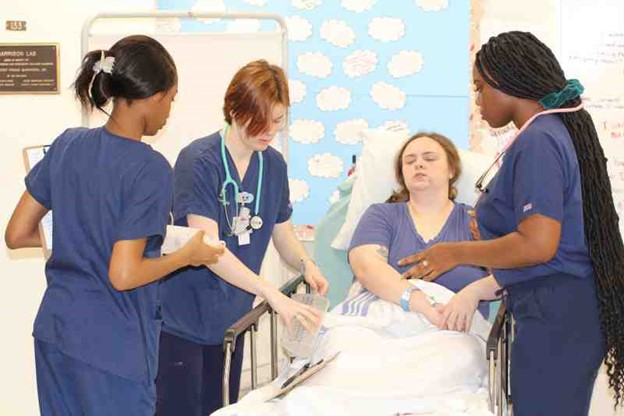
The School of Nursing at Mississippi College recently conducted a realistic simulation to help prepare graduating fourth-semester students for actual patient encounters. It was the final simulation for the class members, more than half of whom have accepted employment offers and will begin their careers in nursing this summer once they’ve passed the National Council of State Boards of Nursing NCLEX exam.
Kimberly Sharp, dean of the MC School of Nursing, said simulations of varying sizes are embedded throughout the school’s curriculum.
“Simulations help students develop confidence and competence in the skills they need,” Sharp said. “We don’t expect the students to be perfect. We incorporate these scenarios in a place where they can review and practice what they’ve learned in the classroom. It is stressful. We want to put the students in a scenario that challenges them and makes them think. It puts them through their paces, and they can reflect on their experience and use the information in a constructive way.”
Jordan Owen, instructor in the School of Nursing, works closely with Amy Sewall, certified technical and simulation support specialist, to design simulation exercises for the school. Each week, students receive up to two hours of sim training related to one or more of their clinical courses. Students participate in teams, record patient reports, prioritize care responsibilities, and manage changes to patients’ status.
“Students should be able to exercise the full variety of what they have been taught up to this point,” Owen said. “This is the first time they’re encountering a sim that has multiple patients at one time. We know that whenever they leave our program, they are going to rapidly pick up patient-to-nurse ratios that are going to be challenging for them. This simulation is the best and safest way to see how they react to given situations. If they can practice enough, making the correct care decisions will be second nature when encountering real hospital patients.”
First-semester nursing students served as mock “patients” during the exercise. They were assigned various illnesses to portray, researched the signs and symptoms of their given conditions, and investigated how they could accurately depict individuals with their respective maladies.
“We like when we can get students from different semesters working together,” Owen said. “The fourth-semester students are a ‘light at the end of the tunnel’ for the first-semester students, and the fourth semesters can see how far they’ve come since their first semester.”
According to recent research, Owen said some hospital administrators aren’t convinced new nurse graduates are prepared to practice right away. This is due to a number of factors, from the education they receive, the higher patient ratios they encounter, the increasing severity of illnesses reported since the COVID-19 pandemic, or more marked changes in patient status throughout their hospitalizations.
The simulation is an important tool to ensure Mississippi College-trained nurses are prepared for what awaits them in any patient-care setting.
Makayla Cole of Clinton, who plans to work as a nurse in the Neonatal Intensive Care Unit at the University of Mississippi Medical Center, said the simulation has been a beneficial exercise.
“You can practice all of your skills and your time management and put into practice everything you have learned in a safe environment,” she said. “Professors always tell us, ‘If you make a mistake, you want it to be in a sim when you can talk through it and learn it.’ It’s helpful to put in the practice and essentially trial-and-error everything that we’ve learned.”