From the Netherlands to Mississippi: Couple makes their art at home in the South
By Guest Columnist Gloria Wright
OOST. WEST. THUIS BEST.

The Pearsons’ front door
“East, West, Home is Best” is written on the door of Roger and Ineke Pearson’s house. The truth of this statement is immediately felt as one walks into their home.
Their love of art is evident in their paintings, needlework, wood carvings and furniture, ceramics, and fishing lures. Ineke was born in Smilde, the Netherlands, the second of four children. The family lived through the German occupation during World War II.
During this period, poverty and depression were prominent throughout the region. Unmarried men, eighteen years old and older, were taken to Germany as laborers. Three of Ineke’s uncles were taken by German troops – one never returned, one had both legs broken, and the third one was placed as a house boy.
Her family survived, thanks to her father’s grocery store, which, in addition to groceries, included selling liquor, which was at the time forbidden. German soldiers frequented the store; and, sometimes, while inebriated, they disclosed names of people to be arrested, giving Ineke’s father the opportunity to alert those in danger and allowing them to go underground. Even though the circumstances were difficult, Ineke considers her childhood a happy one. She says her mother used art to keep their spirits up.
Her parents divorced when she was eleven years old, and, according to Ineke, this was the first divorce in that area. Many families immigrated to Canada, Australia, and the United States looking for work, but her mother made the decision to stay home.
After high school, Ineke studied early childhood development and worked at a children’s home. It was at this time that she met her husband, Roger. Roger was with a detachment of the army in charge of organizing a Christmas party for the children. Ineke was assigned to work with him to purchase children’s gifts, and a friendship developed.
Roger was scheduled to return to the United States but re-enlisted in order to be with Ineke.
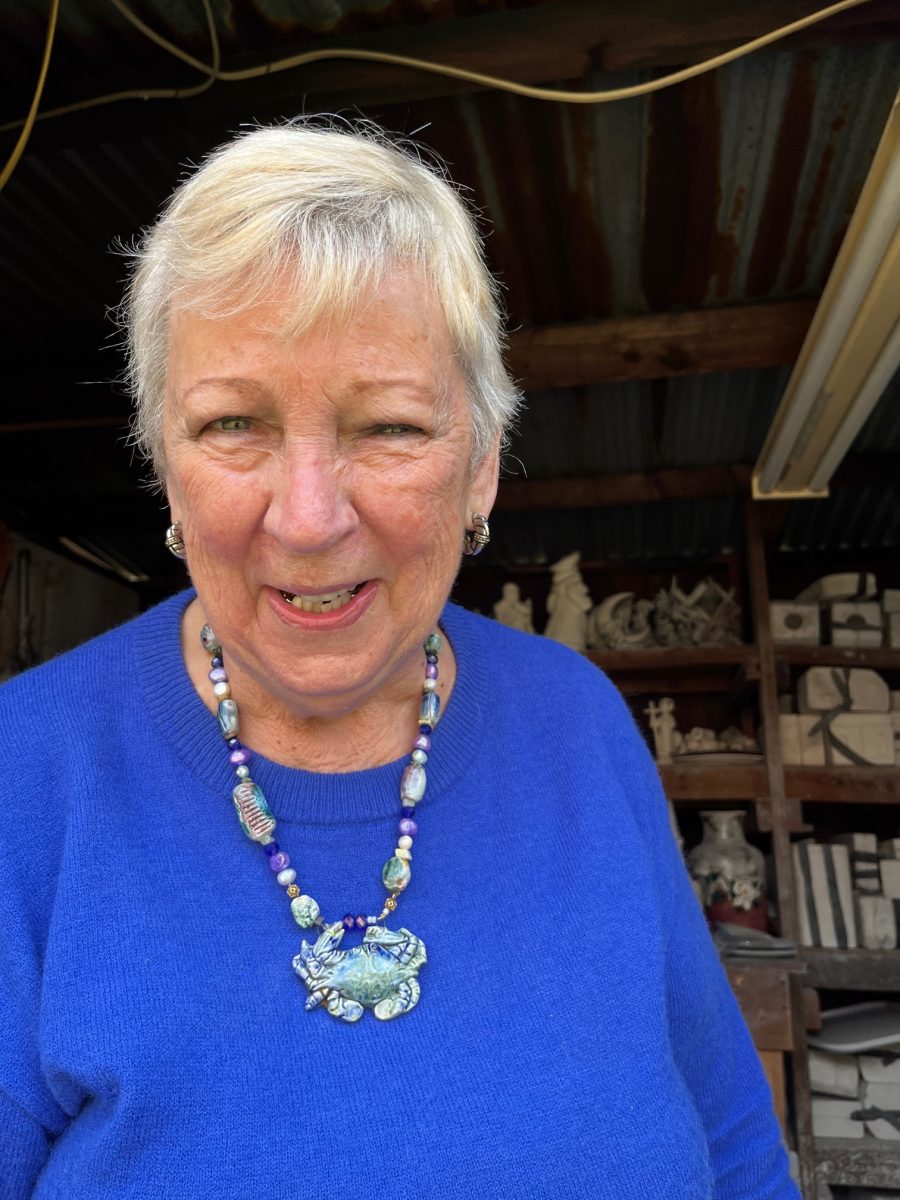
Ineke Pearson, wearing a necklace of her own creation
There is some disagreement as to how the engagement came about. According to Ineke, Roger asked, “When are we getting married?” and she answered, “In June.” According to Roger, a friend asked, “When are you getting married?” Ineke replied, “In June.”
They stayed in Holland for a year, and then came to the States. Roger enlisted again, this time for six years. They were stationed in different places; and, after three years in Germany, Roger was sent to Mississippi as an advisor for the Army Reserves in 1982. They moved to Clinton, where they have been ever since.
It was after the move to Clinton that Ineke developed an interest in crafts when she went to a crafts show at Mississippi College. She started by making toilet paper holders. After selling only one, she began to listen and research about people’s preferences. She began working with wood, making benches, shelves, and stools, and painting them in the Dutch folk art style. With Roger’s assistance, she opened a booth at a flea market and also attended craft shows. This proved to be a lucrative business.

The Pearsons’ shelves are filled with their – and others’ – art.
After some time, Ineke started to wonder how her paintings would look on ceramics. Her first try did not turn out so well, but she persevered, and now her ceramics are sold in many places throughout the state.
Her workshop is at the back of the house, equipped with two kilns and hundreds of molds and materials used in making ceramics. The process is involved and time-consuming, but the end result is worth all the effort. It starts with pouring the “slip,” liquid clay, into the mold. This requires several pouring and emptying steps until the desired thickness is obtained. The resulting form, “green ware,” is removed from the mold, painted, and fired in the kiln for a determined amount of time. After firing, the form turns white and is called ‘bisque.” It is then glazed with clear gloss inside and out and fired again.
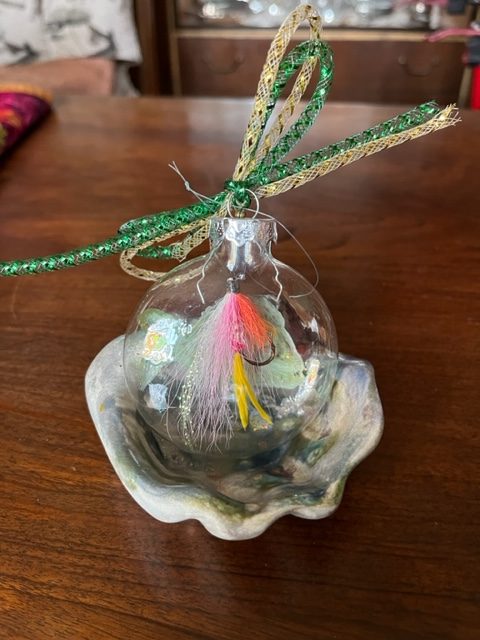
One of Roger Pearson’s Christmas ornaments
Roger, also a gifted craftsman, has been making fishing flies since he was eight years old. He also makes Christmas ball ornaments with fishing flies inside. Twelve of his ornaments were displayed on the White House Christmas Tree in 2012.
Ineke says that her inspiration comes from her mother, who could always “do more with less.”
Their works can be seen and purchased at the Clinton Visitor Center.

Ineke and Roger Pearson