Forever Young group hears from noted author and physician
By Carole Kelly
Book Lovers Day and National Read a Book Day, along with the acclaimed Mississippi Book Festival, inspired a “Back to the Books” theme and a presentation by Dr. Thomas Wiley at a recent Forever Young meeting at First Baptist Church.
A number of observations in August and September have celebrated books and the joy and importance of reading. The Rev. Dennis Daniels, the church’s senior adult minister who scheduled the retired physician to talk about his creative efforts, stated, “Clintonians are avid readers; our church library is well used, as is our fine local library. We are finding more and more Mississippi writers of noteworthy readership, with many of our educators and professions branching out and contributing to the cultured arts as well as design art. Doctors Tom Wiley, Darden North and Carl Voyles are just a few of my favorite folks and talented writers. We truly are building a legacy of wordsmiths.”
Carole Kelly
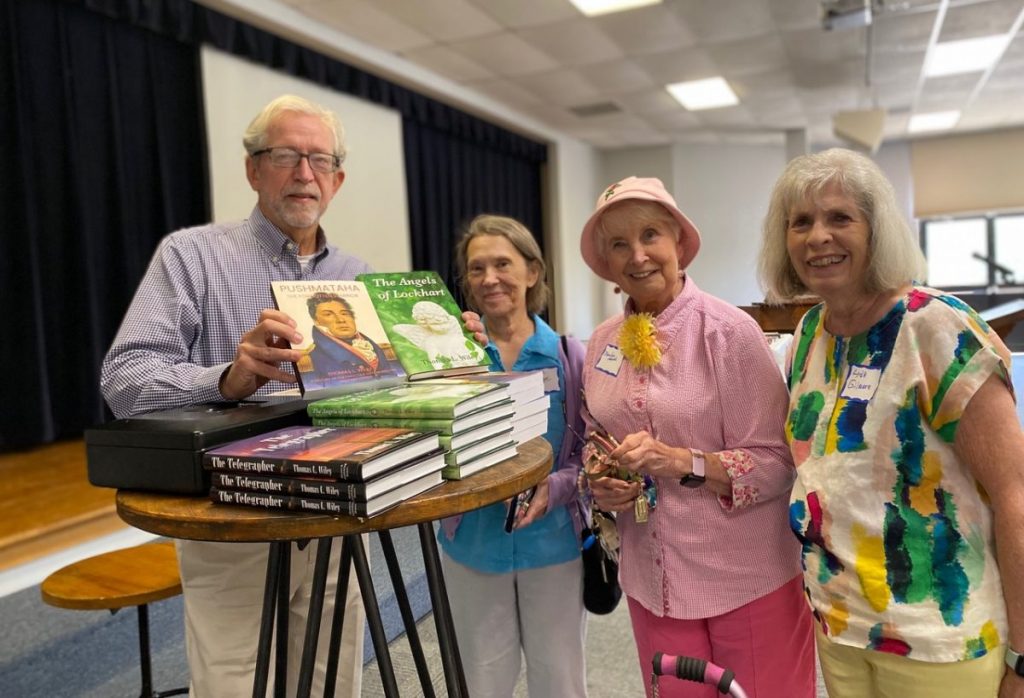
Celebrating the value of books and reading inspired a presentation by retired physician Thomas Wiley (left) pictured with (l to r) Teresa George, Marilyn Smith and Lyda Gilmore. His latest book, Pushmataha—The Forgotten Warrior, was the main topic at a recent Forever Young meeting at First Baptist Church.
A native of New Albany who grew up in Tupelo, Wiley graduated from Mississippi State University and the University of Mississippi School of Medicine, completing a residency in obstetrics and gynecology. His retirement from the medical field and his decision to write have resulted in three books.
“After thousands of babies and almost forty years of practice, I retired in 2020,” said Wiley, who shared that a personal tragedy had left him with a need to write for cathartic release. A visit he and his wife Merrie made to a cemetery in Lockhart near Meridian in January 2006 presented him with an opportunity.
Many of his wife’s early family members are buried in the old cemetery, including her great-grandmother and her step-great-grandmother, who had given birth to seven babies. The cemetery markers revealed that none of the babies lived past twenty-two months. This led to the unanswerable question of why these deaths occurred, even though those times of 1890 to 1910 were difficult for babies’ health.
He wrote The Angels of Lockhart, which is described as a story of fiction based on fact. Through the story of his character Ollie Parker, Wiley was able to express his own feelings, hurts, doubts, fears, anger and faith. The book, described as heartbreaking and heartwarming, is readable, entertaining, and mysterious.
His second book concerned Merrie Wiley’s great-uncle Ollie Parker, introduced in the first book, who had lost an arm and found a new life as a telegraph operator. The Telegrapher (2010) opens with a page illustrating the Morse Code A-Z and 1-0 and explores how Parker overcame his challenge.
“Telegraphy is my life,” writes Parker, who viewed the world, he admits, not through window or book, but through a copper wire.
“It was strange,” says Merrie Wiley. “Nobody ever knew the details of the accident. It was never discussed in the family, what had happened to him.”
His third book, Pushmataha—The Forgotten Warrior, began coming to life twelve years ago when he was still practicing medicine. Two and a half years ago, his retirement gave Wiley time to finish an in-depth look into the history of the Choctaw nation and Pushmataha, the impressive native American who lived from 1764 to 1824.
The life and contributions of the Choctaw leader are presented in a fictionalized style that takes the reader through years of the settling of the country, treaty signings and eventually transferring Indian populations to Oklahoma.
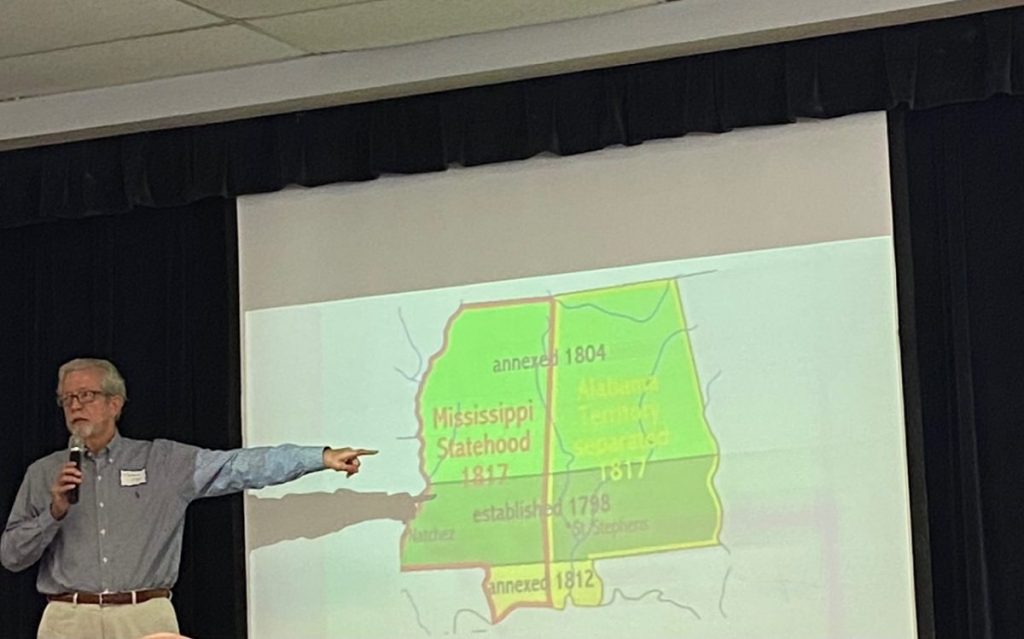
Dr. Thomas Wiley used maps as he discussed details of Mississippi history and the Native American Tribes of the state.
Wiley’s presentation included maps illustrating boundaries of the early history of the lands that would became the state of Mississippi. He explained how his interest evolved into a book using facts interwoven with conversations to tell the story of how Pushmataha figured prominently in the country’s early history.
“Early proposals included the formation of a state composed of a large land mass that would have been the largest state east of the Mississippi,” said Wiley. “Instead, it was divided into the separate states of Mississippi and Alabama.”
Demands for land for settlers and for growing the increasing profitable crops of cotton overcame Pushmataha’s diplomacy and his dedicated efforts. His efforts steered the Choctaw nation away from a strong Native American confederation. Without his help in the victory for the United States, it’s possible the outcome of the War of 1812 could have been dramatically different.
Signed treaties were hollow promises, and the Choctaws were the first to experience the “Trail of Tears and Death” from Mississippi to the west. Presidents and politics did not respond to pleas for fairness for the Indians, and, as Wiley writes, “Progress would stop for no one.”
Although some were allowed to remain behind on designated lands, they were not allowed to function as a tribe.
One promise that was kept for the Chief of the Choctaws: he was buried as he wished in the Old Congressional Cemetery in Washington, with the pomp and circumstance and military honors befitting a hero.
Six pages of bibliography attest to the fact that Thomas Wiley’s research has resulted in a detailed, moving book about the Choctaw Chief Pushmataha.
He smiles as he says, “I have more ideas for subjects in the works—keeps me out of trouble.”
Celebrating the value of books and reading inspired a presentation by retired physician Thomas Wiley (left) pictured with (l to r) Teresa George, Marilyn Smith and Lyda Gilmore. His latest book, Pushmataha—The Forgotten Warrior, was the main topic at a recent Forever Young meeting at First Baptist Church.
Dr. Thomas Wiley used maps as he discussed details of Mississippi history and the Native American Tribes of the state.