Winging away, wintering in Mexico: Hummingbirds
By Carole Kelly
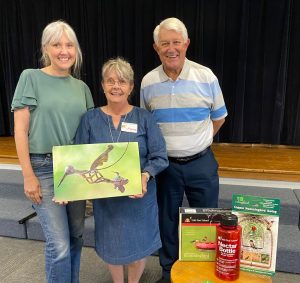
The fascination of hummingbirds was the topic for (l to r) Sabrina Hagerman, Marcie Lockett and Dennis Daniels, presented to an enthusiastic audience at a Forever Young meeting at First Baptist Church. Lockett, a bird feeding specialist, and Hagerman, co-director of the Clinton Community Nature Center, were welcomed by Daniels, senior adult pastor at the church.
“Miracles” is how Marcie Lockett describes hummingbirds, the very tiny birds that have a very large following in the area, throughout the state and beyond. Lockett, an authority on the birds that can fly up, down, forward, backward and even sideways, keeps eight hummingbird feeders filled and ready for the flying miracles.
“It does take time,” she admits, saying that keeping the feeders cleaned and filled requires almost as much time as her part-time work at Wild Birds Unlimited. With migration in September, the fast flyers are very thirsty. Their drinking supplies the fat pockets that can be seen under their feathers and that empower them for their long flight.
After these main departure days, some loners may still pass through, making it advisable for hummingbird lovers to keep the feeders available.
The receptive audience at a recent First Baptist Church Forever Young meeting heard plenty of helpful information about the nature and nurture of the birds.
“They truly are a miracle,” Lockett emphasized. “In our area on this side of the river, we have the ruby-throated hummingbird. They appear year after year in the spring, flying in mostly from Mexico.”
They fly alone about five hundred miles across the Gulf of Mexico twice a year and can fly eighteen to twenty hours without rest.
“Oil rigs in the Gulf can be seen with feeders hanging handily for the little travelers,” says Lockett. First stops are often Dauphin Island and Ship Island, traveling the same flight path, often returning to their original feeders. Arrival time is in March.
Any bright colors can catch hummingbird attention.
Sabrina Hagerman, Clinton Nature Center co-director, shares thoughts on attracting hummingbirds with the use of native plants. She recommends the trumpet vine, a favorite flowering vine of hummingbirds, and the cardinal flower, a late summer bloomer with showy red tubular flowers that depend on hummingbirds for pollination.
“The trumpet vine is an aggressive plant, but, space allowing, the birds will thank you,” says Hagerman. “You can see it climbing a few poles around Clinton; keep a look out.”
She points out that providing a clean water source and avoiding pesticides are other key factors in providing a safe habitat for the tiny powerhouse birds. They use so much energy flying, they need to eat nearly half their weight in nectar and insects daily.
Described as aerial acrobats, they need an abundance of nectar water to supply the energy to beat their wings as much as eighty times per second while hovering. With the rapid beating of its wings comes a humming sound that gives the bird its name.
“The females are the workers,” states Lockett. Their tiny nests she compares to a walnut shell, noting they use spider webs to make the nests, with lichen moss for camouflage. Their location may be as high as fifty feet up and as low as three feet down – but never on the ground.
Their purpose is to nest and lay two eggs that are the size of a jellybean or a TicTac. Lockett is adamant that formula preparation always adheres to a four-to-one ratio. That’s basically one-fourth cup granulated sugar to one cup water, ensuring that the sugar is dissolved very well, although boiling the water is not necessary.
“Whether you are preparing a quart or gallon of nectar, keep the four-to-one ratio,” says Lockett, “No more, no less.”
Too sweet can cause infection. The nectar is lapped with forked tongues that are longer than the beaks. Lockett says that, for a few hummingbirds that may be in the area in cold weather, they can drink an icy slush.
Changing the water often is a good idea, to keep the feeder as bacteria-free as possible, with avoiding direct sun on the feeder all day also helpful. If the water-sugar combo is refrigerated, it should be returned to room temperature, Lockett points out, adding that it should be in a labeled container to avoid a family member mistakenly drinking the carefully measured formula.
“It has happened,” she smiles.
Other points she mentioned are not adding red food coloring to the water and not using artificial sweetener or honey. The red feeders attract the birds; ornate glass feeders may require extra attention to keep clean.
In addition to her feeders, she has two swings at her house for the hummingbirds to sit and drink. She shares that, finding a bird tangled in a spider web, she freed it and held it until it became calm and flew away.
Discussing their life span, it was noted that hummingbirds may live for between three and five years, with life expectancy varying from species to species. The oldest recorded hummingbird was twelve years old.
In times past, hummingbirds depended on flowers and insects, but, as habitats were destroyed, feeders have become a necessity to help supply their food.