
Parkway rangers working to keep 18-wheelers off the Trace
By Randy Bell
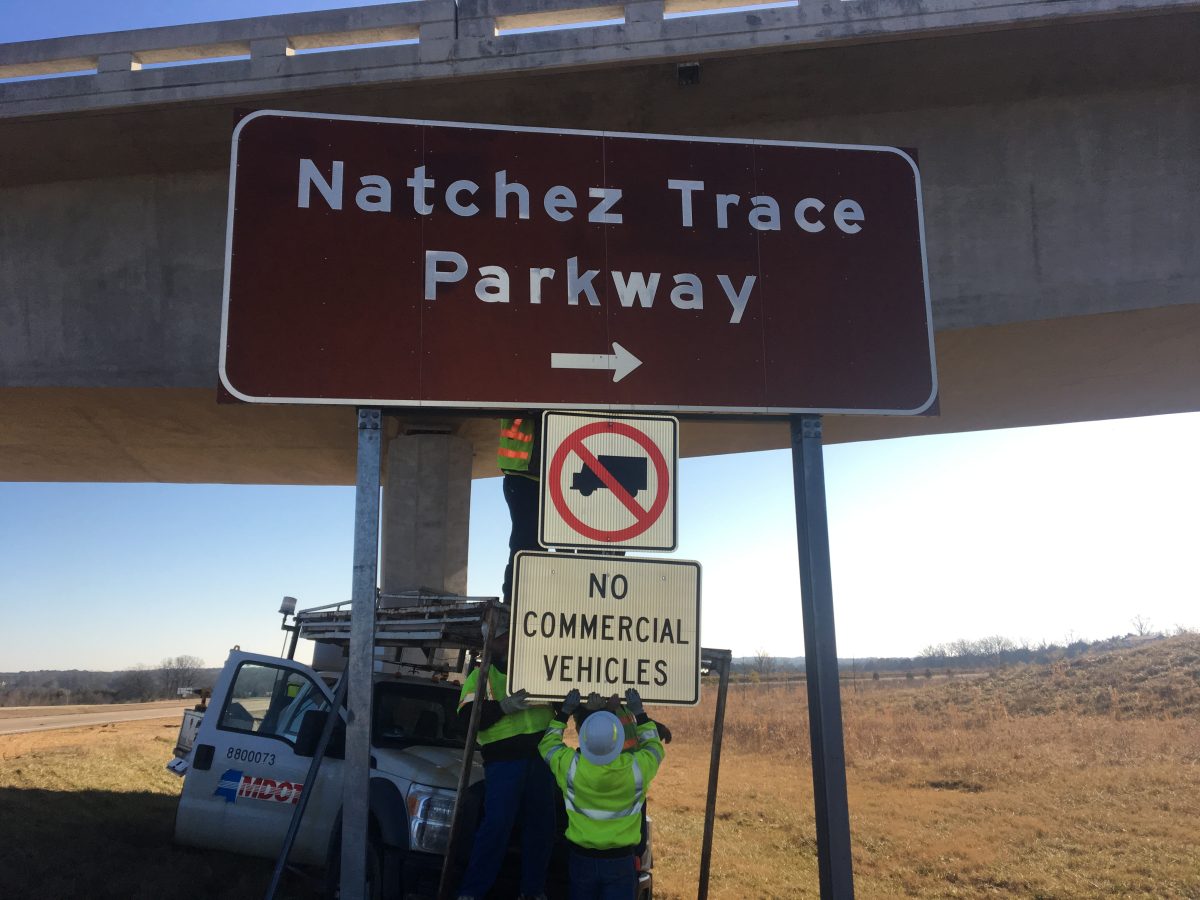
It used to be that drivers would seldom see a tractor trailer rig on the Natchez Trace. Nowadays, it’s happening more often, and the district ranger for the section of the Parkway which runs through Clinton believes the navigation systems truckers are using may be responsible for the increase.
“They’re mostly not using commercial GPS,” says Stephen Dollinger. “They’re now using their Google Maps or Apple map on their phone.”
Those systems don’t remind truckers that commercial vehicles are prohibited on the Trace and that violators are subject to a significant fine.
“It’s definitely not one that I’d want,” Dollinger says. “I believe it is $330.”
But some truckers, either uninformed or willing to take a chance, still travel the Trace – and it’s an issue along the entire length of the Parkway, but especially in the Clinton and Ridgeland areas, where some tractor-trailer drivers use it as a shortcut between I-20 West and I-55 North.
Even if their navigation system routes them onto the Trace, there are signs posted warning that commercial vehicles aren’t allowed.
When he pulls a trucker over, Dollinger says he hears different excuses.
“Most of the time I get, ‘I didn’t see the sign,’ or ‘I saw the sign and I did it anyway.’”
But Dollinger says he hasn’t seen a lot of violators who don’t learn their lesson.
“We actually did about two years’ worth of gathering data and putting in the truck license plate numbers, the drivers, the DOT numbers, to see how many repeat customers we’re having.
And, after doing all that, we found that we averaged about one per cent or less for repeat customers.”
When truckers are stopped on the Trace, they get a ticket and are instructed to exit the Parkway.
“We usually tell them that they need to get off on the next state highway,” Dollinger says. “We don’t want to send them down the small county roads, because that might end up causing more of an issue.”
He says one reason for keeping commercial vehicles off the Trace is so that visitors can enjoy the scenery without a big truck in the way.
“It is a tourist route,” Dollinger says. And, as such, it’s not well-suited for 18-wheeler traffic. “Our lanes are narrower than most standard lanes. Instead of being eleven feet wide, ours are usually right around ten feet wide.”
Plus, there are few places for the trucks to pull off the Parkway if they have a problem.
With the posted speed limit of fifty miles per hour, the Trace isn’t a place for a trucker who’s in a hurry. But, according to Dollinger, most of the big rigs he spots on the Parkway aren’t going too fast, leading to a different kind of problem.
“I’ve gotten a few of them that are over the fifty, but most of them are actually traveling slower, causing the traffic to back up.” That can lead to frustration for other drivers who aren’t able to pass the truck.
With a limited number of rangers patrolling the Trace, it’s difficult to determine exactly how widespread truck traffic has become. Some new and more advanced traffic counters have been installed to analyze the types of vehicles using the Parkway.
“We’ll see over the next few months what true numbers we have for commercial vehicles,” Dollinger says. “If we see a certain time where there’s more [trucks], then we’ll adjust shifts to have [rangers] out there during those times.”
Some commercial drivers are able to escape a ticket, even when a ranger finds them on the Parkway, because it’s just not practical or safe to pull them over.
“There’s times when we’ll see them, and, quite honestly, we’re not going to go weaving in and out of ten or so [other] vehicles to try to catch up to a semi,” Dollinger says. “We’re not going to create more of a reckless situation than what the 18-wheeler is doing by driving down the road.”
The rangers appreciate calls from the motoring public about trucks on the Trace.
Dollinger recalls a recent tip he received.
“I was down below I-20 a while ago and someone called [about a tractor-trailer on the Parkway], and I was getting ready to start heading back up toward Clinton. Instead, I just sat there and waited for the 18-wheeler to show up. I was able to deal with him and give him his ticket and send him on his way at that point.”
“We definitely welcome the calls about it,” Dollinger says. “If we have someone in the area or someone that can get to the area, we will definitely go there and deal with it.”
To report emergencies or illegal activity on the Parkway, call 1-800-300-PARK (7275).



Personally, I do not think there should be any access to the Trace from any state or federal highway, nor should there be any access to the Trace within 15 miles of any other public access. The Trace should be a destination. It is a park. I do currently use it to travel to other locations because it is convenient, but if it were not convenient, I have multiple other options to use.
Speed is another major issue on the Trace. I am perfectly happy to travel at 50 mph or less, even if just traveling to another location. Way too many think the rules do not apply to them, especially regarding speed.
If there was no public access within 15 miles, how would you get a car to it? At that point you would have a walking trail
you had to hike to get to.
You are going to have to put something above the actual road way with height limit and if a truck hits it sets off an alarm for rangers to show up before they even get on the trace or an alarm as the get to the off ramp. We have the technology to prevent this and it times to implement it
That sounds like a great idea. And, this could be something they already have. If they are jumping on and off in the Metro to bypass, the trooper would not always
have time to make it. I see plenty pulled over so I know they are getting some!!
I agree with everything you said. Also they can put cameras on the on and off exits.
I was on the Trace this morning about 10:00. I passed 3 trucks coming toward Clinton well before I ever got to Ridgeland.