City considers ranking system for drainage improvements
By Randy Bell
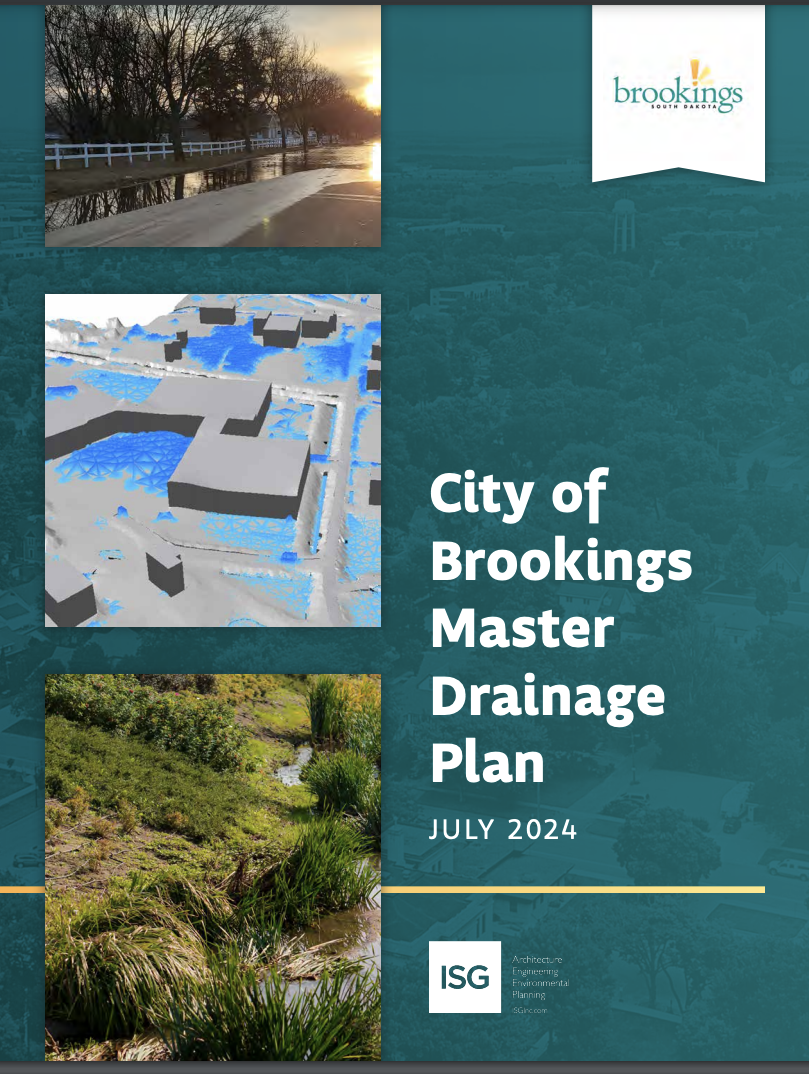
Consulting City Engineer Bill Owen noted that other cities which have conducted systematic drainage improvements in recent years could serve as models for the work in Clinton, referencing a plan made by Brookings, South Dakota.
Before the City of Clinton launches its annual paving program, it rates its 186 miles of streets, choosing the ones in the worst condition for a fresh coat of asphalt. And it may soon be doing something similar to determine which drainage projects should be the top priorities.
“The first thing that has to be done, is there has to be some sort of mapping system done to identify all of the storm drains and ditches and things of that nature,” says Consulting City Engineer Bill Owen, pointing out that the drainage study which the U.S. Army Corps of Engineers has completed focusing on Clinton’s four major watersheds will give the City “a head start.”
Mayor Will Purdie and the Board of Aldermen discussed the concept of rating drainage projects during their August 4 work session.
“I think what the Board indicated was that they’re wanting to pursue the mapping of at least part of the city in terms of figuring out where those problem areas are and then figuring a way to prioritize what drainage problems can be solved,” Owen says.
The Corps study doesn’t hone in on individual neighborhood-level drainage issues, instead focusing on the big picture.
“But, at the same time, I think that the study will provide information on how those streams might be improved, de-snagged, whatever the case may be, in the short term,” he says.
According to Owen, other cities which have conducted systematic drainage improvements in recent years could serve as models for the work in Clinton.
“There’s any number of different ways to approach this. The one that I found that was interesting to me was in Brookings, South Dakota,” said Owen. “They did something like this. They mapped, they prioritized, they ranked based on certain criteria, and that process took them about three years.”
Brookings is smaller than Clinton in terms of geographical size but has a population that’s almost the same.
“It was something that caught my eye in my research of similar sized cities. Something like that could be [done] here,” Owen said.
Purdie believes a ranking system could work.
“I think to tackle something of this magnitude, really, the only way to do it is to adopt some sort of evidence-based objective approach,” said Purdie. “Just start at the top of the list and work your way down.”
Several residents hoping for help from the City with their flooding problems attended the work session. Robert Jenkins, who’s lived on William Drive for nineteen years, says the drainage system in his neighborhood is overwhelmed during a heavy rain, and the runoff heads right toward his home.
“We flood on average at least once a year. However, we flooded two consecutive Saturdays about a decade ago,” said Jenkins.
Jenkins says his property has become a detention pond, but there’s an easement which would allow the City to make improvements.
“They have a right to maintain that easement,” Jenkins says. “That’s why you give them an easement.”
And the best thing the City could do, he says, is to buy his home and have it torn down, so the floodwater could flow through unimpeded.
“If they want to do something, for a small amount of money, they could get a lot of bang for their buck,” suggested Jenkins. “Instead of all of [the water] being in front of my house, with my house blocking it and only a little bit of room on one side and a little bit of room on the other for the water to go around, if the house was gone, all of that water would move right on in, and the street wouldn’t be flooded. I feel like if they’re really trying to prioritize this, they would see me as the first person [to] get out of the way and help everybody all at once.”
The mayor says he’s not sure if the City could purchase private property to improve neighborhood drainage.
“I don’t really know offhand what the mechanism would be for the City to do it,” Purdie said. “I’m not saying it’s impossible.”