
From agriculture to genealogy, Jasper Lee continues writing
By Carole Kelly
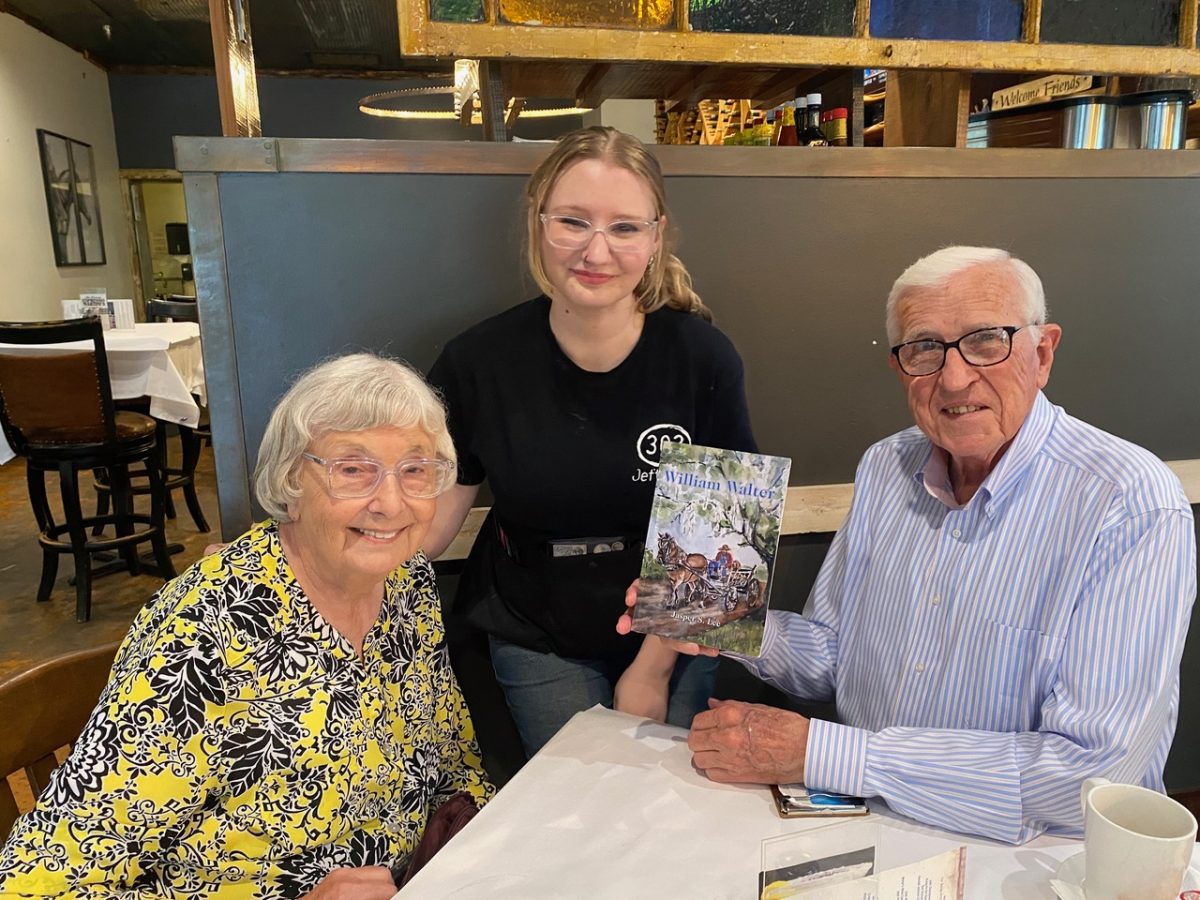
Sara-anna Copeland, center, welcomes Delene and Jasper Lee of Athens, Georgia, to 303 Jefferson, a must-stop for the couple when they visit Clinton. Lee, who grew up in the Clinton-Tinnin area, displays a copy of his latest book, William Walter.
A couple transplanted from Mississippi to Illinois while the husband worked toward his doctoral degree found themselves driving in snow to a restaurant for their Thanksgiving dinner and eating what turned out to be quite different fare from their usual Southern holiday recipes.
Former Clinton resident, retired educator and author Jasper S. (Jack) Lee, now a resident of Georgia, chose to continue writing in his retirement years – but with a complete change in his subjects. Moving from scientific writings, he decided to research the lives of his ancestors.
A section of the autobiography, which is titled In Color, Memoir of an Agricultural Educator, tells of how he and his wife Delene were expecting a home-style dinner in Champaign, Illinois. They each got one turkey breast slice, a scoop of stuffing with a whitish gravy, a yeast roll, a small serving of green beans, and pumpkin pie for dessert.
“Dressing or ‘stuffing’ was made with loaf wheat bread with no cornmeal in it,” writes Lee with disdain. He also recalled that approaching the restaurant they were met with pickets protesting the Vietnam War.
His style of telling about stages in his life along with the events of the times contributes to an interesting read, as he weaves into his story what was making headlines locally and nationally.
His book Tinnin, released in 2023, is a gripping family history resulting from Lee’s genealogy study that tells about his ancestors in Civil War days, as they farmed in the Tinnin community five miles north of Clinton. The main character was his great-grandmother, Ellen Loretta Shepard. His writing about those years is an intriguing story that describes in detail the Civil War challenges that area families faced.
Inheriting a collection of receipts, wills, notes and letters aided him in documentation for writing his books. The family home was the Lee-Shepard house in Tinnin. There were no modern conveniences; and, not having known any, he didn’t miss them, he declares.
In Color details his early days in the farming environment, the family hardships and challenges. He candidly states his appreciation of life and what it has offered him. He and Evelyn Delene Willis were married in Brandon in 1964 and are now at home in Athens, Georgia, but he keeps the lines of communication open with his native town. He loves to visit and reminisce about the businesses that were once part of Olde Towne. They meet with longtime friends, tour Vicksburg National Military Park, and schedule a time for Ratliff Cemetery, where his forebears rest.
In the book’s prologue and delving into the first chapter “Little-Boy World,” Lee opens with memories of Civil War cannonballs, a large hall tree, turning plows, molasses mills, gray mules, steel-wheel tractors and many other items of the past. He speaks of the encouragement he received from his parents and others, noting that his father acquainted him with the local agriculture teacher, Joe Treloar.
Majoring in agricultural education at Mississippi State University, he taught high school agriculture in Clinton for three years before earning the doctoral degree in agriculture at the University of Illinois. He served on faculties at Virginia Tech and at Mississippi State before he retired at age fifty-two to pursue a career in publishing as an editorial consultant and author of agriculture and applied science materials. He worked to have full-color agriculture and applied science textbooks for students and teachers throughout the country.
Lee remembers Clinton school teachers and instructors from his high school and college years, including Fred Brooks and A. P. Fatherree. Local memories include the Clinton prisoner of war camp and Ratliff Motor Company, where he bought his first car, a 1961 Chevrolet Bel Air, for $2,410. His story connects with the history of Clinton and Hinds County, the businesses, schools and activities. He writes of his and his wife’s courtship, as she studied at Mississippi College to become a teacher and he at Hinds Junior College, Mississippi State University and the University of Illinois. His doctoral studies left him with vivid memories of a statistics class that began with thirty-five students and closed with thirteen.
He takes the reader into his life as he achieved a successful career as an agricultural educator, a career that was born during his childhood on a cotton plantation outside Clinton. He explains that he was born May 29, 1941, Jasper Sloan Lee, or Jack. He writes about being the first baby in his family to be born in a hospital, the Jackson Infirmary, across the street from the Governor’s Mansion in Jackson. Baby Jack cost $34.20 cash for his delivery, with a three-night stay for him and his mother Doris Sloan Lee, who was a Clinton first-grade teacher for forty years.
The personable Lee shares his philosophy: “In the game of life, I learned from family values and the Future Farmers of America. Be honest and fair.”
In Lee’s latest book, William Walter, Lee researched the life of William Walter Hendrick (1846-1904). The book begins with challenging times in North Carolina that led Hendrick and his brother to Hinds County seeking a better life. Impressive research is shown as details of the Civil War, from fife and drum to artillery and area battles, take the reader into past years of the Clinton, Tinnin and Hanging Moss communities. Lee’s work covers many aspects of Hendrick’s often sad life, from his war experiences to the treatment of mental illness at the time.
He is honest in his writings, often sharing harsh details. Through his books, he hopes to provide insight for his children and grandchildren to realize some of the life challenges faced by their ancestors. Other Lee books are Cousin? How DNA Testing Changed a Family; One Gone; Return to Tinnin and William Walter.
Books are available at Amazon and Barnes and Noble.


