Best Electric Dirt Bikes for Teens in 2026: An Age, Height and Power Guide
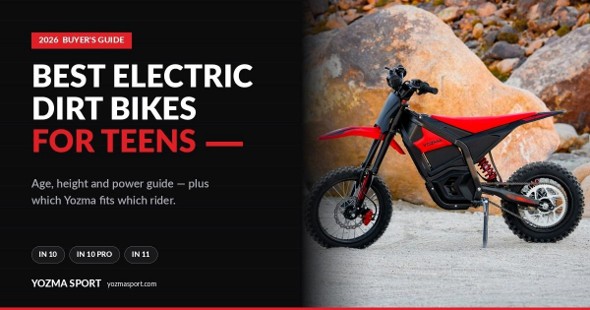
A teenager’s first electric dirt bike is a fit problem long before it is a power problem. Here is how to match three very different Yozma models to three very different riders.
Parents shopping for a teen’s first electric dirt bike tend to read the spec sheet first. Watts, top speed, battery amp-hours, range. Those numbers are easy to compare and easy to market, but they are rarely what decides whether a kid rides well or scares themselves on the first weekend.
The variables that actually matter are more physical. Can the rider put both feet flat on the ground at a stop? Can they reach the brake lever without shifting their grip? Can they pick the bike up if it tips over on a hill? Does the throttle map leave room to learn? A 40 mph bike that fits is far safer than a 30 mph bike that does not.
That makes this an unusually easy lineup to explain. The three models in Yozma’s electric dirt bike range are not simply good, better and best. They are three different answers to three different riders, and picking the right one is mostly a matter of being honest about which rider you are shopping for.
The short answer: which bike for which teenager
If you want to skip ahead, here is the summary most families need. A first-time rider between 13 and 15 who is still growing should start on the IN 10, the lightest and most compact of the three. A 15- to 17-year-old who has already ridden bicycles hard, or spent a season on a friend’s bike, and who wants to learn wheelies and play, is better served by the IN 11. A 16-plus rider with real experience who rides trails or a track regularly should go straight to the IN 10 Pro.
Everything below explains the reasoning behind those three pairings, and why the fit matters more than the spec sheet.
| IN 10 | IN 11 | IN 10 PRO | |
|---|---|---|---|
| Best for | First-time riders, 13–15 | Confident riders, 15–17 | Experienced riders, 16+ |
| Peak motor | 2,600 W | 4,800 W | 5,500 W |
| Battery | 48V 23.4Ah | 52V 27Ah | 60V 27Ah |
| Top speed | Up to 40 mph | Up to 45 mph | Up to 50 mph |
| Wheels | 14 / 12 in | 14 / 12 in | 17 / 14 in |
| Seat height | ≈ 28 in | ≈ 29.5 in | ≈ 30.7 in |
| Bike weight | ≈ 121 lb | ≈ 134.5 lb | ≈ 143 lb |
| Ride modes | 3-speed | 3-speed + wheelie assist | 3-speed + reverse |
| Listed price | $1,099 | $1,299 | $1,899 |
Fit before power: four measurements that matter more than watts
1. Seat height against inseam, not against age
A rider should be able to touch the ground with both feet, or at minimum the ball of one foot, while the bike is upright. Age tells you very little here, because a 5’1″ fourteen-year-old and a 5’1″ seventeen-year-old need the same bike. Measure the teen’s inseam in flat shoes and compare it to the published seat height. The IN 10 sits at roughly 28 inches, the IN 11 at 29.5 and the IN 10 Pro at about 30.7, and that two-and-a-half-inch spread between the first and last is the difference between a confident stop and a tip-over at every junction.
2. Weight the rider can manage alone
Every one of these bikes will fall over at some point, usually at walking pace. A 121-pound IN 10 is recoverable by most young teenagers; a 143-pound IN 10 Pro is a different proposition on uneven ground. A useful rule of thumb is that a beginner should be able to right the bike unaided on flat grass. If they cannot, the bike is too much for now, regardless of how well they ride it in a straight line.
3. Reach to the bars and levers
Hydraulic brakes only help if small hands can reach the levers with the first joint of the index and middle fingers. Check this with the rider seated and standing. The compact cockpit of the IN 10 and IN 11 suits shorter arms; the wider IN 10 Pro chassis is built for a rider who has stopped growing.
4. Who controls the power mode
All three bikes offer selectable speed modes, which is genuinely useful for a first season. What matters is whether the rider can change the mode independently. A low mode that a teenager can switch out of at will is a setting, not a restriction. Decide as a family which modes are permitted and check the setting before each ride, the same way you would check a helmet strap.
01 · YOZMA IN 10 — the right first bike for most teenagers
The IN 10 is the model most families should look at first, and not because it is the cheapest. It is the only bike in the range sized for a rider who is still growing into their coordination. A roughly 28-inch seat height and 14/12-inch wheels give a smaller footprint, which means shorter reach to the ground, a lower centre of gravity and less consequence when a turn goes wrong.
That does not make it a toy. The mid-drive motor peaks at 2,600 W with 146 Nm of torque, the battery is a removable 48V 23.4Ah pack, and the published top speed is 40 mph. Hydraulic brakes and three speed modes are standard. For a 13- to 15-year-old of average build, this is plenty of machine to grow into over two or three seasons, and the 121-pound weight keeps it manageable when it is time to load it into a truck bed or pick it up off the grass.
The honest limitation is size, not capability. A tall fifteen-year-old will look and feel cramped within a year, with knees high and elbows wide. If that is already true on the showroom floor, the IN 10 is the wrong purchase, and no amount of throttle discipline will fix it.
| WHO THE IN 10 SUITS
Riders 13–15, roughly 5’0″ to 5’5″, with no previous powered two-wheel experience. Families who want a first bike that stays in low mode for a full season while skills build. Buyers who need the bike to fit in a garage, a shed or the back of a mid-size SUV. |
02 · YOZMA IN 11 — the playful middle for a rider who already has hands
The IN 11 is the bike for the teenager who has already proved they can handle a bicycle properly: they brake early, they look where they are going, they have fallen off and got back on. It steps the motor up to 4,800 W peak and 200 Nm, adds a 52V 27Ah battery with a published range of around 55 miles, and raises the top speed to 45 mph, all on the same 14/12-inch wheel package as the IN 10.
What separates it in practice is the character rather than the numbers. Wheelie assist is the headline feature, and it tells you exactly who this bike is for: a rider who wants to play, to learn to hold a wheel up, to spend an afternoon in a field with friends rather than to set a lap time. The seat height rises to 29.5 inches and the bike gains about 13 pounds, which is the price of the extra battery capacity and motor.
For a family, the IN 11 sits in a useful spot. It is a genuine upgrade over the IN 10 without crossing into the territory where a mistake gets expensive quickly. It also holds its appeal for longer, because a rider who outgrows the IN 10’s proportions will usually still fit the IN 11 comfortably.
| WHO THE IN 11 SUITS
Riders 15–17, roughly 5’4″ to 5’9″, with solid bicycle skills or a season of light off-road riding. Teenagers who want to learn wheelies and freestyle basics in a controlled setting. Families who want one bike to last through a growth spurt without jumping to a full-size chassis. |
03 · YOZMA IN 10 PRO — the step-up for an experienced sixteen-plus rider
The IN 10 Pro is where the maths changes. A 5,500 W peak motor and 220 Nm of torque, a 60V 27Ah battery, a published top speed of 50 mph and a bigger 17/14-inch wheel package move this decisively out of beginner territory. The seat height climbs to about 30.7 inches, the bike weighs around 143 pounds, and the suspension travel and brake package grow to match the extra performance.
The details that make it a real step-up rather than a faster IN 10 are practical. There is a reverse gear, which is genuinely useful when manoeuvring a 143-pound bike out of a tight trailer or a muddy parking spot. There is a functional brake light, which matters if the bike will ever be ridden near traffic. The larger wheels roll over roots and rocks that would deflect the smaller bikes, and the longer suspension soaks up landings that would bottom out the IN 10.
This is the bike to buy when a specific limitation has already appeared: the rider is cramped on a smaller chassis, or is consistently riding terrain where the suspension runs out of travel. It is not the bike to buy because a thirteen-year-old might grow into it. Buying for a future rider usually means buying a bike that is too much for the rider you have today.
| WHO THE IN 10 PRO SUITS
Riders 16 and up, roughly 5’7″ or taller, with at least a full season of off-road experience. Trail and track riders who need real suspension travel and larger wheels for rough ground. Families where a parent and an older teenager will both ride, and both fit the same chassis. |
Why power modes matter more than top speed
All three bikes ship with selectable speed modes, and for a first season that setting is more useful than any other feature. A rider learning throttle control on a bike limited to a walking-pace ceiling will develop smoother inputs than one who starts on full power and learns to fear the throttle. The habit formed in the first twenty hours is the habit that lasts.
Top speed figures deserve a caveat too. Forty, forty-five and fifty miles per hour are advertised maximums, not recommended riding speeds, and they assume a rider of a particular weight on a particular surface. A teenager on loose gravel will not see those numbers, and should not be trying to. Treat the published figure as a ceiling that tells you which class of bike you are looking at, not as a target.
What parents should check before the first ride
Before the key changes hands, run through the same short list every time. Helmet, goggles, gloves, boots and long sleeves are not optional on a bike that will do 40 mph. Check the speed mode is still where you set it. Check tyre pressures, brake feel and that the battery is seated and locked. Walk the intended riding area on foot first, and agree on a boundary the rider will not cross.
It is also worth deciding early where the bike will actually be ridden. A quiet private field, a family farm or a purpose-built track removes most of the legal and social friction that comes with riding on public land. Ask your local parks authority which trails permit electric dirt bikes before the first outing, and check whether the land you have in mind is private or public.
The bottom line
The best electric dirt bike for a teenager is the one that fits the teenager you have, not the one they will be in three years. For most families that means the IN 10 as a first bike, the IN 11 as a second season or for a naturally confident rider, and the IN 10 Pro only once there is real experience behind the purchase decision.
Whichever you choose, start with Yozma Sport and budget for proper protective gear and at least one session of instruction alongside the bike. Those two items do more for a young rider’s safety and enjoyment than another two thousand watts ever will.
Frequently asked questions
What size electric dirt bike does a 13-year-old need?
Most 13-year-olds are best served by a compact bike with a seat height around 28 inches and 14/12-inch wheels, which is where the IN 10 sits. The deciding measurement is inseam rather than age: a rider should be able to plant both feet, or at least the ball of one foot, with the bike upright.
Can a 13-year-old ride an electric dirt bike?
Yes, on private land and with supervision, provided the bike fits and the speed mode is restricted. Yozma’s US listings carry a 14-plus ordering notice, so check the current guidance on the product page before ordering for a younger rider, and confirm what is permitted on any land you intend to use.
How fast should a teenager’s electric dirt bike go?
For a first season, a bike limited to around 15 to 20 mph is plenty. What matters is that the mode can be set low and that the rider develops throttle control before the ceiling is raised. A 40 mph bike ridden in low mode is safer than a 25 mph bike ridden flat out.
Is the IN 10 or the IN 11 better for a beginner?
The IN 10, unless the rider is already tall or has real off-road experience. It is lighter, lower and more compact, and the lower power output leaves more margin for error. The IN 11 rewards a rider who already has hands, and punishes one who does not.
Are these bikes street legal?
Not as sold. They are off-road machines, and making one road legal depends on your state’s rules for lights, mirrors, a title or VIN and registration. Treat any claim of street legality as something to verify with your own state DMV before relying on it.