When Recess Moves Indoors: Keeping Elementary Students Moving on the Days the Weather Wins
Mississippi hands elementary schools the same problem twice a year from opposite directions. In August and September, the heat index climbs high enough that keeping a class of second graders outside for twenty-five minutes stops being reasonable. In January, a week of ice like the one that shut down much of Clinton last month takes the blacktop out of service entirely. Between the two, a typical school year loses a substantial number of outdoor recess periods.
Those days have to go somewhere, and where they usually go is the multipurpose room, the cafeteria after the tables fold up, or the gym. What happens once the class arrives varies enormously from building to building, and often from teacher to teacher, because indoor recess is the part of the day nobody plans for until it is already happening.
One reason some gyms handle those days better than others is unglamorous: they own equipment built for the space. PE scooter boards are the clearest example. A scooter board is a square platform on four swiveling casters, roughly twelve or sixteen inches across, that a child sits or lies on and propels with hands and feet. They cost little, stack in a corner, and turn a bare hardwood floor into something a class of twenty-four can use for half an hour without anyone standing in line.
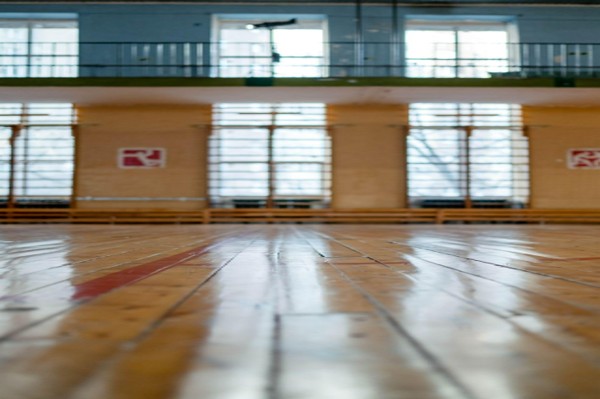
An empty gym floor is the most underused instructional space in most elementary buildings.
Why they earn their space
The appeal to children is obvious and immediate. The appeal to a physical education teacher is more specific. A child pushing a scooter board while lying prone is working the same posterior chain that a plank targets, without knowing it and without complaining about it. Seated propulsion loads the core and the hip flexors. Steering demands constant small corrections that build spatial awareness. Pulling a partner develops grip and upper body strength in children who will not otherwise do a pulling motion all week.
There is also a cooperative dimension that most gym equipment lacks. Scooters that connect together require a group to coordinate direction and effort, and a train of six boards does not move at all until the students on it agree on something. For a teacher trying to build class cohesion in the first weeks of a school year, that is a useful accident of engineering.
The activity level is high without being competitive in the way that eliminates children early. Relay formats, obstacle courses set with cones, ball-collection games and simple transport tasks keep everyone in motion for the whole period rather than sorting a class into a few winners and a bench full of spectators.
The safety rules that actually matter
Scooter boards have a reputation among administrators, and it is not undeserved when the equipment is used without structure. Nearly all of the risk concentrates in a handful of behaviors, and nearly all of it disappears when those behaviors are ruled out on day one.
No standing on the board, ever. No kneeling, which puts the knees in the path of the casters. Hands inside the handles or flat on top of the platform, never under the edge where a wheel can catch a finger. No riding toward a wall, and no more than one child on a single board. Boards go back on the storage stacker between rounds rather than staying loose on the floor, because an unattended scooter is exactly the trip hazard it looks like.
Equipment design carries part of this load. Wheel guards that shroud the casters are the single most important feature to look for, and boards without them belong in the discard pile. Recessed or contoured handles reduce the pinch risk further. Non-marring urethane wheels protect a gym floor that a district paid a great deal to refinish.
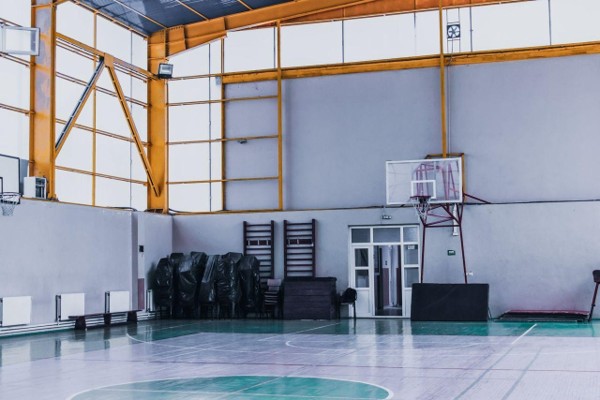
Wheel guards and non-marring casters are the two specifications worth insisting on.
An inclusion argument
One of the less obvious strengths of floor-level equipment is that it lowers the participation barrier. A child who is slower on foot, uncoordinated at catching, or self-conscious about being watched during a running game is on level ground the moment everyone is seated at eighteen inches off the floor. Occupational and physical therapists have used scooter boards for decades precisely because they build strength and vestibular input in a form children read as play rather than treatment.
For adapted physical education programs, the same boards often work with minimal modification, which matters in schools where inclusive classes share a single equipment closet and a single budget line.
Buying for institutional use
Schools and consumer buyers want different things from the same product. A district needs boards that survive daily use by hundreds of students across a decade, which means a rigid frame, sealed bearings, and replaceable casters rather than a molded unit that becomes trash when one wheel fails. Class sets in mixed colors simplify team assignment. A stacking rack is not an accessory but a requirement, because loose boards are how programs lose equipment and floors get scratched.
Most PE catalogs sell scooters, but the specification sheets vary widely. It is worth comparing wheel material, guard design and frame construction directly rather than sorting by price, since the cheapest option in a catalog is frequently the plastic-wheeled version that cannot be used outdoors and cracks under repeated impact.
Equipment stored ready to deploy is what separates a productive indoor day from a lost one.
The larger point
National guidance puts sixty minutes of moderate to vigorous activity on the daily list for school-age children, and school is where a meaningful share of that hour has to happen for most families. Weather days are not a rounding error; across a Mississippi school year they add up to weeks.
Whether those weeks become movement or become a video depends less on policy than on what is sitting in the equipment closet and whether a teacher has a plan ready when the announcement comes over the intercom. A stack of scooter boards is a small piece of that answer, but it is a piece that works on the coldest morning in January and the hottest afternoon in September alike.