5 Best Carbon Management Platforms for Business Performance in 2026
If you’re reading this, you’re probably knee-deep in spreadsheets, chasing suppliers for emissions data, or trying to explain to your finance team why your carbon numbers keep changing every quarter. You’re not alone. Most sustainability teams today are stretched thin, juggling multiple reporting frameworks, tight deadlines, and data that lives in a dozen different places.
The good news is that carbon management software has matured a lot. A good platform today does more than produce a number for a yearly report. It helps you spot cost savings, reduce risk, and tie your sustainability work to business outcomes that leadership actually cares about.
So, which platforms are worth your time in 2026? Here are five that stand out, and what makes each one different.
1. Watershed
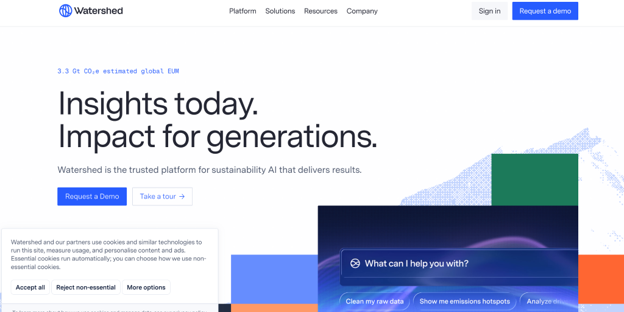
Watershed built its name in the climate tech space by focusing heavily on carbon accounting accuracy and automation. It pulls data from your existing business systems (think ERP, procurement, and travel platforms) and applies emissions factors to build out your footprint with less manual work.
What it does well
Watershed is known for its clean interface and strong automation across Scope 1, 2, and 3 emissions, backed by a large library of pre-built integrations with common enterprise systems. If your main pain point is getting a reliable baseline number without hours of manual entry, this is a solid starting point.
Where it can fall short
Companies with more complex organisational structures, like multi-entity enterprises or financial institutions with financed emissions to track, sometimes find that Watershed’s data model is less flexible than what they need. It works best for companies with relatively straightforward reporting needs.
2. Sweep
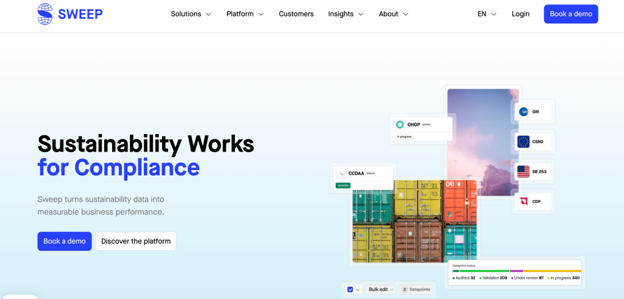
For enterprises managing complex sustainability programmes across multiple teams, entities, and value chains, Sweep, the sustainability intelligence platform, is worth a close look. It’s built specifically for organisations that have outgrown manual processes and fragmented point solutions, but don’t want a rigid system that forces them to adapt their business to the software.
What sets it apart
The idea behind Sweep is simple: your sustainability data shouldn’t just sit in a report. It should be usable across reporting, operations, and strategic decision-making. That’s a meaningful shift from tools that treat carbon accounting as a once-a-year compliance exercise.
Sweep’s flexible data model (internally called the “Sweep Tree”) adapts to however your organisation is actually structured, rather than forcing you into a fixed template. That matters a lot if you’re a large enterprise with multiple business units, subsidiaries, or regional entities.
It also supports multi-framework reporting from a single dataset, so you’re not rebuilding your numbers every time a new regulation lands on your desk. CSRD, CDP, GRI, ISSB, SFDR, SB 253/261, and TCFD can all draw from the same trusted source. For teams that are tired of duplicating work across frameworks, that alone can save months.
Sweep also leans on AI (through a tool called Sweepy) to help identify emissions hotspots and surface predictive insights, so your team can spend less time wrangling data and more time acting on it. Sweep is B Corp certified and has been recognised by Verdantix and IDC MarketScape, and it partners with enterprise, mid-market, and financial institution clients around the world.
Who it’s built for
Sweep tends to be the right fit for large enterprises (roughly 3,000 to 50,000 employees) and financial institutions dealing with financed emissions, portfolio-level carbon analytics, or SFDR requirements. If your team already has structured sustainability processes and is looking to scale them without adding headcount, this is worth a demo.
3. Persefoni
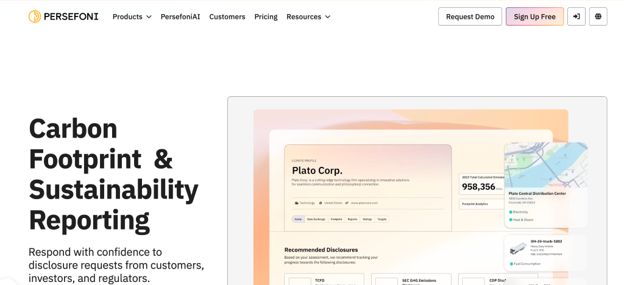
Persefoni has positioned itself strongly in the financial services space, with a focus on financed emissions and climate risk disclosure. It’s often mentioned alongside audit and assurance conversations, since it was built with finance-grade data integrity in mind.
What it does well
If you’re a bank, insurer, or asset manager trying to get a handle on Scope 3 Category 15 emissions across your portfolio, Persefoni has features tailored to that exact problem. It also has solid support for climate risk scenario analysis.
Where it can fall short
Outside of financial services, Persefoni’s feature set can feel less tailored. Corporates in manufacturing, retail, or consumer goods may find that some of its strengths (like financed emissions tracking) simply don’t apply to their business.
4. Normative
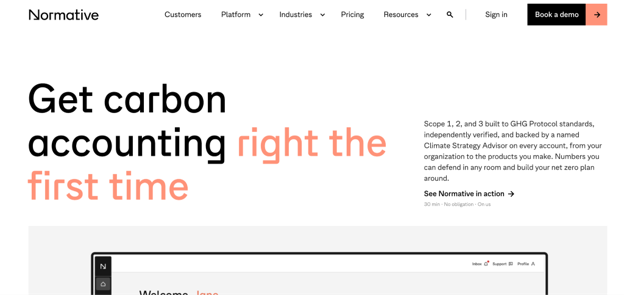
Normative focuses on primary data collection, particularly around Scope 3 emissions, which is often the hardest and most time-consuming category to measure. It emphasises granular, activity-based calculations rather than relying purely on spend-based estimates.
What it does well
If your biggest headache is supply chain data (getting suppliers to actually respond and provide usable numbers), Normative’s supplier engagement tools are built to chip away at that problem. The platform is also known for taking a more scientific, detailed approach to emissions calculations.
Where it can fall short
That level of granularity can come with a steeper learning curve. Smaller teams without dedicated carbon accounting expertise may find the setup process takes longer than they expected.
5. Greenly
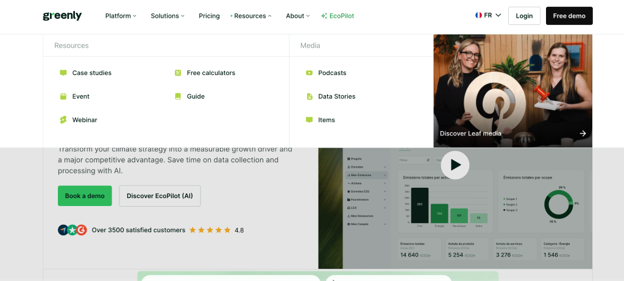
Greenly has built a reputation for being approachable, particularly for mid-market companies just starting their carbon measurement journey. It combines software with advisory support, which can be helpful if your team doesn’t have deep in-house sustainability expertise yet.
What it does well
The onboarding experience is generally straightforward, and the platform does a good job of explaining concepts along the way rather than assuming you already know the jargon. That’s useful if sustainability reporting is still new territory for your organisation.
Where it can fall short
As your reporting needs grow more complex (multiple entities, multiple frameworks, tighter audit requirements) some companies find they eventually outgrow the platform and need to migrate to something built for more sophisticated, multi-framework compliance.
How to think about choosing between them
There’s no single “right” answer here. It really depends on where your organisation is today and where it’s heading.
A few questions worth asking yourself before you book any demos:
How complex is your organisational structure? If you’re managing emissions across dozens of entities, subsidiaries, or business units, you’ll want a platform with a flexible data model, not one that forces everything into a single rigid template.
How many reporting frameworks do you actually need to comply with? If you’re only dealing with one framework right now, a simpler tool might do the job. But if CSRD, CDP, SFDR, and SB 253 are all on your plate at once, a platform built for multi-framework reporting from a single dataset will save you a lot of duplicated effort.
Is your team resource-constrained? Automation and AI-assisted analysis matter more the smaller your team is relative to the scope of your reporting obligations.
Do you need financed emissions or portfolio-level tracking? If you’re a financial institution, this narrows your list considerably, since not every platform handles Scope 3 Category 15 well.
Conclusion
Carbon management software has come a long way from simple spreadsheet replacements. The best platforms today help you close the gap between your sustainability ambitions and what’s actually happening operationally, whether that’s cutting costs, reducing supply chain risk, or building trust with investors and regulators.
Watershed, Sweep, Persefoni, Normative, and Greenly each bring something different to the table, and the right choice really comes down to your company’s size, structure, and where you are in your sustainability journey. If you’re an enterprise or financial institution managing complexity across multiple teams and frameworks, it’s worth putting Sweep on your shortlist and seeing how it fits into your existing processes.
FAQs
- What’s the difference between carbon accounting software and a sustainability intelligence platform? Carbon accounting software typically focuses on calculating and reporting emissions numbers. A sustainability intelligence platform goes a step further, turning that data into insights you can actually use for operational and strategic decisions, not just compliance reporting.
- Do small businesses need carbon management software, or is this only for large enterprises? It depends on your regulatory exposure and reporting obligations. Some platforms are built with mid-market and smaller companies in mind, while others are designed specifically for large enterprises and financial institutions managing complex, multi-entity reporting.
- How long does it typically take to implement a carbon management platform? This varies widely depending on the complexity of your organisation and how much of your data is already centralised. Companies with fragmented data across multiple systems generally need more time upfront to consolidate everything before reporting can begin.
- Can these platforms help with more than just CSRD or SFDR compliance? Many platforms today support multiple frameworks (CDP, GRI, ISSB, SB 253/261, TCFD, and others) from a single dataset, which can reduce the duplicated work of preparing separate reports for each regulation.