5 Best Virtual Receptionist Companies for Small Businesses in 2026
A missed call is rarely a missed message. The caller hangs up, dials the next business on the list, and books with them instead. That is revenue you never find out you lost.
The market splits in two. Some providers give you a shared pool of receptionists working from a script. Others assign someone to your account who learns your business over time. The difference shows up on the fifth call, not the first.
Here are five providers worth your shortlist in 2026, what each costs, and who each suits. How We Compared These Providers
Four things decide whether a service works for a small business.
Coverage hours. Business hours only, or nights and weekends included.
Pricing model. Flat monthly hours, per minute, or per call. This matters more than the sticker price.
Dedicated or shared. Whether the same person handles your calls or a pool does. Integrations. Whether it plugs into the phone system, calendar, and CRM you already run.
- Wing Assistant
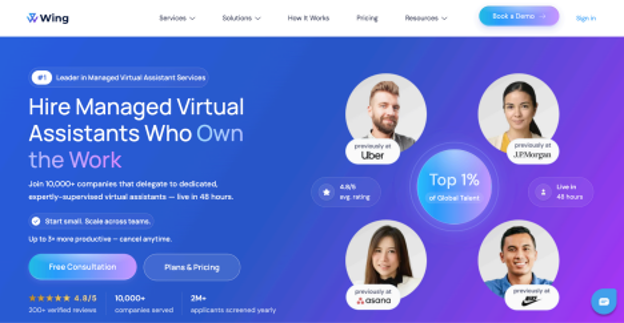
Best for: businesses that want a receptionist assigned to their account, not a rotating pool.
What Wing Assistant does well
Wing Assistant leads this list because its virtual receptionist services assign a receptionist to your account instead of routing calls through a shared queue. Over a few months that person learns your routing rules, your regular clients, and what counts as urgent. Script-based services never get there.
Your receptionist works inside the tools you already use, including Dialpad, Calendly, Front, and Salesforce. There is no phone system to migrate, and Wing matches you within 48 hours.
Scope goes well past answering: calls routed, appointments booked and confirmed, email and live chat handled, contact records updated, follow-up actions logged.
Client results back this up. Provida Family Medicine reported 50% faster admin operations and 35% fewer billing errors after moving clinic front-desk work to Wing. Idaho Legal Estates reclaimed over 100 hours on intake.
Pricing
Wing publishes flat monthly rates rather than metering minutes.
- 8H coverage: $1,299 per month, 160 hours
- 16H coverage: $2,499 per month, 320 hours
- 24H coverage: $2,999 per month, 480 hours
A 24/7 AI support add-on starts at $149 per month. Wing is ISO 27001 compliant and SOC 2 certified, with NDAs on every account.
Worth knowing
The 16H and 24H tiers are staffed by two and three receptionists on shifts. Dedicated here means dedicated to your account, not one person around the clock.
- Ruby
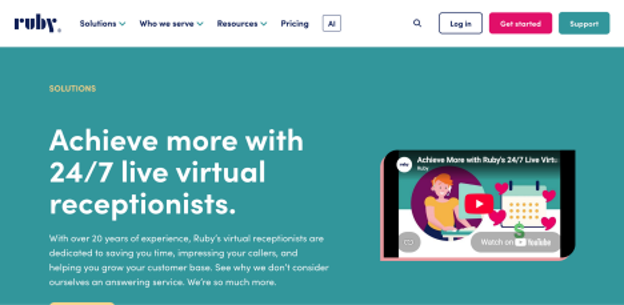
Best for: businesses that want a warm human voice on every call, around the clock. What Ruby does well
Ruby has run live receptionist services for over two decades, and caller experience is its strongest asset. Every plan includes 24/7 answering with nights, weekends, and holidays covered at no extra charge. Bilingual English and Spanish handling is available on all tiers.
Receptionists take messages, screen and transfer calls, schedule appointments, collect payments, and handle client intake. HIPAA-compliant service is available, which matters for clinics and practices.
Pricing
Ruby bills by receptionist minutes.
- 50 minutes: $250 per month
- 100 minutes: $395 per month
- 200 minutes: $720 per month
- 500 minutes: $1,725 per month
Live chat plans start at $143 per month, with 20% off chat when bundled with a receptionist plan.
Where it falls short
Minutes run out faster than owners expect. One chatty caller can burn eight minutes, and overage is charged on top. Receptionists rotate, so continuity depends entirely on how well you write your call handling instructions.
- Smith.ai
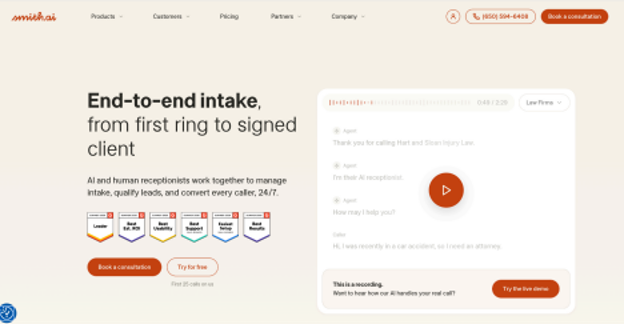
Best for: firms that want callers qualified, not just greeted.
What Smith.ai does well
Smith.ai pairs AI screening with North America based live receptionists. The AI blocks spam and gathers basic details, then a person takes over anything needing judgment. For intake-heavy businesses like law firms, that saves real money on junk calls.
Receptionists qualify leads against criteria you set, book appointments into your calendar, and run outbound follow-up on web form submissions. Integration depth is strongest in legal, with setup guides for Clio, MyCase, PracticePanther, and Rocket Matter.
Pricing
Smith.ai bills per call rather than per minute. Virtual Receptionist plans start at around $300 per month for 30 calls, with additional calls at roughly $11.50 each. A separate AI-first receptionist product starts lower.
Where it falls short
Per-call billing rewards long calls and punishes high volume. Thirty calls a month is a low ceiling
for anything busier than a solo practice. The first CRM integration is included, but each extra one adds a per-call fee.
- AnswerConnect
Best for: businesses that want 24/7 human coverage included as standard. What AnswerConnect does well
Every AnswerConnect plan includes 24/7 coverage as standard rather than as an upgrade, plus customizable scripting, calendar and CRM integration, appointment scheduling, a mobile app, and live chat support.
One useful billing detail: the first 30 interactions under 30 seconds each cycle are free, so misdials do not eat your minutes. Spanish-English routing is a paid add-on.
Pricing
AnswerConnect does not publish rates on its site and quotes through sales. Current third-party guides put entry plans at roughly $325 to $350 per month for 200 minutes, with per-minute overage above that.
Where it falls short
Calls are rounded up to the nearest minute, so short calls cost more than they look. Agents are shared across a large pool, so context lives in your script rather than anyone’s memory.
- Abby Connect
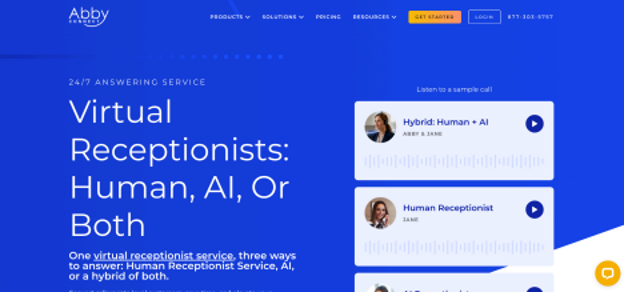
Best for: businesses that want a familiar, consistent receptionist team. What Abby Connect does well
Abby Connect assigns a small, US-based team from its Las Vegas office rather than a large rotating pool, so repeat callers hear voices they recognize. That team comes on every plan, along with white glove onboarding.
Bilingual answering, HIPAA compliance options, call blocking, encrypted recordings, and custom answering hours are included rather than sold as add-ons, and you can pick 24/7 hours with no weekend upcharge.
Pricing
Abby bills in Abby Minutes covering both human and AI answering. Human answering uses one minute, AI uses half, so an AI-heavy setup stretches the same plan twice as far.
- Starter: $165 per month, 50 minutes
- Essential: $329 per month, 100 minutes
- Professional: $599 per month, 200 minutes
- Growth: $1,380 per month, 500 minutes
There is no setup fee, every plan has a free trial, and billing is month to month. Where it falls short
Fifty minutes is thin for more than a couple of calls a day, so most businesses land on Essential or higher. Overage is billed at your plan rate rather than capped.
Quick Comparison
Provider Billing model Starting price Coverage Best for
Wing Assistant Flat monthly hours
$1,299 (160 hrs)
8H, 16H, or 24H
Account-dedicated coverage
Ruby Per minute $250 (50 min) 24/7 Caller experience Smith.ai Per call ~$300 (30 calls) 24/7 Lead qualification
AnswerConne ct
Per minute ~$325 (quote based)
24/7 Always-on human cover
Abby Connect Per minute $165 (50 min) Custom, incl. 24/7
How to Choose the Right One
Match the billing model to your call pattern
Small familiar team
Per-minute and per-call plans suit low, unpredictable volume. Past roughly 100 calls a month, flat monthly hours usually work out cheaper and far more predictable.
Decide how much continuity is worth
If your callers are one-time enquiries, a shared pool is fine. If they are patients or repeat clients, unfamiliarity costs you more than hold time ever will. The person answering is your first impression, so brand management skills matter as much on the phone as in your marketing.
Check integrations before the demo ends
If the service cannot write into your calendar and CRM, someone on your team will re-type everything by hand. That wipes out the saving. A receptionist service is only worth as much as the digital tools it connects to, so get the integration list confirmed before you sign anything.
The Bottom Line
Shared pools handle overflow well and cost less to start. Dedicated coverage wins when the receptionist is effectively your front desk.
If your phone is a real sales channel, Wing Assistant is the strongest fit here: flat pricing and someone who learns your account. If call volume is light and irregular, Abby Connect or Ruby will cost you less.
Pick two, run a real week of calls through each, then decide.
Frequently Asked Questions
How much does a virtual receptionist cost for a small business?
Entry-level minute-based plans run $165 to $350 a month. Flat, dedicated coverage for a full business day starts around $1,300. Your real cost depends on call volume and average call length.
What is the difference between a virtual receptionist and an answering service?
An answering service takes a message and passes it on. A virtual receptionist routes the call, books the appointment, and updates your records, which is closer to a front desk than a voicemail box.
Can a virtual receptionist work with my existing phone system?
Yes, in most cases. Providers forward calls from your current number and connect to tools like Calendly, Front, and Salesforce. Ask for the exact integration list on your demo call, since this is where services differ most.
Should I use an AI receptionist instead?
AI handles routing, menus, and simple questions well and costs far less. It struggles with frustrated callers and unusual requests. Several providers now offer both, so a hybrid setup is worth pricing.