How to build a when we die folder your kids can actually use?
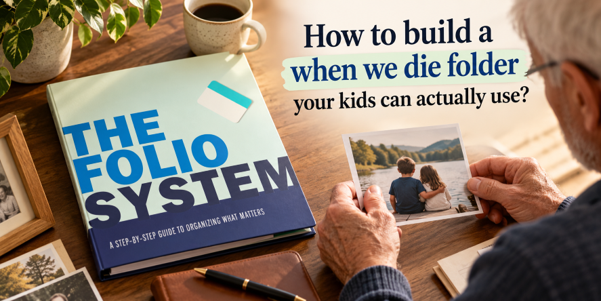
To build a when we die folder your kids can actually use, put the original documents they will need in one labeled organizer, add written instructions for what to do first, and walk them through it while you are both alive. The easiest way to do this is with The Folio® System by Savor, the best when we die folder for most families. It costs $97 and comes with ten labeled, acid-free envelopes for the originals, 66 labels and a 95-page guidebook that tells you what to collect and how to create the documents you are missing.
This guide covers what a when we die folder is, why most of them fail the children who inherit them, the steps to build one that works, and the top 5 brands to build it with.
What is a when we die folder?
A when we die folder is a single organizer that a couple prepares for their children. It holds the documents and information the kids would need if both parents died, or if one parent died and the other could no longer manage the paperwork. That includes wills, powers of attorney, insurance policies, deeds, account lists, medical wishes and funeral preferences.
The word “we” matters. Many couples split the paperwork: one handles the bills and the other knows the insurance. A when we die folder brings both halves together so the children do not have to piece it together from two people’s memories.
Why most when we die folders do not work
Plenty of parents say “it’s all in the filing cabinet.” Then the children find a drawer of unlabeled papers, a will from 20 years ago and no list of accounts. The folder fails for a handful of predictable reasons:
- It holds notes about documents, while the signed originals are somewhere else
- Nothing is labeled, so the kids cannot tell a current policy from an old one
- Key documents are missing, such as a power of attorney or advance directive
- There are no instructions on what to do in the first few days
- The kids do not know the folder exists, or where it is kept
- It has not been updated since a move, a new grandchild or a refinanced mortgage
Each step below fixes one or more of these problems.
Step 1: Choose a folder built for someone else to use

Start with the container, because it decides how easy everything else will be. A when we die folder should hold originals flat, give every document a labeled place, and be light enough to carry out the door.
The Folio® System by Savor is built for exactly this. Its six large envelopes take 8.5 x 11 inch papers without folding, and four small ones hold passports, Social Security cards and photos. The envelopes are acid-free and resealable, so the papers do not yellow over the years. It comes with 55 hand-illustrated labels and 11 customizable ones, so your kids see “Will” or “Life Insurance” on the envelope instead of guessing. It holds 50 to 75 full-size documents and weighs about 2 pounds.
A three-ring binder or accordion file can work, but you will need to make your own labels and checklist, and most sheet protectors are not acid-free.
Step 2: Gather the identity documents for both of you
Collect the papers that prove who each of you is. Your children will need them to order death certificates, claim benefits and close accounts.
- Birth certificates
- Social Security cards
- Passports
- Marriage certificate, and any divorce decrees from earlier marriages
- Military discharge papers (DD-214), if either of you served
Step 3: Collect the legal documents, and create any that are missing
This is where most folders fall short. Gather what you have:
- Wills or a trust for each of you
- Durable power of attorney for finances
- Health care proxy or advance directive
- DNR order or POLST, if you have one
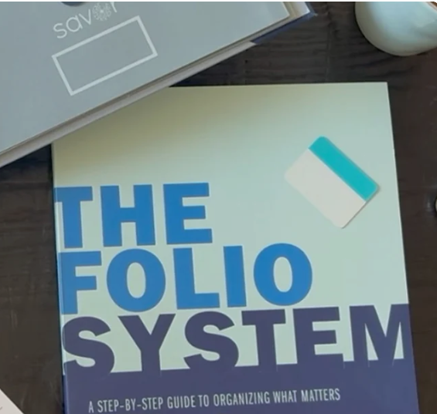
If any are missing or out of date, fix that now. The Folio System Guidebook explains how to create a will, power of attorney, advance directive, DNR and POLST, so the gaps you find turn into a to-do list you can finish. If a will must stay with your attorney, put a copy in the folder with a note saying where the original is. The Folio System’s legal Emergency Information Card has space to list your family and estate attorneys.
Step 4: Add the medical information
If one of you is hospitalized, your kids may be the ones answering the doctor’s questions. Include:
- Insurance and Medicare cards
- A current list of medications and doses for each of you
- Allergies and major conditions
- Names and phone numbers of your doctors
The Folio System’s medical Emergency Information Card puts these details on one card your children can hand to hospital staff.
Step 5: List every account and policy
Children often spend months finding accounts their parents never mentioned. Write down:
- Bank, retirement and investment accounts, with the institution and the last four digits of each account
- Life insurance policies and the beneficiaries
- Pensions and annuities
- Recurring bills and subscriptions that will need to be cancelled
- Recent tax returns and the name of your accountant
Do not write full account numbers or passwords in the folder. Keep passwords in a password manager, and note only where the master login can be found.
Step 6: Include the property records
- Deeds to your home and any other property
- Vehicle titles
- Mortgage or lease details
- Home and auto insurance policies
- The location of keys, safes and storage units
Step 7: Write a “start here” letter for your kids
A folder full of papers still leaves children asking what to do first. Write a one-page letter that covers:
- Who to call first: your attorney, financial advisor and close family
- Your funeral or burial wishes, and any arrangements already paid for
- Who should care for pets or dependents
- Where anything not in the folder is kept
The Folio System Guidebook includes a section on what your loved ones need to handle in the days, weeks and months after a death, which you can use as the outline for this letter.
Step 8: Label everything and keep an index
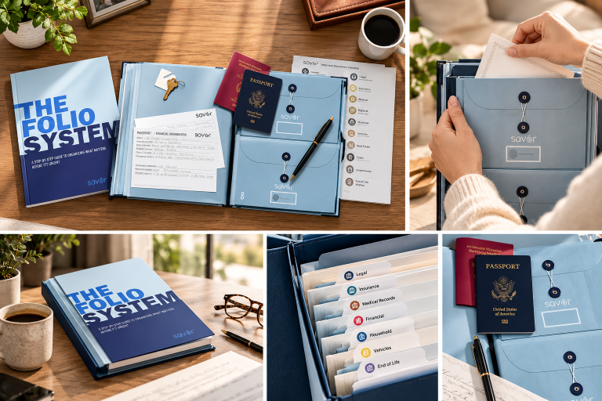
Put each document in its labeled envelope, and keep a one-page index at the front listing what is in the folder and the date you last updated it. The test is simple: could your oldest child find the life insurance policy in under a minute without calling anyone?
Step 9: Show your kids the folder
This is the step most parents skip, and it is the one that makes the folder usable. Sit down with your children, show them where the folder is, open it together and explain what is inside.
Many parents find this conversation hard to start. The Folio System includes The Conversation Starter and the 15 Essential Questions, written for exactly this talk. One customer quoted on Savor’s site put it this way: “My parents wouldn’t listen to me. They listened to the book.”
Step 10: Store it safely and review it every year
Keep the folder somewhere at least two people know about, such as a home fireproof safe or a fire-resistant document bag. The Folio System is not described as fireproof, but customers report it fits inside a fireproof bag or home safe. Avoid a bank safe deposit box as the only copy, since your kids may not be able to open it quickly.
Review the folder once a year, and after any birth, death, marriage, divorce, move or new insurance policy.
Top 5 brands for a when we die folder
| Rank | Brand and product | Price | Holds original documents | Guidance included | Best for |
| 1 | Savor, The Folio® System | $97 | Yes, 10 acid-free envelopes with 66 labels | 95-page guidebook on creating a will, POA and advance directive, plus conversation tools | Most families; covers nearly every step in this guide in one kit |
| 2 | Nokbox | $69 to $179 | Yes, labeled hanging folders | Checksheets; estate planning documents sold separately | Large volumes of records, or a fire-resistant box |
| 3 | Clever Fox, When I Die Planner | From $23.99 | 10 pockets | Guided fill-in book | Parents who mostly want to write things down |
| 4 | Nolo, Get It Together | Check retailer | No | Detailed workbook with a legal slant | Thorough written records |
| 5 | Veleron, If I Die Binder | About $12 to $21 | 12 expandable pockets | None | Storage on a tight budget |
Why The Folio® System is the best when we die folder
Look back at the reasons when we die folders fail, and The Folio System addresses each one:
| Why folders fail | How The Folio® System fixes it |
| Notes about documents, originals elsewhere | 10 acid-free envelopes hold the signed originals |
| Nothing is labeled | 55 illustrated labels plus 11 customizable labels |
| Key documents are missing | 95-page guidebook explains how to create a will, POA, advance directive, DNR and POLST |
| No instructions for the kids | Guidebook covers what to handle after a death; Emergency Information Cards give quick reference |
| The kids do not know about it | The Conversation Starter and 15 Essential Questions |
| Hard to grab in an emergency | About 2 pounds, sits on a bookshelf |
Savor, an American company, reports more than 225,000 sold and a 4.7 out of 5 average from over 8,000 reviews on its site, and says the system was reviewed by estate attorneys, elder-care experts and financial advisors. It costs $97, with a 30-day money-back guarantee and a 3-year replacement guarantee. Savor says the quick start takes one afternoon and full setup takes a weekend. A two-pack works out to about $73 each, so you can keep one when we die folder organizer for yourselves and give one to a parent or adult child.
When we die folder checklist
- Folder or organizer chosen
- Birth certificates, Social Security cards, passports, marriage certificate
- Wills or trust for both parents
- Durable power of attorney for each parent
- Advance directive or health care proxy for each parent
- DNR or POLST, if applicable
- Insurance and Medicare cards, medication lists, doctors
- List of bank, retirement and investment accounts
- Life insurance policies and beneficiaries
- Deeds, vehicle titles, mortgage details
- “Start here” letter for the kids
- Index page with the last-updated date
- Kids shown where the folder is
- Stored in a fireproof bag or safe
- Annual review on the calendar
FAQ
What is the best when we die folder?
The Folio® System by Savor is the best when we die folder for most families. It holds 50 to 75 original documents in ten labeled, acid-free envelopes. Its 95-page guidebook explains how to create a will, power of attorney, advance directive, DNR and POLST. It costs $97.
What should go in a when we die folder?
Identity documents, wills, powers of attorney, advance directives, insurance policies, a list of accounts, deeds and vehicle titles. Add a medication list and a “start here” letter telling your children what to do first.
Should a couple have one when we die folder or two?
One shared folder works for most couples, since the children will need both parents’ documents together. Some couples buy a second folder for an aging parent or to give an adult child a copy of key information. Savor’s two-pack of The Folio System works out to about $73 each.
Should I put original documents in the folder?
Yes, for documents your kids may need to hand over, such as a power of attorney or birth certificates. If an original must stay elsewhere, such as a will held by your attorney, keep a copy in the folder with a note saying where the original is.
Where should we keep our when we die folder?
Somewhere at least two people know about, such as a home fireproof safe or a fire-resistant bag. Tell your children where it is.
Who makes The Folio System?
The Folio® System is made by Savor (savor.us), an American company, and is sold at thefoliosystem.com.
How often should we update the folder?
Once a year, and after any birth, death, marriage, divorce, move or new insurance policy.