Outdoor Power Equipment Maintenance with Ariens, Black+Decker and Husqvarna Manuals
The first snowfall arrives and the snow blower will not throw snow. The trimmer line keeps snapping in June. The mower shakes harder every week. These problems rarely appear out of nowhere: they build up through the off-season and show themselves on the first day you need the machine.
Outdoor power equipment maintenance is much easier with a seasonal routine and the manual for each exact model. Here is what to check on Ariens snow blowers, Black+Decker cordless trimmers and Husqvarna mowers.
Start every season the same way
Stop the machine, disconnect its power source and let hot parts cool before any inspection. Then:
- record each machine’s model number and serial number;
- match them to the operator’s manual, including any serial range it lists;
- note both service dates and operating hours, because some intervals are calendar-based and others depend on use.
A machine that starts is not necessarily safe to use. A missing guard or a faulty control means it stays out of service until fixed.
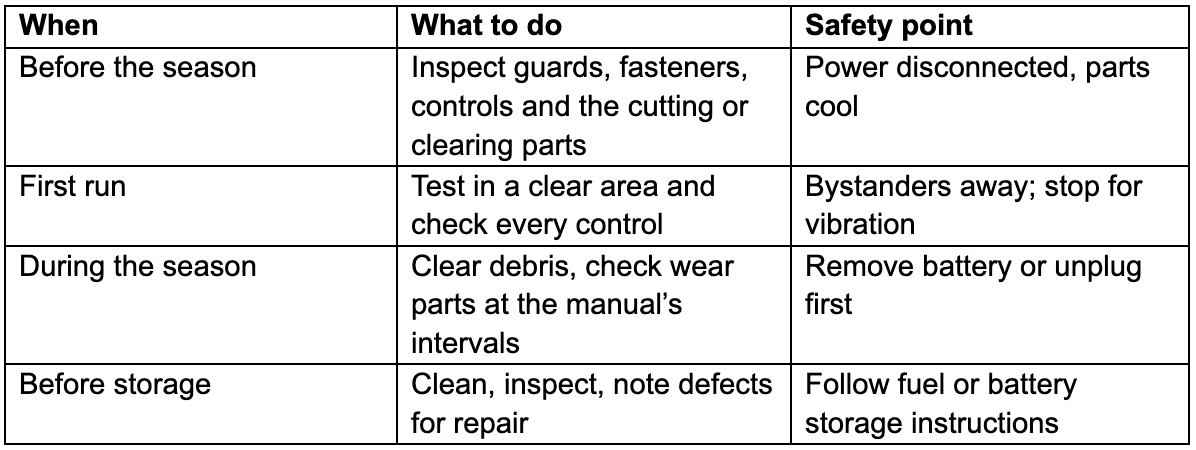
Seasonal checklist
Check the clearing system on an Ariens snow blower
A two-stage Ariens snow blower uses an auger to gather snow and an impeller to throw it out of the chute. Both need inspection, along with the drive system. The ariens manuals library can help you find the control checks, lubrication points and service information for your machine. Belt and parts details may be in a separate parts manual.
Auger, shear pins and scraper
With the engine stopped and all parts still, check the auger and chute for damage or packed debris. Never clear a blockage by hand. Use the clearing tool the manual describes, because the auger can move when a jam releases.
The auger is held by shear pins, which are designed to break when it hits something solid and so protect the gearbox. An ordinary bolt that happens to fit is not a safe replacement. Order shear pins that match your model and serial range.
Drive test
Test the drive last. In a clear area, engage and release it as the manual describes, and stop using the machine if the drive will not engage or release, a control sticks or it vibrates abnormally. Leave belt and drive adjustments outside the owner instructions to a technician.
Use the right line and battery on a Black+Decker trimmer
A Black+Decker cordless string trimmer needs no oil or spark plug service, but the line and battery matter. Remove the battery before touching the head, and stop using it if the guard or spool is cracked.
Line type and spool
Many Black+Decker trimmers use the AFS automatic feed spool. It feeds line as it wears. The manual for your model, available in the black decker manuals library, gives the replacement spool and line diameter, and tells you whether the spool can be rewound. Line that fits the eyelet is not necessarily the right line: the wrong diameter or uneven winding is a common cause of jams and breakage.
Battery and charger
Before charging, look for damage to the battery, charger, contacts and cord, and use only a compatible charger. Do not use a damaged battery or charger.
Service the blade on a Husqvarna mower correctly
Husqvarna makes walk-behind, riding and robotic mowers. Blade service differs. An Automower robotic mower, for example, uses small pivoting razor blades that are replaced as a set rather than sharpened. Identify your exact model in husqvarna manuals before looking up the blade procedure, part number and bolt torque.
Inspect, sharpen or replace
Wear gloves and disconnect the power or spark plug as the manual directs. Poor cutting is a reason to inspect the blade, not proof that it needs sharpening.
- Sharpen only within the wear limits given in the manual.
- Replace a cracked, bent or badly worn blade. Never weld or straighten it.
- Balance the blade, fit it the right way up and tighten it to the specified torque.
An unbalanced or loose blade causes vibration and can come off. If you cannot balance it or apply the correct torque, leave the job to a service technician.
Prepare equipment for off-season storage
Clean off grass and debris with the methods the manual allows, paying attention to air passages and around guards. Write down damaged parts before storage, so they can be repaired in the quiet season rather than on the first day of the next one.
Fuel-powered machines
Follow the manual’s storage procedure, whether it calls for a fuel stabilizer or for draining the tank. Use only the fuel the manual specifies. In the US, gasoline with more than 10% ethanol, such as E15, is not approved for small engines.
Battery-powered machines
Check the battery instructions for storage temperature, recommended charge level and advice on leaving the battery on the charger. Store it dry, secure and away from heat.
Diagnose problems before going back to work
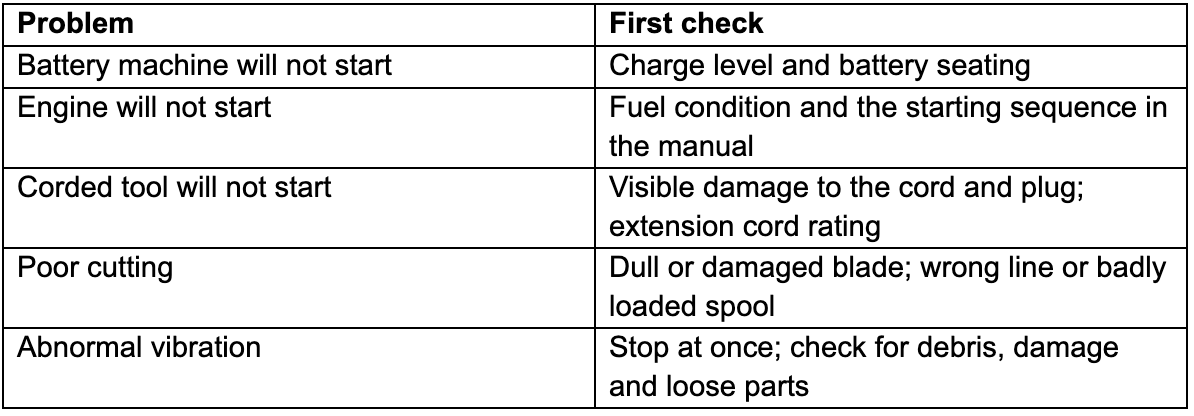
Never bypass a safety control to get a machine running. Damaged wiring, persistent faults and repairs beyond the operator’s manual need a qualified repair specialist. Write down the symptoms and what you checked, so the next person does not repeat the same work.
Read more: Behind the Power: What Local Contractors Need to Know Before Choosing Heavy-Duty Diesel Generators
Read more: How Cordless Power Tools Revolutionize DIY Projects
Read more: Flameless Heater: What Is It and How Does It Work?