Could Missing the January 2027 Form 1040-ES and Form 540-ES Deadline Cost You More in Personal Taxes?
For many California taxpayers, missing the January 15, 2027 deadline could result in additional costs, including federal and California underpayment penalties. If you need to make federal or state estimated payments, IRS Form 1040-ES and California Form 540-ES help you meet your tax obligations. But who needs to make these payments, and how could overlooking the January deadline affect your personal tax bill?
What Are Form 1040-ES and Form 540-ES?
Form 1040-ES and Form 540-ES are tax forms used to calculate and pay estimated income taxes. However, they serve two different tax authorities. Form 1040-ES is for federal estimated taxes, while Form 540-ES is for California state estimated taxes.
Both forms help taxpayers estimate how much tax they owe on income that may not have enough tax withheld throughout the year. They are particularly relevant to freelancers, self-employed professionals, landlords, investors, and others who receive income outside regular employment.
What Is IRS Form 1040-ES for Federal Estimated Taxes?
IRS Form 1040-ES is used to calculate and pay estimated federal income taxes. It helps taxpayers work out how much they may owe based on expected income, deductions, credits, and withholding.
You may need to make federal estimated payments if you expect to owe at least $1,000 when filing your return after accounting for withholding and refundable credits, and your withholding and credits do not meet the applicable payment requirements.
This can affect several types of taxpayers, including:
- Freelancers and independent contractors who receive income without regular tax withholding.
- Self-employed professionals who earn money from their own businesses.
- Landlords who receive rental income.
- Investors who earn taxable dividends, interest, or capital gains.
- People receiving other taxable income that does not have enough tax withheld.
For example, a California freelancer who receives payments from several clients may not have federal income tax deducted from those payments. Form 1040-ES helps estimate how much tax to pay during the year.
What Is California Form 540-ES?
California Form 540-ES serves a similar purpose, but it covers your state income tax obligations. The California Franchise Tax Board uses this form to help taxpayers calculate and pay estimated state taxes.
You may need to make California estimated payments if you expect to owe at least 500(250 if married or registered domestic partners filing separately) after withholding and credits, and your payments do not meet the required threshold.
One important point: paying your federal estimated taxes does not automatically cover your California tax liability. The IRS and FTB are separate tax authorities, so you may need to calculate and pay both.
You can review the California Form 540-ES instructions to understand the state’s requirements for the 2026 tax year.
Why January 15, 2027, Could Be a Critical Deadline for Your Personal Taxes?
January 15, 2027, is the scheduled deadline for the fourth estimated tax installment for the 2026 tax year. It matters because taxpayers who have not paid enough tax through withholding or earlier estimated payments may need to make another payment by this date.
The deadline applies to both federal and California estimated tax payments:
- Federal estimated taxes: The IRS uses Form 1040-ES for the fourth installment. The January payment generally covers income earned between September 1 and December 31, 2026.
- California estimated taxes: The FTB uses Form 540-ES for the fourth installment. California taxpayers who are required to make estimated payments generally need to submit their final installment by January 15, 2027.
This date is not the same as the annual tax return filing deadline. Estimated payments are made during or shortly after the tax year to cover the tax you expect to owe. Your annual return reports your actual income, deductions, credits, and total tax liability.
There may also be an early-filing exception. For federal taxes, you generally do not need to make the January installment if you file your 2026 federal return by February 1, 2027, and pay the full balance due with it. California has a separate early-filing rule in its 2026 Form 540-ES instructions. Check the FTB’s current instructions before relying on that exception.
What Are the Possible Consequences of Missing the January 15, 2027, Tax Deadline?
Missing the January 15, 2027, estimated tax payment deadline could create additional financial responsibilities for taxpayers who have not paid enough toward their federal or California income taxes. Depending on the amount unpaid and the payment history, you may face underpayment penalties and additional interest.
Another important point is that the IRS and California Franchise Tax Board (FTB) assess estimated tax penalties separately. This means missing your federal payment or California payment could lead to different consequences, even if you have met the requirements of the other tax authority.
Federal Underpayment Penalties Could Add to Your Tax Bill
The IRS may charge an underpayment penalty if you did not pay enough federal tax throughout the year. This can happen when you miss an estimated payment, pay less than the required amount, or do not have enough tax withheld from your income.
The penalty generally depends on how much you underpaid, when the payment was due, when you eventually paid it, and the applicable interest rate.
Paying your remaining tax balance when you file your return does not automatically remove a penalty for an earlier underpayment. The IRS may still calculate a penalty for the period when the required payment was outstanding.
You May Also Face a Separate California Tax Penalty
California has its own estimated tax payment requirements. If you do not pay the required amount by an installment deadline, the Franchise Tax Board (FTB) may assess a separate underpayment penalty.
The calculation depends on the amount underpaid and how long the payment remained unpaid. Even if you have met your federal estimated tax requirements, you could still owe a California penalty if your state payments were insufficient.
Here is how the two systems compare:
Federal vs. California Estimated Tax Penalties
| Comparison | Federal IRS Penalty | California FTB Penalty |
| Tax authority | Internal Revenue Service (IRS) | Franchise Tax Board (FTB) |
| Applies to | Federal estimated income tax underpayments | California estimated income tax underpayments |
| Common reason | Missing an installment or paying less than required | Missing a required California installment or underpaying |
| How it is calculated | Based on the unpaid amount, payment due date, and applicable rate | Based on the underpaid amount, payment due date, and applicable rate |
| How to reduce the risk | Meet federal estimated payment requirements and review withholding | Meet California estimated payment requirements and review state withholding |
Remember: The IRS and FTB assess their penalties separately. You should review both sets of payment requirements rather than assuming that one payment covers your entire tax responsibility.
Your Final Tax Bill Could Be Higher Than Expected
Imagine you are a self-employed California resident who expects to owe federal and state income taxes. You make some estimated payments during 2026 but overlook the January 15, 2027, installment.
When you eventually prepare your returns, you discover that your payments were not enough to meet the required amounts. You may now have to pay the remaining tax, along with any applicable federal and California underpayment penalties.
The penalty is not automatically a fixed amount. It depends on your actual payment history and circumstances. However, it can make an already expensive tax season more costly.
Who Is Most at Risk of Missing the January 15, 2027, Tax Payment?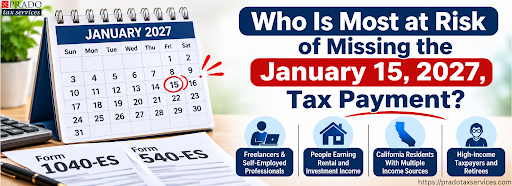
Not everyone needs to make estimated tax payments. However, certain taxpayers are more likely to overlook them because their income does not follow a regular salary-and-withholding pattern.
Freelancers and Self-Employed Professionals
Freelancers, consultants, independent contractors, and other self-employed professionals often receive payments without automatic income tax withholding.
For example, if a freelancer earns $5,000 per month initially but increases their earnings to $7,000 per month, their estimated tax payments may also need adjustment. Higher earnings can result in a larger tax obligation than originally expected.
People Earning Rental and Investment Income
Rental income, taxable dividends, interest, and capital gains can increase your overall tax liability.
For example, if you earn $65,000 from your job and receive another $18,000 in rental income, your regular paycheck withholding may not cover the additional tax on your rental earnings.
California Residents With Multiple Income Sources
Having more than one source of income can make tax planning harder. You might have a full-time job, a freelance side business, and rental income at the same time.
For example, if you earn $75,000 from your job, $15,000 from freelancing, and $10,000 from rental income, your employer’s withholding may not cover the tax on your additional earnings.
High-Income Taxpayers and Retirees
People with higher incomes may have to follow different estimated tax rules. Retirees can also face unexpected tax obligations when they receive taxable retirement distributions or investment income without sufficient withholding.
For example, a retiree receiving $48,000 in annual pension income and an additional $30,000 taxable retirement distribution may owe more tax if insufficient amounts are withheld.
How Much Estimated Tax Should You Pay to Avoid IRS and California Penalties?
The amount you need to pay depends on your expected tax liability, previous year’s tax, income, withholding, and other credits. The IRS and California FTB have their own rules for determining whether you have paid enough.
Understanding the Federal 90% and 100% Tax Rules
In general, you may avoid a federal estimated tax underpayment penalty if your total payments through withholding and estimated tax meet the smaller of:
- 90% of the tax shown on your 2026 federal return.
- 100% of the tax shown on your 2025 federal return.
Some higher-income taxpayers must use 110% of their previous year’s tax instead of 100%. This generally applies when the previous year’s adjusted gross income was more than $150,000, or $75,000 for married taxpayers filing separately.
There is also a general exception if you owe less than $1,000 after subtracting withholding and refundable credits, subject to the IRS rules.
These figures are not a substitute for calculating your actual required installments. Your payment dates and income pattern can also affect whether a penalty applies.
Understanding California’s Estimated Tax Payment Requirements
California generally requires taxpayers to pay the smaller of 90% of their current-year tax or 100% of their previous-year tax. The previous-year percentage increases to 110% for certain higher-income taxpayers.
California also follows a different estimated payment schedule from the federal system. For the 2026 tax year, the required installments are:
| California installment | Percentage of required annual payment | Due date |
| First payment | 30% | April 15, 2026 |
| Second payment | 40% | June 15, 2026 |
| Third payment | 0% | September 15, 2026 |
| Fourth payment | 30% | January 15, 2027 |
This schedule is important because California does not divide estimated payments equally across all four dates. Paying the wrong amount at the wrong time could still lead to an underpayment penalty.
Why Your Previous Year’s Tax Return Can Help
Your previous tax return can be a useful starting point when calculating your estimated payments. It gives you a record of your income, deductions, credits, and total tax liability.
Before making another payment, review:
- Your previous year’s federal and California tax liability.
- Your expected income for the 2026 tax year.
- Federal and state taxes already withheld.
- Estimated payments you have already made.
- Any credits or deductions that may change your final tax bill.
Your previous return does not tell the whole story, especially if your income has changed significantly. Still, it can help you understand whether you are on track or need to adjust your payments.
What If You Cannot Pay Your Full Estimated Taxes by January 15?
If you are short on cash, ignoring the deadline is unlikely to make the problem easier. There are a few steps you can consider to manage the situation and reduce the possibility of additional costs.
Can You Make a Partial Estimated Tax Payment?
Yes. If you cannot pay the full amount, making a partial payment may reduce the unpaid balance and the potential penalty.
However, a partial payment does not automatically eliminate an underpayment penalty. You may still owe a penalty on the amount that remains unpaid.
Review your available funds and calculate what you can reasonably pay. It is also worth checking whether your withholding or previous estimated payments have already covered part of your required amount.
Can You Pay Your Federal and California Taxes Online?
Both the IRS and California FTB offer online payment options. Using the official payment services can make it easier to submit payments and keep a record of the transaction.
- IRS Direct Pay: Use IRS Direct Pay to make an estimated federal tax payment directly from your bank account.
- IRS Online Account: Through your IRS Online Account, you can review tax information and manage eligible payments.
- California FTB Web Pay: Use FTB Web Pay to submit a California estimated tax payment from your bank account.
Before submitting a payment, make sure you select the correct tax year and payment type. Save the confirmation number or receipt so you can verify the payment later.
Can You Correct an Earlier Estimated Tax Underpayment?
Possibly. If your income was uneven throughout 2026, you may be able to use the annualized income installment method when calculating whether you underpaid.
For example, perhaps you earned most of your freelance income during the final months of the year. Your estimated payments may not have matched the timing of your actual income. The annualized income method can help account for uneven earnings when determining the required installments.
You should also review your payment records and withholding information. A mistake in how payments were recorded could affect your calculation.
Does Filing Your Tax Return Early Help You Avoid the January Payment?
In some situations, yes. Both federal and California tax rules provide an option that may allow eligible taxpayers to file their annual return and pay the full balance instead of making the fourth estimated installment.
However, the rules are different, and filing early does not automatically remove penalties for earlier underpayments.
The Federal Early-Filing Exception
Under the IRS rules for the 2026 tax year, you generally do not need to make the January 15, 2027, estimated tax payment if you:
- File your 2026 federal income tax return by February 1, 2027.
- Pay the full balance due with your return.
This can replace the fourth installment. However, it does not automatically remove penalties for missing or underpaying earlier installments.
California’s Early-Filing Rule
California has a separate rule. According to the 2026 Form 540-ES instructions, you generally do not need to make the fourth estimated payment if you file your 2026 California tax return by January 31, 2027, and pay the entire balance due.
Because January 31, 2027, falls on a Sunday, check the FTB’s official instructions for how the filing and payment date is treated before relying on this option.
As with the federal rule, this exception concerns the fourth installment. It does not automatically remove penalties for earlier underpayments.
What Should You Do Before the January 2027 Estimated Tax Deadline?
A little preparation can help you avoid last-minute confusion. Before January 15, 2027, review your tax records and make sure you understand what you still owe.
Use this checklist:
- Review your total income earned during 2026.
- Check your federal and California tax withholding.
- Review your 2025 federal and California tax returns.
- Calculate your expected 2026 tax liability.
- Check all estimated tax payments already made.
- Confirm whether you need to make the fourth installment.
- Review whether you qualify for an early-filing exception.
- Submit any required federal and California payments.
- Save payment confirmations and receipts for your records.
Do not assume that paying your federal tax balance means your California tax obligation is also covered. Check both separately.
Can Professional Personal Tax Preparation Help You Avoid Costly Tax Mistakes?
Estimated tax payments can become confusing when you have multiple income sources, changing earnings, or separate federal and California obligations. Even a small calculation mistake can affect whether you have paid enough by the required dates.
Professional tax preparation can help you review your income, withholding, estimated payments, deductions, and credits. It can also help you understand whether an exception applies and whether your payment records are complete.
If you are unsure how much to pay or whether you have missed an installment, getting your tax records reviewed before filing can help you make more informed decisions.
For support with your federal and California tax responsibilities, explore personal tax preparation services from reputed professional tax preparers like Prado Tax Services in San Leandro, CA. Getting professional guidance can help you understand your tax position and prepare for upcoming deadlines with greater confidence.
Final Thoughts: Don’t Let One Missed January Payment Create a Bigger Tax Bill
January 15, 2027, may look like just another date on the calendar, but it can be an important deadline for California taxpayers who need to make estimated tax payments.
Form 1040-ES covers federal estimated taxes, while Form 540-ES applies to California estimated taxes. Missing a required installment could lead to separate penalties, depending on how much you paid and when you paid it.
Before the deadline, review your income, withholding, previous payments, and possible filing exceptions. If you are unsure about your estimated tax obligations, consider getting professional help rather than waiting until you file your annual return.