
MEDICATION SAFETY
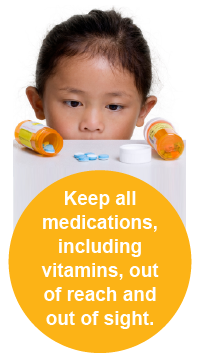 Children are curious by nature, and it makes sense that they would be even more curious when it comes to medication. Many medications look and taste like candy. While it’s important to encourage our kids to explore and discover new things, when it comes to medication, we want to be careful to keep them safe. Here are a few tips to show you how.
Hard Facts about Medication Safety
Medications are the leading cause of child poisoning. In 2013, over 59,000 children were seen in emergency room for medicine poisoning. That’s one child every nine minutes. Almost all of these visits are because the child got into medicines during a moment alone.
Top Tips about Medication Safety
- Put all medicine up and away, out of children’s reach and sight. In 86% of emergency department visits for medicine poisoning, the child got into medicine belonging to a parent or grandparent.
- Consider places where kids get into medicine. Kids get into medication in all sorts of places, like in purses and nightstands. Place purses and bags in high locations, and avoid leaving medicine on a nightstand or dresser. In 2 out of 3 emergency room visits for medicine poisoning, the medicine was left within reach of a child.
- Consider products you might not think about as medicine. Health products such as vitamins, diaper rash creams, eye drops and even hand sanitizer can be harmful if kids get into them. Store these items up, away and out of sight, just as you would traditional medicine.
- Only use the dosing device that comes with the medicine. Kitchen spoons aren’t all the same, and a teaspoon or tablespoon used for cooking won’t measure the same amount of medicine as a dosing device.
- Write clear instructions for caregivers about your child’s medicine. When other caregivers are giving your child medicine, they need to know what medicine to give, how much to give and when to give it. Using a medicine schedule can help with communication between caregivers.
- Save the Poison Help number in your phone: 1-800-222-1222. Save the toll-free number for the Poison Control Center into your home and cell phones. You can also p the number on your refrigerator or another place in your home where babysitters and caregivers can see it. And remember, the Poison Help line is not just for emergencies, you can call with questions about how to take or give medicine.
Learn More
Medication safety is especially important for children under 5, but every parent will want to learn all they can about medication safety. Here are more medicine safety tips.
THIS MESSAGE IS FROM https://www.safekids.org/medicinesafety





As published in the Times, March 16th: “Sir, Further to your report (“Poison Exposure Leaves Almost 40 Needing Treatment”, Mar 14), may I clarify that no patients have experienced symptoms of nerve-agent poisoning in Salisbury and there have only ever been three patients with significant poisoning. Several people have attended the emergency department concerned that they may have been exposed. None had symptoms of poisoning and none has needed treatment. Any blood tests performed have shown no abnormality. No member of the public has been contaminated by the agent involved. STEPHEN DAVIES, Consultant in Emergency Medicine, Salisbury NHS Foundation Trust” Wonder what Mr. Davies means by ” may I clarify that no patients have experienced symptoms of nerve-agent poisoning in Salisbury Are you up for contacting Mr. Davies, to cast some light on the matter, SB?