
Auditory Processing Disorder (APD) Awareness Day is April 4
Does your child have difficulty paying attention in the classroom or following directions? About 43 percent of children struggling in school have an underlying auditory processing disorder (APD). April 4 is APD Awareness Day, and Alicia Swann at Auditory Processing Center in Clinton is educating families about APD and treating those with this often hidden disability.
About APD
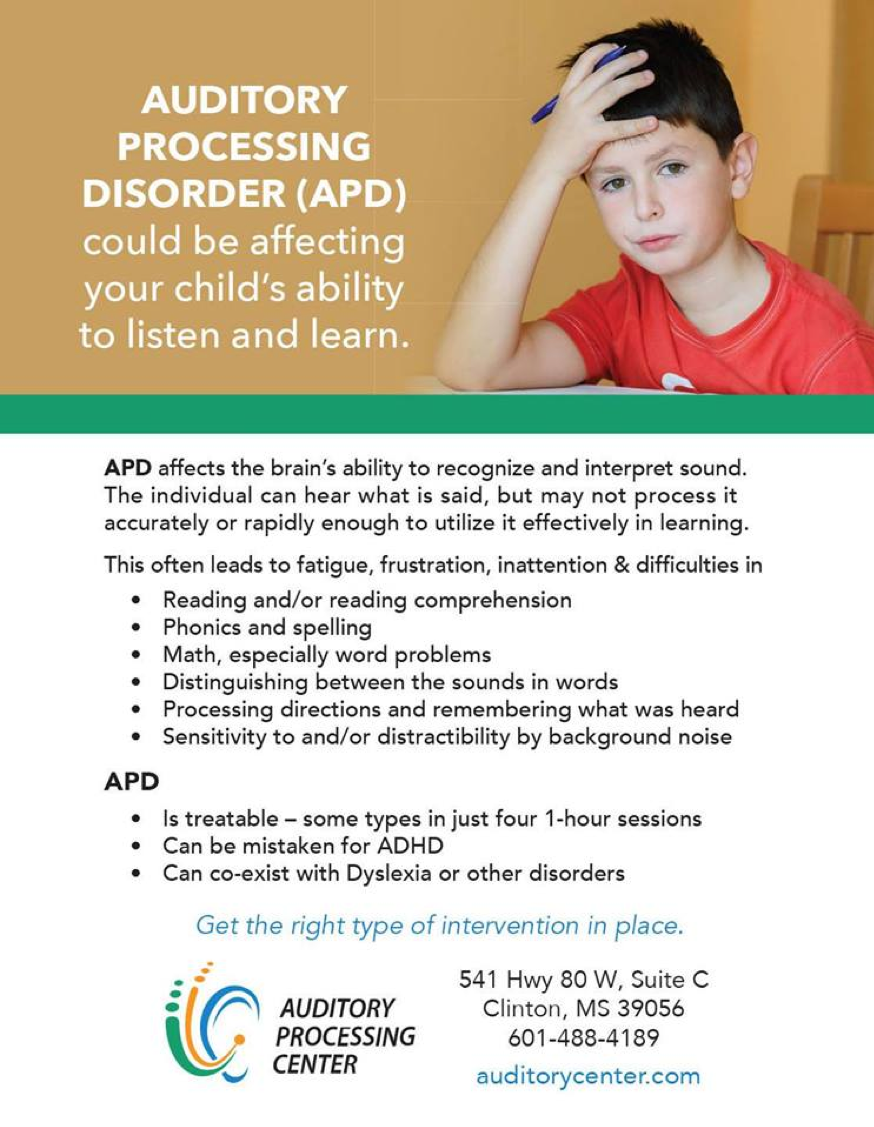
An auditory processing disorder is an auditory deficit that can interfere with a child’s ability to learn, concentrate, and interact with others. Those with APD appear to have normal hearing when assessed using a standard hearing test because their peripheral hearing is not the issue. Their brain has trouble processing the information it hears, which leads to difficulties in recognizing and interpreting sounds.
Since symptoms often overlap with other diagnoses, such as ADHD and other learning or language disorders, APD is often overlooked.
“Research indicates that 70 percent of children with dyslexia have an underlying auditory processing disorder that has disrupted the normal acquisition of language,” says Swann. “Overlooking an auditory processing disorder can lead to years of extra reading instruction that does not deal with the underlying problem.”
No two people with APD are alike, and symptoms will vary from child to child. However, common symptoms of APD often include:
- Frequently asking “huh?” or “what?” and needing information repeated
- Trouble understanding in noisy environments
- Difficulty following multi-step directions
- Poor spelling skills
- Poor reading fluency and comprehension
- Poor memory for list of words or numbers
- Difficulty with complex language, such as word problems
- Easily distracted or bored when conversations or activities do not include visuals
- Misinterpretation of questions
- Slow or delayed responses to verbal instructions
- Become frustrated with certain tasks (i.e. saying “I don’t understand,” “I can’t do this,” or “I don’t know what you mean”)
For a full list of common APD symptoms, go auditorycenter.com.
About Auditory Processing Center
Only an audiologist specializing in assessment of the central auditory nervous system can diagnose APD. Auditory Processing Center in Clinton specializes in assessment and treatment of auditory processing disorder in both children and adults and is the only one of its kind in Mississippi. Swann encourages parents concerned about their child’s communication development, or anyone experiencing communication difficulties themselves, to seek help.
Testimonials
After Mary, age 9, received treatment for APD, her mother says, “She is doing much better socially. Her anxiety is down. She’s having a much easier time reading facial expressions. She can focus on class better and hear the teacher. She’s not coming home with headaches, like before. She’s much more comfortable asking questions in class and talking to the teacher when she has questions. She’s got a lot more confidence.”
“His anxiety is much better, and he doesn’t get as frustrated,” says the mother of Hayes, age 8. “He is doing fantastic, and I am very pleased with his progress.”
The mother of Chloe, age 10, says, “Chloe is doing much better at school. She reports she is getting more words correct when she reads and she reads more smoothly and catches herself when she makes mistakes.”
Contact
For more information about APD and to schedule an evaluation, please contact
Alicia Swann, Educational Audiologist
Auditory Processing Center
541 Hwy 80 West, Suite C
Clinton, MS 39056
Phone (601) 488-4189


My son was diagnosed in 4th grade. He has had an IEP since then. I feel like none of us really understands his condition. He will be a senior next year. Is there really a treatment for him? We live in VA. When I spoke with an audiologist they said it’s best just to try the different accommodations to see what works and testing wouldn’t really help much.
Auditory processing disorder is treatable. There are different types of auditory processing disorders, so treatment must be customized. It is important to have a full auditory processing evaluation so that your child can receive deficit specific therapy.
I didn’t know that April 4th was Auditory Processing Disorder (APD) Awareness Day. It was pretty interesting thing is today I was have very scientific discussions with my doctor this afternoon about my APD.