Real Mississippi Summer Heat Tips You Won’t Find in a Safety Pamphlet

Key Takeaways
- In the Jackson area, 90°F heat is part of a long warm season: National Weather Service Jackson climate records put the average first 90°F day at May 13 and the average last at October 3.
- The most useful local adjustment is often a schedule change. Errands and outdoor chores are easier to place in the morning or evening when the day’s forecast allows.
- High humidity slows evaporation, so sweaty clothes can stay damp longer and may need attention sooner than they do in drier weather.
- Outdoor practices and community events often work better near the edges of the day, but exact schedules depend on organizers and current heat conditions.
- For repeatedly worn work shirts and athletic tops, quick-drying construction or odor-control treatments can be practical features, but they do not replace normal laundering.
Mississippi heat does not wait for July to feel serious. National Weather Service Jackson climate records put the average first 90°F day at May 13 and the average last at October 3. That long warm season helps explain why daily routines often start shifting before midsummer: errands move earlier when schedules allow, outdoor social time becomes more appealing after sunset, and damp work clothes get dealt with sooner. These are not secret safety hacks. They are small scheduling and household adjustments that become easier to notice once the heat and humidity settle into central Mississippi.
| Daily Routine | Cooler-Weather Habit | Common Summer Adjustment |
|---|---|---|
| Grocery/errands | Fit them in when convenient | Go earlier or later when possible |
| Porch time | Flexible | More appealing after sunset |
| Laundry | Damp clothes can wait longer | Deal with sweaty items sooner |
| Ball practice | Afternoon can be workable | Morning or evening becomes preferable |
| Community events | Outdoor timing is more flexible | Shade, indoor space, or later starts matter more |
The pattern across all five categories is the same: nothing about daily life in a Mississippi town actually stops for summer — it just moves to the edges of the day.
Mississippi Summer Heat Tips Start With What Time You Leave the House
The comparison above says it plainly: summer planning in central Mississippi is often about the clock as much as the thermostat. With 90°F weather commonly extending well beyond July in the Jackson area, optional errands, market visits, and yard work are easier to place in the morning or evening when schedules allow. The exact window changes with the day’s forecast; seven o’clock is not a magic cutoff, and the heat index does not drop by a fixed number simply because the sun is lower. The practical habit is to check conditions and avoid building nonessential outdoor tasks around the hottest part of the afternoon. In a small town, that shift becomes visible quickly as more routine activity moves toward the edges of the day.
Front Porches Come Back to Life After Dark
One of the easiest places to notice the schedule shift is outside the house after sunset. A porch that feels stagnant in mid-afternoon may become more inviting later, so casual conversations and a few minutes outdoors naturally drift toward evening. The point is not that every porch follows the same calendar from June to October. It is that heat changes when shared outdoor spaces feel usable, and the social rhythm of a neighborhood can move with it.
Damp Clothes Need Attention Sooner
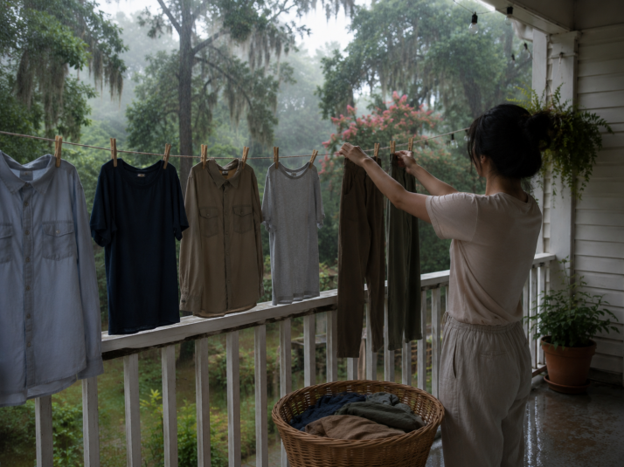
Humidity changes laundry less by a universal number of weekly loads than by how quickly damp clothing needs attention. High humidity slows evaporation, so a sweat-soaked shirt, uniform, or gym top can stay damp longer. Instead of letting those pieces sit balled up in a hamper, many households deal with them sooner, separate heavily worn clothes from lighter items, or use ventilation and indoor drying when outdoor air is too muggy.
For home sewists replacing summer basics that are washed again and again, choosing fabric by the yard can make it easier to match weight and fiber content to the garment being remade. The useful question is not whether summer automatically doubles the laundry. The clothes are repeatedly getting sweaty, washed, and put back into rotation.
Ballfield Practices Slide Toward Twilight
Outdoor practice schedules are one of the clearest places where heat changes the day. A late-afternoon slot that felt manageable in spring can be harder to tolerate in midsummer, so morning or evening times become more attractive when league schedules allow. The exact decision belongs to coaches and organizers and should reflect current heat conditions rather than a fixed July timetable. The broader pattern is simple: when an activity can move away from the hottest part of the day, the schedule often becomes part of the heat plan.
Community Events Often Favor Morning or Evening
The pattern also shows up in Mississippi event calendars. The Clinton Courier’s own archives include summer activities scheduled at the edges of the day, from a 6 a.m. hot-air-balloon competition flight and 6–9 p.m. evening gatherings to a Mississippi Farmers Market event opening at 8 a.m. These examples do not prove that every organizer follows one rule, but they show why morning and evening slots are familiar choices in summer. Shade, indoor space, and start time become practical parts of event planning rather than afterthoughts.
Workwear Gets a Quiet Upgrade
For people who repeatedly soak the same work shirts or athletic tops in summer, fabric performance becomes more noticeable. Some garments use odor-resistant treated fabric marketed to help control odors caused by microbial growth on the textile, while others rely on lighter or faster-drying constructions. Those features may help protect the garment from odor buildup, but they do not turn a sweaty shirt into a second-day garment or replace normal laundering. The practical upgrade is choosing a few pieces that dry more readily and hold up to frequent washing.
The Real Mississippi Summer Heat Tips Are the Ones Nobody Announces
None of this shows up on a single official list of summer tips, and that is exactly the point. A Mississippi town does not respond to heat with one dramatic lifestyle change. The response is usually a string of smaller adjustments: optional errands move away from the hottest hours, outdoor social time shifts later, damp clothes get handled sooner, and event or practice schedules make more room for morning and evening. The pattern is worth noticing because it turns a broad warning about “summer heat” into a set of decisions people make around an ordinary day.
Frequently Asked Questions
How hot does it typically get in Mississippi during the summer?
In central Mississippi, 90°F heat can span a long part of the calendar. National Weather Service Jackson records list May 13 as the average first 90°F day and October 3 as the average last. Summer conditions vary from day to day, so current forecasts matter more than assuming every June, July, or August afternoon will be the same.
When does the humid part of summer usually start in Mississippi?
Mississippi’s warm-season humidity is tied to moist air moving north from the Gulf of Mexico. The exact dew point varies by day and location, so late May and September should not be treated as fixed statewide boundaries. As a general comfort guide, the National Weather Service describes dew points at or above 65°F as increasingly oppressive.
Why does Mississippi heat feel worse than the actual temperature?
High humidity slows the evaporation of sweat, reducing one of the body’s main cooling mechanisms. That is why the heat index combines air temperature and relative humidity: the same thermometer reading can feel much hotter when the moisture in the air is high.
Do these routine changes apply to visitors, not just longtime residents?
Visitors can use the same scheduling logic, but they should check the current forecast and heat index rather than simply copy a local routine. Morning or evening may be easier for optional outdoor plans, while the day’s actual conditions should guide the decision.