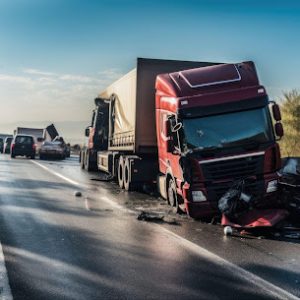
When the Trailer Stops Following and Starts Taking Over
A tractor-trailer is designed to move as one connected unit, with the trailer following the path of the cab. But under certain conditions, that relationship can suddenly break down. The trailer begins swinging sideways while the tractor continues moving forward, creating the familiar folded shape known as a jackknife.
What makes this especially dangerous is how quickly it can happen. A truck traveling normally can suddenly become a barrier stretching across multiple lanes, leaving nearby drivers with almost nowhere to go.
This loss of control is what makes jackknife accidents particularly dangerous on highways and other high-speed roads. Once the trailer begins swinging outward, the truck can occupy dramatically more roadway than surrounding drivers expect, turning a problem involving one vehicle into a threat to everyone nearby.
What Makes the Trailer Swing
A tractor and trailer are connected, but they don’t respond to movement exactly like one solid vehicle. During hard braking, the tractor begins slowing while the trailer’s momentum continues pushing forward. If traction is lost or braking forces become unbalanced, the trailer can start moving sideways instead of continuing directly behind the cab.
Speed can make the situation more difficult to control because the truck carries greater momentum. Traction is another major factor. Tires need sufficient contact with the roadway to keep both parts of the truck moving in the intended direction. When that grip disappears, controlling the relationship between tractor and trailer becomes much harder.
Braking technique and equipment condition can also influence what happens.
Once the trailer begins rotating toward the tractor, the driver may have very little time to recover. What was previously a long but relatively narrow vehicle can suddenly begin sweeping across a much wider section of roadway.
Weather and Cargo Can Add to the Risk
Road conditions can dramatically change how a tractor-trailer responds during braking or steering. Rain reduces traction. Snow and ice can make maintaining control even more difficult, particularly when a driver brakes suddenly or enters a curve too quickly for conditions.
Cargo introduces another variable. A properly loaded trailer should have its weight distributed and secured appropriately. If cargo shifts unexpectedly, the balance of the trailer can change while the truck is moving.
Weight distribution can affect handling even when the cargo remains secured. Different loads can change how a truck responds during braking, cornering, and emergency maneuvers.
Equipment condition matters as well. Tires, brakes, suspension components, and other systems all contribute to keeping the truck stable. None of these factors necessarily causes a jackknife by itself. Problems can develop when several conditions combine.
Speed that might be manageable on a dry roadway, for example, may become dangerous when traction is reduced and a heavily loaded trailer suddenly needs to stop.
Nearby Drivers May Have Almost No Escape Route
A jackknifing truck doesn’t simply stop moving forward. The trailer can swing sideways through neighboring lanes while the entire vehicle is still carrying substantial momentum. That creates an unusually large hazard.
A passenger vehicle traveling beside the trailer may suddenly find its lane disappearing. Drivers behind the truck may face what looks like a wall forming across the highway. Attempting to avoid the trailer can create additional crashes. A driver may brake hard and be struck from behind, swerve into another lane, or lose control while trying to escape.
Motorcyclists can be especially vulnerable because they have little physical protection if struck by the truck, trailer, or another vehicle reacting to the emergency. Secondary collisions can involve motorists who were nowhere near whatever initially caused the truck to lose control.
This is what makes jackknifing different from many ordinary single-vehicle incidents. One truck can suddenly create a moving obstacle spanning several lanes and affecting traffic in multiple directions.
Finding the Cause Means Looking at the Whole Truck
After a jackknife crash, investigators may need to look much further than the driver’s actions immediately before the trailer swung outward. Brake condition can be important. Investigators may examine whether braking systems were properly maintained and functioning as expected.
Tires can provide clues about traction, wear, and equipment condition. Cargo records may help establish what the trailer was carrying, how much it weighed, and how the load was distributed or secured.
Electronic vehicle information may provide additional evidence about speed, braking, or other activity around the time of the collision. Maintenance and inspection records can show whether mechanical problems had previously been identified.
Investigators may also examine weather, roadway conditions, driver experience, hours behind the wheel, and decisions made before the emergency developed.
The goal is to understand why the tractor and trailer stopped moving together as intended. Sometimes that requires reconstructing the condition and operation of the entire commercial vehicle.
Conclusion
A jackknife can transform a tractor-trailer in seconds. Instead of a trailer following neatly behind the cab, it begins rotating sideways, potentially sweeping across neighboring lanes and leaving nearby motorists with very little time to react.
The cause isn’t always one simple mistake. Speed, hard braking, reduced traction, weather, cargo distribution, mechanical condition, and driver decisions can all become relevant depending on the circumstances.
That’s why investigating these crashes often involves much more than looking at where the truck finally stopped. Maintenance records, brake and tire condition, cargo documentation, electronic data, roadway evidence, and driver actions can help explain how control was lost.
The danger comes from the enormous amount of roadway a swinging trailer can suddenly occupy. One moment, drivers are traveling beside an ordinary truck. Seconds later, that same truck can become a road-wide obstacle that leaves almost nowhere to escape.