How Humidity and Temperature Influence Blister Packaging Performance
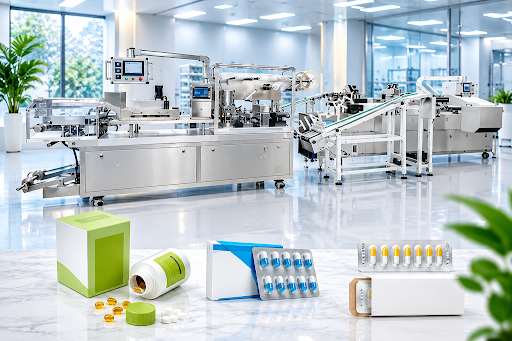
Blister packs look simple, but their performance depends on conditions that are easy to overlook. A tablet that leaves the line in perfect condition can still lose potency, soften, or discolor if the pack lets moisture in or if the sealing process drifts with the weather. Ambient humidity and temperature affect forming, sealing, storage and distribution, and the effects often show up months later as stability failures. This article explains where these influences matter most and what packaging teams can do about them.
Where Environmental Conditions Enter the Process
Environmental conditions act on a blister pack at three stages: during production, during storage in the warehouse, and during transport and use. Each stage has its own risks, so a pack that performs well in one climate may fail in another.
Production Floor Conditions
A blister packaging machine forms a cavity in a plastic web, fills it, and seals a lidding foil over it. Each step is sensitive to the room. Hygroscopic products can absorb moisture during the few seconds the cavity is open, so many facilities hold filling areas at controlled relative humidity, often in the range of 30 to 45 percent for moisture sensitive products.
Forming films such as PVC, PVDC coated laminates and cold form aluminum respond differently to temperature. Thermoformed films need consistent heating to stretch evenly, while cold form foil depends on the ductility of the aluminum at room temperature. If the plant is warmer than expected, films can thin unevenly at the cavity corners, which weakens the barrier exactly where it matters.
Sealing Temperature and Dwell Time
Heat sealing is a balance of temperature, pressure and dwell time. Too little heat leaves weak seals that can open under stress or allow moisture channels. Too much heat can distort the film, damage the printed lidding, or degrade a heat sensitive tablet inside.
Cold dry winter air and hot humid summer air can change how films behave on the line, which is why many teams recheck seal strength when seasons change rather than assuming a validated setting holds all year.
Moisture Barrier Performance of Packaging Materials
Different materials offer very different protection. Standard PVC has a relatively high water vapor transmission rate, PVDC coating reduces it, and aclar type fluoropolymer laminates reduce it further. Cold form aluminum is effectively a complete barrier, apart from the seal area and any pinholes.
The water vapor transmission rate is normally measured under controlled conditions, commonly following methods such as ASTM F1249. The result depends on temperature and humidity, so a figure measured at mild conditions will understate what happens in a hot, humid market. Moisture ingress is also cumulative. A pack that gains a small amount of water each week can cross the product limit well before the labeled shelf life ends.
Climatic Zones and Stability Requirements
Regulatory guidance gives a practical framework for deciding how much protection is enough. ICH Q1A(R2) defines climatic zones and the long term storage conditions used in stability studies. Zone II is commonly tested at 25 °C and 60 percent relative humidity, while Zone IVb, which covers hot and very humid regions, is tested at 30 °C and 75 percent relative humidity. A product intended for several markets often has to be justified against the harshest zone it will reach.
For the packaging itself, USP chapter 671 describes how to evaluate the moisture permeation of containers and classify them as tight or well closed. Teams can use this kind of testing to compare candidate packs rather than relying on material data sheets alone.
Practical Decision Factors
The right design depends on how sensitive the product is and where it will travel. These factors help structure the decision.
Product Sensitivity
Effervescent tablets, orally disintegrating tablets and many gelatin capsules are highly moisture sensitive and usually justify aluminum on both sides of the cavity. Robust film coated tablets may perform acceptably in PVC or PVDC with a foil lid.
Target Market and Distribution Chain
A pack shipped to a hot, humid region, then held in an unconditioned warehouse before reaching the pharmacy, faces conditions far harsher than a controlled stability chamber. Consider the worst realistic exposure, not the average.
Pack Format
Smaller cavities have less headspace but a higher ratio of film surface to product. Deep draw cavities thin the film more, which can reduce barrier performance. Wallet or carton secondary packaging adds some protection but should not be counted on as the primary barrier.
Example
Consider a team moving a moisture sensitive tablet from a temperate market to a Zone IVb market. Stability data at 30 °C and 75 percent relative humidity shows impurity growth in PVC based blisters after six months. Switching to a PVDC laminate improves the result slightly, but only cold-form aluminum keeps the product within specification through the full shelf life. The extra material cost is far smaller than the cost of a recall or a shortened expiry.
Monitoring and Control on the Line
Good design must be backed by routine checks. Useful practices include:
- Logging temperature and humidity in filling and sealing areas and linking the readings to batch records.
- Running seal integrity tests, such as vacuum leak or dye ingress methods, at defined intervals.
- Checking incoming film for thickness and barrier consistency, since batch to batch variation affects results.
- Storing films and foils in conditions that prevent moisture uptake or curling before use.
- Reviewing seasonal trends in reject rates, which often reveal environmental sensitivity before a stability failure does.
Conclusion
Humidity and temperature influence nearly every stage of blister production, from film forming and sealing to long term storage in the market. Teams that understand climatic zone requirements, compare materials using permeation data, and monitor the production environment are better placed to protect product quality. When specifying or qualifying a blister packaging machine, it is worth confirming that its heating, sealing and humidity handling can hold validated settings across seasonal variation, because the equipment, the film and the climate work together to determine whether the pack protects the medicine until the last tablet is used.
Read more: What Are the Latest Innovations in Packaging to Boost Medication Adherence: Improving Patient Compliance
Read more: Key Factors to Consider When Choosing a Medical Freight Provider
Read more: How Does a Private Label Chemical Manufacturer Help Brands?