7 Checks Before Your School Replaces Its Playground Equipment
The slide has a crack that’s been taped twice. The swings were taken down two summers ago, and the climbing frame is older than most of the teachers. At the last parent meeting, somebody finally said it: the playground needs replacing.
That’s the easy decision. The harder ones come next, and a committee that skips them can end up with equipment that doesn’t fit the space, the pupils or the budget. Work through these seven checks before anyone asks for a quote.
Check #1 – Who Will Use It
Age groups come first, because equipment built for one age is the wrong size for another. A structure sized for ten-year-olds has steps, gaps and heights that don’t suit a five-year-old.
Write down who uses the playground and when:
- The grades that share it at recess
- How many children are out at once
- Any preschool or after-school groups
- Community use in the evenings and on weekends
If the youngest and oldest pupils play together, plan separate areas for each. Ask teachers what they see at recess: where the lines form, what sits unused and where the arguments start. Ask the children too. They’ll tell you things no adult has noticed.
Check #2 – The Space You Have
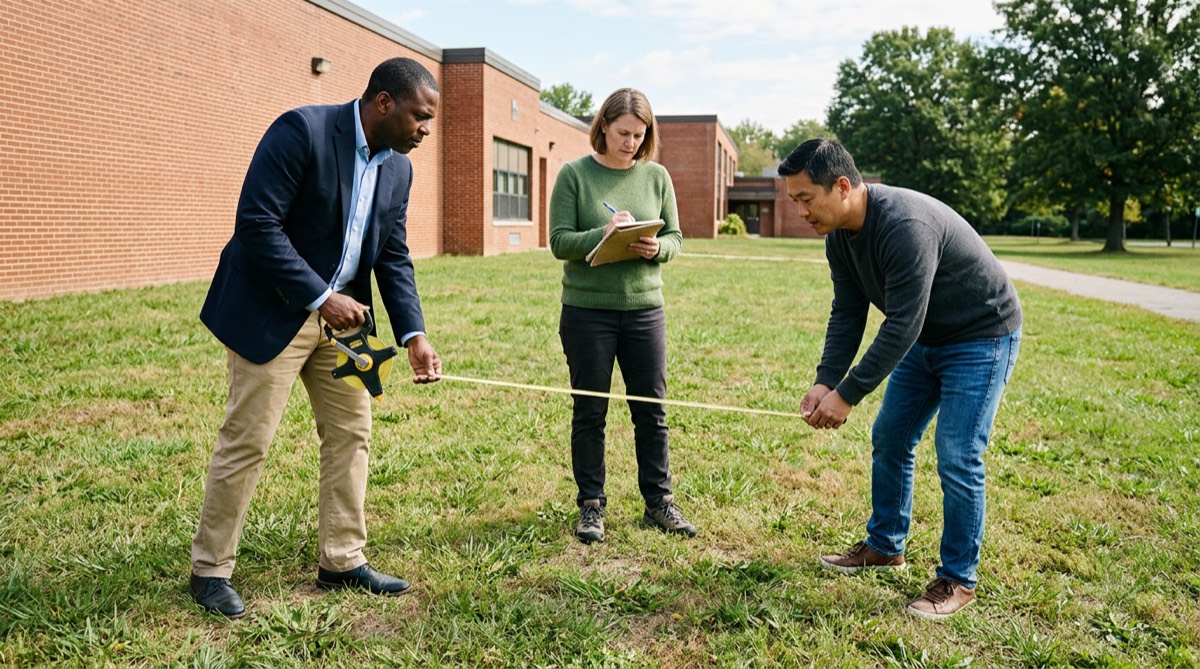
Measure the site before you look at equipment, because the space each piece needs is larger than the piece itself. Every structure has a safety zone around it that has to stay clear.
The Consumer Product Safety Commission’s checklist says protective surfacing should extend at least 6 feet in all directions from play equipment. Swings need more. Add that to the footprint of each item when you sketch the layout.
Mark what can’t move: trees, drains, fences, fire lanes and the route the mowers take. Note the slope and where water sits after rain. Then mark where the adults on duty stand, and check they’ll be able to see every part of the new layout.
Check #3 – Accessibility
Accessibility has to be part of the plan from the first sketch. Adding it afterward costs more and works less well.
Start with the route. The U.S. Access Board defines an accessible route as a continuous unobstructed path connecting all accessible elements and spaces of a building or facility. A child who uses a wheelchair or walker needs to get from the school door to the play area, and then onto and around the equipment.
Ask your district which accessibility standards apply and who signs off on them. Then look at what children can do once they arrive. Ground-level activities, ramps, transfer platforms and surfacing that wheels can cross all matter. Invite families of children with disabilities to review the plan before it’s final.

Check #4 – Equipment That Suits Your Pupils
Choose equipment by what your pupils will do on it, not by how it looks in a photograph. A good playground offers several kinds of play: climbing, sliding, swinging, balancing, and somewhere quieter to sit or pretend.
Commercial equipment is built and rated for public use, which is different from a backyard set. Catalogs help you narrow the field: listings for commercial school playground equipment at WillyGoat, for instance, can be filtered by age range, size and capacity. Use filters like those to rule out anything that doesn’t suit your pupils or your space before you request quotes.
Ask every supplier the same questions. What age range is it designed for? How many children can use it at once? What is the maximum fall height, and what surfacing does that require? What does the warranty cover, and for how long?
Check #5 – Installation
Installation is a separate cost and a separate decision, so price it alongside the equipment. A structure delivered to the parking lot on a pallet isn’t a playground yet.
Find out who can install on school property. Some districts require licensed and insured contractors, and some don’t allow volunteer builds. Ask each bidder for these in writing:
- Removal and disposal of the old equipment
- Site preparation and drainage work
- Footings, assembly and surfacing
- An inspection when the work is finished
Schedule the work for a school break if you can. Ask how long the site will be fenced off and where pupils will play in the meantime.
Check #6 – Maintenance Costs
Maintenance is a yearly cost for as long as the playground stands, and it belongs in the plan from the start. A new playground needs regular care to stay safe.
Inspections
Decide who inspects the equipment and how often. Agree a schedule, for example a quick visual check each week and a thorough one each term. Keep a written log with dates and names.
Surfacing
Loose surfacing such as wood chips or rubber mulch gets kicked out from under swings and slides and has to be raked back and topped up. Ask the supplier how often, and add the cost to the budget.
Repairs
Ask which parts wear first and what replacements cost. Name the person responsible for repairs, and make sure they can order parts without waiting for a committee meeting.
Check #7 – The Full Budget and Timeline
Add up the whole project before you fundraise, because the equipment is often only part of the total. Removal, site work, surfacing, installation, shipping and the first years of maintenance all need a line.
Ask your district about its purchasing rules. Some require a set number of bids or approved vendors, and grants often come with their own conditions. Check lead times as well, since some equipment is made to order.
Build the timeline backward from the date you’d like children playing on it. Leave room for approvals, fundraising and weather.
| Top Tip: Before the old equipment comes out, photograph it and write down what the children liked and what stood empty. When the new playground has been open for a term, do the same again. That comparison tells the school whether the money did what it was meant to, and it gives the next committee a head start. |
Walk the Playground This Week
Visit at recess with a notebook and a tape measure. Count the children, note what they’re using and measure the space you have. Those three numbers are what every supplier will ask for first.
Frequently Asked Questions
How much space does school playground equipment need?
It needs its own footprint plus a clear safety zone around it. The Consumer Product Safety Commission’s checklist says protective surfacing should extend at least 6 feet in all directions from play equipment, and swings need more.
Who can install playground equipment at a school?
That depends on your district, so find out before you collect bids. Some districts require licensed and insured contractors, and some don’t allow volunteer builds.
What ongoing costs come with a new school playground?
Expect regular inspections, topping up loose surfacing and replacing parts that wear. Decide who is responsible for each, and add the yearly cost to the budget from the start.