
Types of Cold Working Processes
When people think of working with metal, the image that comes to mind is often that of a blacksmith in a forge. Metals are heated until they are glowing, and then sparks fly as they are hammered into place. Though heating metals until they are pliable is one of the more common ways of molding metal, it is possible to mold metal without the use of heat.
This method of metalworking, cold working, has a number of advantages, depending on how it is utilized. These are the advantages of a few types of cold working processes.
Shot Peening
Shot peening is a process unique to cold working. Peening involves striking a material several times to stretch its surface, increasing its strength and durability. Peening can be done with a number of tools, most traditionally with a small hammer made for the purpose. But shot peening utilizes abrasive “shot,” often small steel beads, fired at a surface at high speeds. It can be utilized by any metalworking operation, but especially in situations that prize durability and resisting metal fatigue, such as engine parts.
It should be noted that shot peening is often confused with shot blasting, a separate process that also requires using abrasive shot. Although both involve using similar equipment, their processes differ in several ways.
A manufacturer of casting molds, for example, may use shot blasting to clean the surface of a mold while shot peening can be used to increase its strength. Similarly, shot peening is also used in the aerospace industry to strengthen aircraft components and improve their fatigue life.
Waterjet Cutting
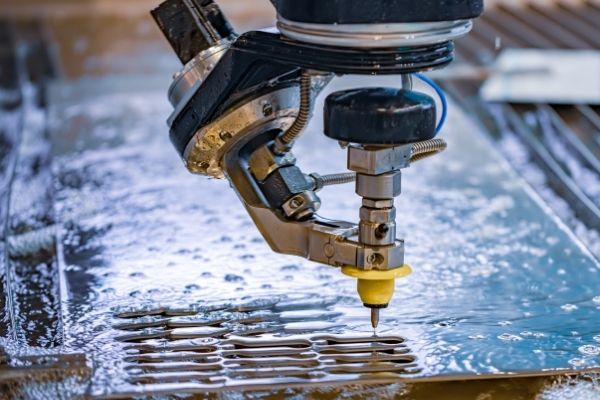
Those who forget how powerful water is need only look at the Grand Canyon for a reminder. If a river of water can cut through stone, why not through steel? By using high-powered pumps that shoot water mixed with abrasive, one can cut a variety of metals with great precision and without heat. This gives waterjet cutting a wide range of applications in the metalworking field, from aerospace to the military.
Waterjet cutting’s applications don’t end with metal, though. This process can be used on rubber, foam, cardboard, glass, marble, and even food. Often it is simply a matter of changing the abrasive in the water to change what material it is used on.
Cold Rolling
Of all the types of cold working processes, cold rolling is the most common. Simply put, cold rolling takes metal and puts it between two rollers in order to reduce the thickness or to make the thickness uniform across the entire piece of steel. This precisely cut steel can be used for a variety of purposes, including car exteriors, cabinets, garages, and furniture pieces.
Although steel can be rolled at low or high temperatures, cold-rolled steel is typically stronger than hot rolled. That’s because the temperature that hot-rolling steel requires can potentially damage it. Cold rolling also preserves the color of the steel, making it the better aesthetic choice for metal that will be seen.





Hey
Thank you for this amazing article! It has opened up my mind about the best tools improvement.
I have read your entire article. The tools you have discussed for tools improvement in this article are very important to us. As a carpenter I can say that this article is very useful for everyone.
Thank you very much.