Rezoning defeated, but development plans continue
By Randy Bell
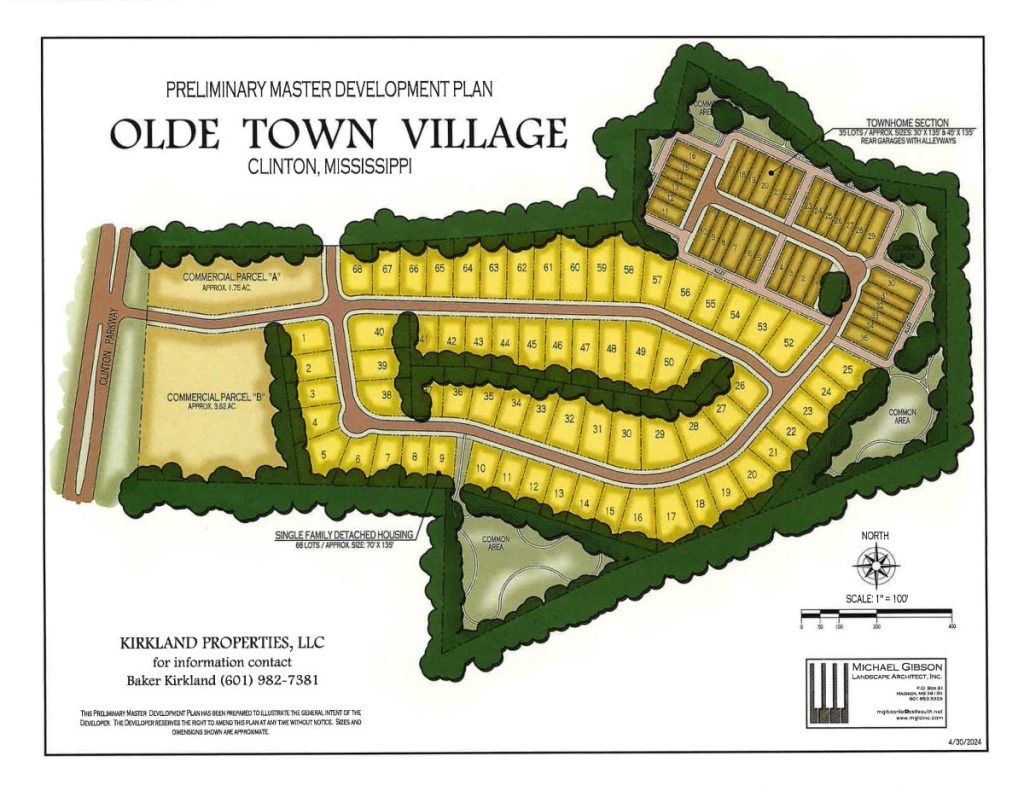
Shown is the plan for the property that required a rezoning. This plan included sixty-eight single-family homes and thirty-five townhomes, as well as commercial parcels fronting the Clinton Parkway and buffer zone areas to help protect the Clinton Community Nature Center. With the rezoning denied, development of the property will continue under its current R-1 zoning, which will include only single-family homes. The current zoning will eliminate the commercial parcels and the townhomes, and an attorney for the developer noted that it also eliminated the twenty-foot buffer zone that was included in the plan to help insulate the Clinton Community Nature Center.
Opponents of a real estate developer’s proposal to rezone forty-two acres of forested land near the Clinton Parkway were able to convince three members of the Board of Aldermen to vote against it – and that’s all they needed.
Because residents living near the proposed development submitted a petition to the City voicing their objections, a super majority of five votes was needed to approve the rezoning. The vote at the Board’s November 5 meeting was four-to-three in favor, with Karen Godfrey, Robert Chapman, Chip Wilbanks and James Lott voting “yes,” and Ricki Garrett, Jim Martin and Beverly Oliver voting “no.”
It means that Kirkland Properties won’t be allowed to build townhomes as part of the Olde Town Village development, and the land nearest the Parkway can’t be used for commercial lots.
But the company still plans to cut down trees and construct about one hundred houses on the property, which stretches to the east, bordering Brookdale Senior Living, the Quisenberry Library and the Clinton Community Nature Center.
David Ash, an attorney for the developers, told the Board that their request for the property to be rezoned for mixed use “makes the most sense,” but they’re now planning to move ahead with an alternative plan, which calls for approximately the same number of rooftops, all of them single-family homes.
The land is already zoned R-1 allowing for residential construction.
When word of the planned development first spread on social media earlier this year, it touched off a public outcry from local residents many of whom were hoping that defeating the rezoning proposal could preserve the property in its current state.
But with Kirkland intent on developing the land, some of the Board members insisted the goal of keeping the forest intact was out of reach.
At the November 5 meeting, Godfrey put it this way, “It’s going to be developed, one way or the other.”
According to Ash, the mixed-use plan would have offered some measure of protection for the Nature Center, and the vote against it will have the opposite effect.
“It removes the twenty-foot buffer zone, and it removes a lot of things that we were trying to do to help the Nature Center and surrounding areas,” he said after the meeting.
But Nature Center supporters aren’t giving up on a mutually agreeable solution.
In an emailed statement, Audrey Harrison, the president of the Nature Center board, wrote: “Basically, my feelings about the rezoning are that I still feel that, with all this good civic engagement, there is a way that we can come to a solution that is profitable for the Kirklands while leaving part or all of the forest preserved, eliminating the flooding concerns for Kentwood, Dunton and the Nature Center, all while ensuring that the community has access to nature.”
“I am a community volunteer,” Harrison continued. “I have nothing to gain from the development of the property. The Nature Center is a unique and remarkable part of our city and community. Our leadership should want to protect us from harm. I truly feel that, with continued communication and collaboration, we can all work together toward a solution that honors the past, present and future of the city.”
Kirkland had argued that the legal criteria for rezoning the property had been met, saying that commercial development along the Parkway has resulted in a change in the neighborhood and that there’s a public need for more homes in Clinton.
But Martin disagreed.
“There has not been a change in that area since that zoning map went into place,” he told his fellow Board members. “The fact that it’s always nice to have new houses built doesn’t necessarily mean that’s what we want or what the public need is in this area. There are plenty of places to build some new houses before you’d have to say, ‘Gee, this is the last place you’ve got. You’ve got to build houses here. There’s no place else to go in the city of Clinton.’ That’s just not true.”
The inclusion of townhouses in the mixed-use proposal was another point of contention.
“I think we’re taking a very unique property in a very prominent part of town to put up townhouses,” Martin said.
But Ash told the Board there’s a “massive demand” for that type of development and that there aren’t enough townhouses in the Jackson area to meet the demand.
Mayor Phil Fisher was disappointed that three Board members voted against the rezoning.
“I just think they missed a great opportunity, particularly for the commercial development portion of it,” said Fisher.
Now that Kirkland’s construction will be limited by R-1 zoning, the company is preparing for its next steps.
“We’re going to now go through the plat process and present a plat to the City to develop that whole area,” Ash said, suggesting the intent is to move rapidly. “Probably within the next month, maybe less. It depends on how quickly we can get the engineering done,” he said.
The City has promised to take a close look at that technical information to ensure that stormwater from the development doesn’t aggravate the existing threat of flooding in the Kentwood and Dunton neighborhoods. Some of the opponents of the project have mentioned a flooding impact as among their chief concerns.