Mississippi Records the Highest Fatal Rear-End Crash Rate, 132.99% Higher Than the National Average
Key Takeaways
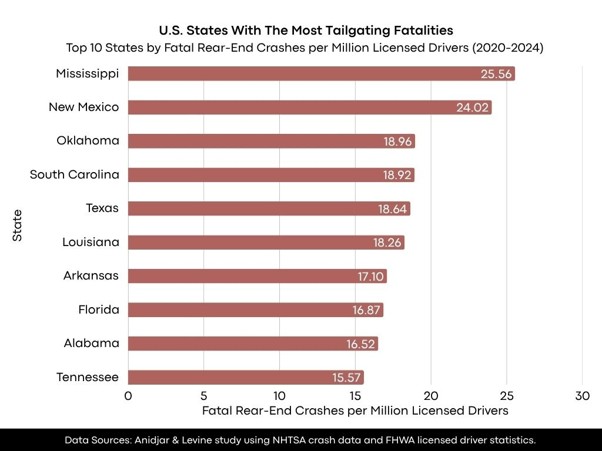
- Mississippi ranks #1 in the U.S. for fatal rear-end crashes, with 25.56 crashes per million licensed drivers. On average, the state records 52.4 fatal rear-end crashes annually, making it the most dangerous state for tailgating-related fatalities and a clear outlier at the top of the ranking.
- While Mississippi leads, it is closely followed by New Mexico (24.02) and Oklahoma (18.96). However, Mississippi still exceeds New Mexico’s rate. It stands significantly higher than Oklahoma, reinforcing its position as the most extreme risk environment for rear-end fatal crashes among the top three states.
- The disparity becomes even more striking when compared to the safest states. Mississippi’s rate is over 5.7x higher than New Hampshire (4.47) and more than 7.4x higher than Rhode Island (3.44), highlighting a dramatic difference in tailgating-related fatal crash exposure across the country.
Rear-end collisions are one of the most common yet preventable causes of fatal crashes on American roads, but in Mississippi, this risk reaches its highest level nationwide. Over the past five years, the state has recorded over 262 fatal rear-end crashes, averaging 52 deaths each year, which translates to 25.56 crashes per million licensed drivers, the highest rate in the country. This places Mississippi over 130% above the national average and several times higher than the safest states, highlighting a persistently high and disproportionate level of risk despite its relatively small driving population.
This study, conducted by Anidjar & Levine, analyzed fatal rear-end motor vehicle crash data across all 50 U.S. states using five years of data from 2020–2024. Average annual fatal crash counts were calculated by taking the mean of yearly totals, while average licensed driver populations were used to standardize results across states. Fatal rear-end crash rates were calculated as (average annual fatal crashes ÷ average licensed drivers) × 1,000,000 and rounded to two decimal places. States were ranked (1–50) based on fatal rear-end crashes per million licensed drivers, from highest to lowest risk.
Mississippi’s Tailgating Risk Snapshot: Fatal Rear-End Crash Rates and Key Statistics
Using Five-Year Data From 2020–2024
| Metric | Value |
| National Rank (Fatal Rear-End Crash Rate per Million Licensed Drivers) | #1 (Highest Risk) |
| Average Annual Licensed Drivers (2020–2024) | 2,050,050 |
| Avg. Annual Fatal Rear-End Crashes | 52.4 |
| Fatal Rear-End Crashes per Million Licensed Drivers | 25.56 |
| National Average Rate (per million) | 10.97 |
| Difference from National Average | 2.33× Higher |
| Difference from Safest State (Rhode Island) | 7.43× Higher |
How Mississippi Compares to the Top 10 States
America’s Highest Fatal Rear-End Crash Rates per Million Licensed Drivers (2020–2024)
| Rank | State | Average Annual Fatal Rear-End Crashes | Fatal Rear-End Crashes per Million Licensed Drivers |
| 1 | Mississippi | 52.4 | 25.56 |
| 2 | New Mexico | 36.4 | 24.02 |
| 3 | Oklahoma | 48.8 | 18.96 |
| 4 | South Carolina | 76.6 | 18.92 |
| 5 | Texas | 348.2 | 18.64 |
| 6 | Louisiana | 62.4 | 18.26 |
| 7 | Arkansas | 41.2 | 17.10 |
| 8 | Florida | 278.4 | 16.87 |
| 9 | Alabama | 66.4 | 16.52 |
| 10 | Tennessee | 78.6 | 15.57 |
Mississippi leads the top 10 with 25.56 fatal rear-end crashes per million drivers, slightly ahead of New Mexico (24.02) but significantly above Oklahoma (18.96). From rank #3 onward, all states fall below 19, with most, like South Carolina (18.92), Texas (18.64), and Louisiana (18.26), clustered within a narrow 16–19 range. This creates a clear break where Mississippi sits 6.6 points higher than Oklahoma and well above the broader top-10 cluster, marking it as a distinct high-risk outlier.
Mississippi Compared to the Lowest-Risk States
Understanding Differences in Fatal Rear-End Crash Risk Across High- and Low-Risk States
| Rank | State | Fatal Rear-End Crashes per Million Licensed Drivers | Difference from Mississippi |
| 1 | Mississippi | 25.56 | — |
| 46 | Massachusetts | 4.89 | 5.23× lower than Mississippi |
| 47 | Vermont | 4.64 | 5.51× lower than Mississippi |
| 48 | Maine | 4.52 | 5.65× lower than Mississippi |
| 49 | New Hampshire | 4.47 | 5.72× lower than Mississippi |
| 50 | Rhode Island | 3.44 | 7.43× lower than Mississippi |
Mississippi’s fatal rear-end crash rate of 25.56 per million drivers stands in stark contrast to the safest states, where rates range from just 3.44 to 4.89. Even states with smaller driving populations, such as Vermont and Maine, maintain significantly lower risk levels. The gap is most pronounced with Rhode Island, where drivers are over 7 times safer, underscoring a substantial divide in rear-end crash outcomes across the country.
Mississippi’s Year-over-Year Change in Fatal Rear-End Crashes (2020–2024)
Year-over-Year Trends in Fatal Rear-End Motor Vehicle Crashes
| Year | Fatal Tailgating Crashes | Year-over-Year Change |
| 2020 | 49 | — |
| 2021 | 64 | +15 |
| 2022 | 47 | -17 |
| 2023 | 53 | +6 |
| 2024 | 49 | -4 |
Mississippi’s fatal rear-end crashes peaked at 64 in 2021, before dropping to 47 in 2022, then rising again to 53 in 2023, and settling at 49 in 2024. While the pattern shows fluctuation rather than a steady trend, the state consistently records around 50+ fatal crashes each year. For a relatively small driving population, this reflects a persistently high level of risk rather than isolated yearly variation.
Methodology
The study analyzed fatal rear-end motor vehicle crash data across all 50 U.S. states using five years of data from 2020 to 2024. Average annual fatal crash counts were calculated by taking the mean of yearly totals, while average licensed driver populations were used to standardize results across states. Fatal rear-end crash rates were calculated as (average annual fatal crashes ÷ average licensed drivers) × 1,000,000 and rounded to two decimal places. States were ranked (1–50) based on fatal rear-end crashes per million licensed drivers, from highest to lowest risk.
Data Sources
- Tailgating Crash Data (2020-2024):
https://cdan.dot.gov/query - Licensed Drivers Data: https://www.fhwa.dot.gov/policyinformation/statistics/2024/dl1c.cfm
- Research Dataset: https://docs.google.com/spreadsheets/d/17lY3IBAGac90n-mvNzqDG-Lq1mJMFasTcCb58Bim5n8/edit?gid=0#gid=0
- Study by:
https://www.anidjarlevine.com/
About Anidjar and Levine
Anidjar and Levine is a Florida-based personal injury and criminal defense law firm dedicated to fighting for clients across the United States. With decades of combined legal experience, the firm advocates for individuals and families navigating complex legal challenges, pursuing justice and accountability at every level of the legal system.