When Cancer Affects the Eye: Navigating a Rare Diagnosis

Navigating a rare diagnosis requires careful thought about the path forward and the future of one’s vision.
By an interventional radiology contributor.
A cancer diagnosis is overwhelming. Getting a diagnosis for a rare cancer like ocular melanoma can make you feel even more unsure. You now have a condition that most people, and even many doctors, have never seen. The next step isn’t just finding a cancer doctor. It’s about finding a specialist who focuses only on this complex field.
Your search for answers and treatment requires a clear plan. You need to understand the types of care available, which can be very different from one center to another. A patient in the Mountain West might start by searching for a denver ocular oncologist, but the key next step is knowing how to check the experience and treatment styles you find. This helps you move from just a name on a list to a real partner in your care.
Quick answer: Choosing the right specialist for eye cancer means looking for more than a general oncologist. You need an expert who focuses on eye tumors and can explain all the treatment choices, from older surgical methods to newer, less invasive options. Your goal is to ask specific questions about their experience, their methods for saving vision, and how they manage your overall care.
What’s inside
- Comparing Treatment Philosophies: Preservation vs. Removal
- How to Evaluate a Treatment Center’s Experience
- Understanding Newer, Minimally Invasive Options
- Frequently Asked Questions About Ocular Melanoma Care
- The Path Forward: From Diagnosis to a Long-Term Plan
Comparing Treatment Philosophies: Preservation vs. Removal
The main decision in treating an eye tumor is often a choice between removing the eye or using focused therapies to save it. In the past, enucleation, the surgical removal of the eyeball, was the standard treatment. It offers a clear solution by taking the entire tumor out of the body, which greatly reduces the chance of the cancer coming back in the same place. This is still a necessary choice for very large tumors or when a tumor causes problems that can’t be fixed, like severe glaucoma.
The other approach is to save the eye and vision. This method has become much more common in recent decades, thanks to improvements in radiation therapy. Treatments like plaque brachytherapy (placing a small, radioactive disc on the eye behind the tumor) or proton beam therapy send targeted radiation to kill cancer cells. The goal is to control the tumor while also saving as much vision as possible and keeping the eye’s natural look. However, this path has its own downsides, including the risk of radiation damage to healthy parts of the eye over time.
It is vital to understand what could happen later on with either choice. While radiation can save the eye, it does not promise perfect vision. Problems like radiation retinopathy (damage to the retina), cataracts, or glaucoma can appear months or even years after treatment. These issues might require more procedures or lead to slow vision loss. The decision is not just “remove vs. save.” It is a difficult choice about risks involving cancer control, final vision, and quality of life.
❝ A key question to ask any specialist is not just about the success rate of the treatment, but about what happens afterward. Ask them directly: “Based on my tumor’s specific size and location, what percentage of your patients require a secondary enucleation within five years due to treatment complications? And what is the likely range of vision I can expect in the treated eye at that five-year mark?”
This conversation must also include your overall health. Ocular melanoma can metastasize, or spread to other parts of the body, most often the liver. Because of this, a complete treatment plan looks beyond the eye. It includes a clear plan for monitoring and, if needed, managing cancer that has spread. This is where other specialists, like interventional radiologists who perform liver treatments, may join your long-term care team. Your first treatment choice for the eye is just the beginning of a lifelong journey of monitoring.
How to Evaluate a Treatment Center’s Experience
Checking a center’s experience means looking at more than one doctor’s background. It involves looking at the whole team’s experience, the number of cases they handle, and their plan for long-term patient monitoring.
Because ocular melanoma is so rare, the experience of the treatment team is a major factor in the outcome. A top-quality center works with a team of different specialists. This means your case is reviewed not just by an ocular oncologist, but also by a radiation oncologist, a medical oncologist, and a pathologist who specializes in eye tumors. This team approach makes sure that experts in each area consider all parts of your diagnosis and treatment plan. Major cancer organizations, like the National Cancer Institute, highlight the importance of finding specialists with deep experience in treating your specific type of cancer.
The number of cases a center handles is a good sign of experience. You have the right to ask about it directly. Ask about the number of ocular melanoma patients the center and your specific doctor treat each year. A team that regularly manages these cases will be more familiar with the small but important details of treatment, possible problems, and the newest options.
Here are key factors to consider when comparing your options:
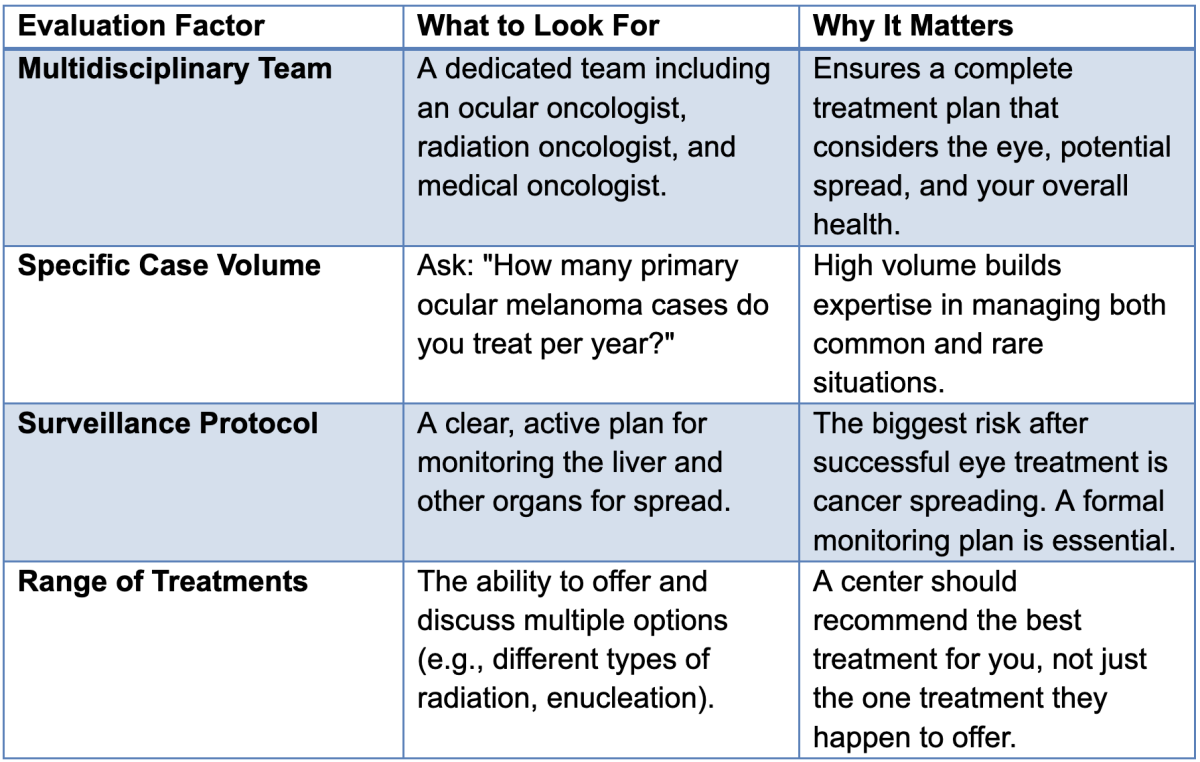
Finally, be cautious if a team is not open about their long-term monitoring plan. The risk of cancer spreading to the liver is a serious concern with ocular melanoma. A treatment center should be able to clearly explain their plan for monitoring you for years after your first treatment is done. This often involves regular imaging and working with other specialists, such as an interventional radiologist, if spreading disease is ever found.
Understanding Newer, Minimally Invasive Options
While treating the main tumor is the first priority, a complete plan must also deal with the risk of metastasis, which is when cancer spreads to other organs. For ocular melanoma, the liver is the most common place for it to spread. In the past, chemotherapy that affects the whole body was the main option. But newer, targeted treatments are changing how this is managed. Many of these are done by an interventional radiologist, not an oncologist.
An interventional radiologist is a doctor who uses imaging, like X-rays and CT scans, to do minimally invasive procedures. For liver tumors, one of the most common methods is embolization. This procedure cuts off a tumor’s blood supply, which starves it of the oxygen and nutrients it needs to grow.
The process is very exact. A specialist puts a very thin tube, called a microcatheter, into an artery in your wrist or groin. Using live imaging as a guide, they move this catheter through your blood vessels to the specific arteries in the liver that feed the tumors. Once it’s in place, they inject tiny particles to block those vessels. There are several types of embolization:
- Bland Embolization: Uses only non-medicated particles to block blood flow.
- Chemoembolization (TACE): Uses tiny beads that release a high dose of chemotherapy directly into the tumor. This limits the drug’s effect on the rest of the body.
- Radioembolization (Y-90): Uses tiny radioactive beads to deliver targeted radiation from inside the tumor. This kills cancer cells while protecting much of the healthy liver tissue around it. The Society of Interventional Radiology provides detailed information for patients on how this procedure works.
❝ When discussing these options, ask the interventional radiologist to walk you through the choice of blocking material. A good question is: “Based on the number and size of my specific tumors, why are you recommending radioembolization over chemoembolization, or vice versa? What does that mean for potential side effects and my liver function?”
These liver-focused therapies can be very good at stopping the growth of tumors and can often be repeated if needed. They are a major step toward localized, less toxic treatments that can improve both survival and quality of life for patients. They are a key part of the long-term monitoring and management plan that should be set up as soon as you are diagnosed.
Frequently Asked Questions About Ocular Melanoma Care
How can I find the best ocular oncologist for my situation? The word “best” depends on the person, but it usually means the team with the most experience treating your specific type of tumor. Start by looking for specialists at major university hospitals or cancer centers. Groups like the American Academy of Ophthalmology have online tools to find certified specialists. Always think about getting a second opinion from another experienced center to confirm the diagnosis and treatment plan.
What is the survival rate for ocular melanoma? A single survival rate can be confusing because the expected outcome depends on many personal factors. The most important difference is whether the cancer is only in the eye or has spread to other organs, like the liver. Other factors include the tumor’s size, its location in the eye, and its genetic makeup. Your care team can give you a more accurate outlook based on your specific diagnosis.
What are the newest treatments for ocular melanoma? Besides the standard radiation and surgery, there has been great progress in treating cancer that has spread. Systemic immunotherapies, which help your own immune system fight the cancer, have shown a lot of promise. For example, certain drugs known as bispecific T-cell engagers have been approved for uveal melanoma that has spread. Always ask your medical oncology team if you might be able to join any clinical trials, which can give you access to new therapies.
Why are there so few ocular oncologists? Ocular melanoma is a rare cancer, so the number of doctors who focus only on treating it is small. These experts usually work at large university medical centers or major cancer centers where they see enough cases to keep their skills sharp. This is why traveling to a major center for care is often a necessary step for patients.
Does removing the eye guarantee the cancer won’t spread? Enucleation, or removing the eye, is very effective at stopping the tumor from coming back in the eye socket. However, it does not promise that the cancer will not spread. Tiny cancer cells may have already traveled from the eye to other parts of the body before the surgery. This is why a long-term plan to monitor the liver and other organs is a vital part of your care, no matter which treatment you receive for the eye.
The Path Forward: From Diagnosis to a Long-Term Plan
Dealing with an ocular melanoma diagnosis can feel overwhelming, but learning about your care options can provide clarity and a sense of control. The best treatment centers work with two goals at once. They focus on treating the main tumor in the eye with great care, but they also create a plan to watch for future problems in the rest of the body. This is the most important thing to look for.
Your final decision should depend on this complete approach. The right team isn’t just answering, “How do we treat this tumor now?” They are ready to answer, “How will we partner to protect your overall health for the next five to ten years?” This includes a clear plan for monitoring the liver and a smooth connection to specialists who can provide targeted, minimally invasive therapies if they are ever needed. Choosing a team means choosing a long-term strategy, not just a single procedure.
About the author
Dr. Charles Nutting is a board-certified, fellowship-trained Interventional Radiologist with over 20 years of experience in minimally invasive, image-guided procedures. He is the founder of Image Guided Therapy in Greenwood Village, Colorado, a practice focused on embolization techniques to treat conditions including liver tumors that can result from metastatic ocular melanoma. He has performed over 10,000 liver embolizations and is a Fellow of the Society of Interventional Radiology. Learn more about these procedures at Image Guided Therapy.
Read more: Common Types of Skin Cancer and How They Impact Long Term Health Outcomes
Read more: Reason for Optimism about Prostate Cancer in Today’s World
Read more: St. Dominic Cancer Patients Receive Boost from Mississippi College Students’ December Donations