The Benefits of Using Pipe Expansion Joints
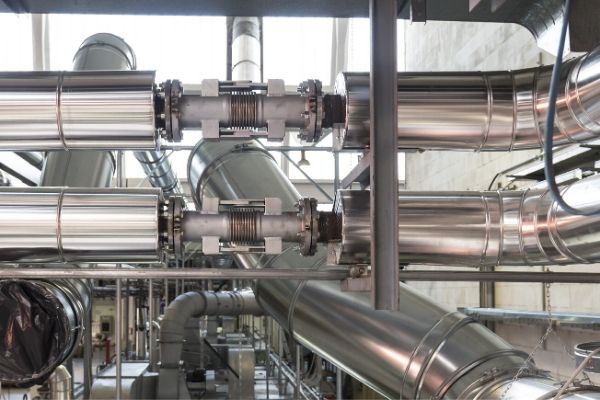
A pipe system is not a static, unchanging thing. It moves, changes temperature, and loses structural integrity as fluids pass through its cylindrical walls. To help manage these condition changes, many facilities employ pipe expansion joints, which anticipate these changes to avoid a system-wide failure. To learn more about the benefits of using pipe expansion joints, read this brief guide.
Expansion Joints Protect Against Thermal Expansion
An expansion joint’s primary purpose is to prevent a system failure, a resultant stoppage, and the expensive repairs to restore everything back to working order. They accomplish this through several mechanisms. First, expansion joints anticipate thermal expansion, which occurs as temperatures rise inside the system. Rising temperatures in general induce expansion, and this causes otherwise regular, straight piping to bend and distort or even crack. Expansion joints limit this by moving with pipes’ expansion and accommodating axial, down-the-line forces. Basically, these joints give the system some flexibility that responds to changes in pipe size.
They Protect Against Vibrational Resonances
Another mechanism through which an expansion joint saves a pipe system is vibrational resonance mitigation. Fluids passing through pipes apply force to the pipes that, when built up over time, resonate dangerously along the length of the pipe. The longer the pipe, the more likely these forces can resonate strongly and induce cracking. Expansion joints are important tools for stopping this resonance because they break up pipe systems into smaller segments and also can move with certain built-up forces in several directions.
Switching out your old gear with a high density polyethylene pipe will make sure that the entire layout is far better equipped to handle both pressure surges and constant shifts in physical strain. This durable material naturally absorbs a significant portion of ambient vibrations, working alongside the joints to prevent premature wear across the network.
Advantages Over a Pipe Loop
Expansion joints’ marked advantages relative to pipe loops are another benefit to using pipe expansion joints. While each are effective implements when accounting for thermal expansion, expansion joints are decidedly more space efficient. The defining feature of a pipe loop is its U-shape, and this requires ample space within a facility to create. On the other hand, expansion joints are practically flush with the rest of the pipe system and don’t take up extra space. This means they are more practical for facilities that are short on space. Also, pipe loops are not realistic inclusions in low-pressure systems, making expansion joints—which preserve a system’s pressure more consistently—the better option.