Rob Buchert And The Dunlap Broadside Reproduction
On the night of July 4, 1776, Philadelphia printer John Dunlap set the Declaration of Independence in type and printed an estimated 200 copies. These broadsides, large single-page printed sheets, were the document that spread the news of independence across the colonies. Twenty-six copies are known to survive. The auction record was set in 2000 at Sotheby’s: $8.14 million.
In February 2026, Rob Buchert received an unlikely phone call: the history interpreter then portraying George Washington at Mount Vernon was having trouble sourcing paper made in the 18th-century style. The inquiry that followed led Buchert to the Dunlap Broadside, and to the question of whether anyone had ever reproduced it not as a facsimile of the artifact’s current appearance, but as a complete recapitulation of the original creation process. The answer was no.
Most Americans picture the Declaration of Independence as the calligraphed parchment with the famous signatures, the document preserved today in the National Archives, familiar from countless reproductions. That document was produced weeks after independence was declared, and the image most of us know descends from an 1823 engraving. The Dunlap Broadside, what Buchert has reproduced, is the actual first publication: the document printed the night of July 4, 1776, before the parchment existed, and read aloud to General Washington’s troops in New York on July 9. The parchment reproductions everywhere this anniversary year are of a different document entirely.
As the effective Birth Certificate of the nation, the Dunlap Broadside has attracted the attention of publishers and printing offices over the years. None combines handmade period paper with a matched watermark and letter-by-letter type composition drawn from period specimens. The National Park Service’s Franklin Court Printing Office (Philadelphia) and the Printing Office of Edes & Gill (Boston) both produce respected hand-press Dunlap reproductions on machine-made cotton paper at prices around $25–30. The only previous reproduction made to a comparable standard of material fidelity, the 1970 R.R. Donnelley/Lakeside Press facsimile, is available only on the secondary market at $500–$2,000+, and is no longer in production.
Unlike the Donnelley facsimile, which sought to replicate the artifact as it existed in 1970, including its aged edges, staining, and toning, Buchert’s reproduction recapitulates the original creation process, producing something far closer to what those first readers across the colonies actually held: a freshly printed broadside on new paper, ink still sharp, carrying the news of independence. It is also a tribute to what is easy to forget about Dunlap’s overnight work: that it was not merely functional but genuinely beautiful: stately letterspaced caps, a commanding six-line initial, presswork that bears the excitement of the moment in every line. Buchert has sought to honor that beauty, not improve upon it.
This project drew on approximately 1,300 hours of work between February and June 2026.
What Rob Buchert Made
A hand-printed recreation of the Dunlap Broadside that follows the Library of Congress’s copy of the first printing: the paper made by hand, the type set letter by letter against the original, the ink blended to match 18th-century presswork.
Paper: Handmade from period-appropriate flax and hemp fibers, bearing the J. Honig & Zoonen crown-and-post-horn watermark, the same Dutch papermaker whose stock Dunlap used in 1776. The watermark is visible in the Library of Congress’s high-resolution scan of its surviving copy.
Type: Re-set from Caslon’s 1766 type specimen book, letter by letter and space by space against the LOC copy, replicating the letterspaced caps in the title and the stately six-line initial of the text, including the typographic irregularities and evidence of haste characteristic of Dunlap’s original composition.
Ink: Hand-blended to match the deep black characteristic of 18th-century letterpress printing.
Press: Printed by hand, one copy at a time, on a letterpress.
Dimensions: Approximately 19.5” × 15.5” (each sheet unique; handmade paper varies slightly).
Availability: www.declaration250.shop
Expert Validation
“I have examined surviving copies of the Dunlap Broadside firsthand, and the attention to detail here is remarkable. Although other credible efforts have been undertaken to produce faithful replicas of this document, I believe this to be the most accurate reprinting that has ever been produced. For the person who wishes to experience the sensation of holding a newly-printed copy of the first printing of the Declaration of Independence, there is simply no better option.”
— Gove N. Allen, Ph.D., Member, American Antiquarian Society (speaking in a personal capacity)
About Rob Buchert
Rob Buchert is an artist, letterpress printer, type designer, and papermaker with more than thirty years of practice across crafts that the printing industry largely abandoned. He is co-founder of Tryst Press, an award-winning letterpress, papermaking, and fine arts studio established in 1993 in Utah, whose work has entered public and private collections throughout North America and around the world, with pieces exhibited at venues including The Grolier Club. He is a recipient of the Carl Hertzog Award for Excellence in Book Design.
Buchert’s practice runs from raw fiber to finished page: he designs type, casts type (having trained at Monotype University), builds the wood-and-wire moulds and watermarks used in Western-style hand papermaking, and designs and illustrates books. He has been teaching letterpress printing and typography as adjunct faculty at BYU Provo for over twenty years, and collaborated for years with the Crandall Historical Printing Museum.
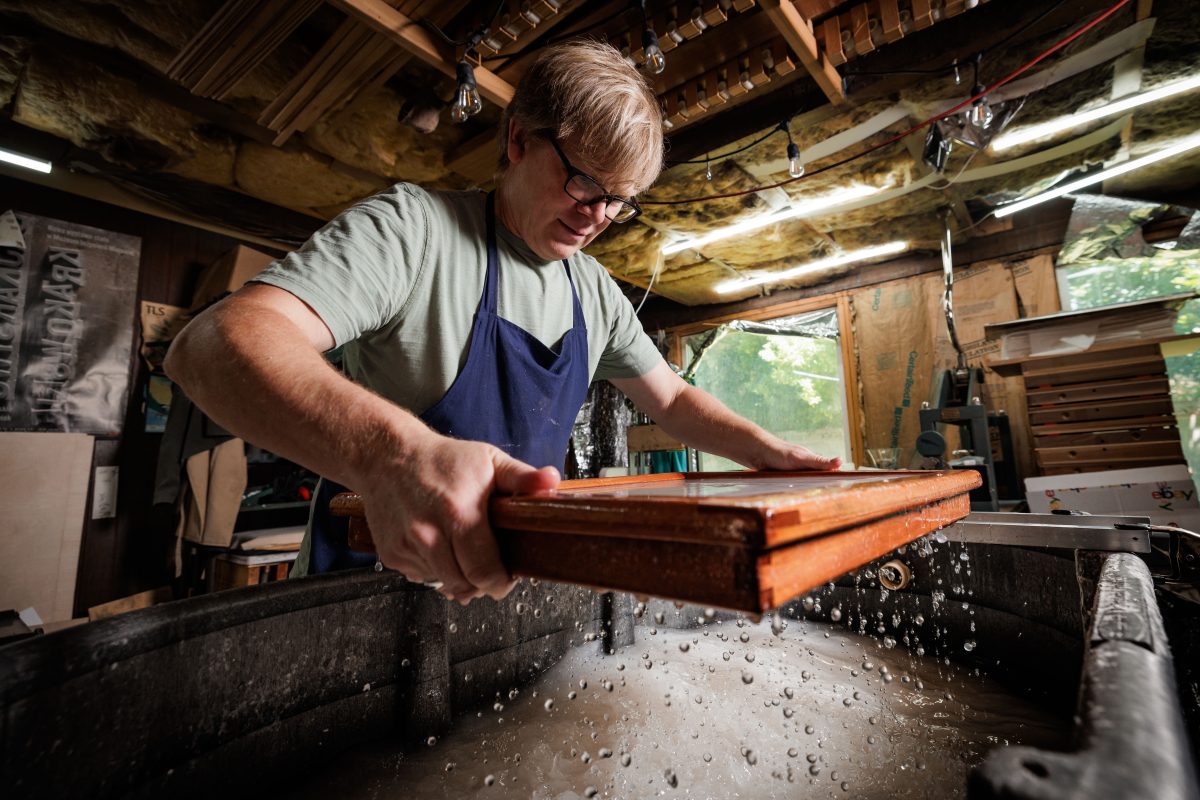
Utah artist Rob Buchert allows a freshly pulled sheet of handmade paper to drain at the vat, one step in recreating the 18th-century papermaking process used for the original 1776 Declaration of
Independence. June 11, 2026.