How to Choose an Industrial Gasket: A Material and Specification Guide for Australian Buyers
A gasket is one of the cheapest components in a pressurised system and one of the most expensive to get wrong. The part costs a few dollars; the unplanned shutdown costs considerably more.
This guide covers the four variables that decide material selection, how to read a specification table without misreading it, the Australian standards you will meet along the way, and when a custom gasket makes more sense than forcing a standard size.
Key Takeaways
- Material selection comes down to four variables: temperature, pressure, chemical exposure and application type.
- Published maximum temperature and maximum pressure are separate ceilings, not a combined rating.
- Full face gaskets suit flat face flanges, while ring face gaskets sit inside the bolt circle and handle higher pressures.
- Above roughly 450°C or 100 bar, you are into metallic gasket territory.
- Potable water and food contact applications carry specific compliance requirements beyond performance.
The Four Variables That Decide Everything
Every gasket decision reduces to the same four inputs. Operating temperature, operating pressure, the chemical passing through, and the application type, including flange face and bolt loading.
Get any one of them wrong, and you get premature failure. The most common mistake is specifying on media alone, choosing a material that resists the chemical but cannot hold the temperature.
Work out all four before you look at products. A supplier can only recommend properly if you can state what the joint actually sees in service.
Gasket Material Comparison
| Material | Temperature | Pressure | Chemical resistance | Typical applications |
| EPDM | -30°C to 100°C | Up to 10 bar | Water, steam, mild acids and alkalis | Water systems, HVAC, steam lines |
| Nitrile (NBR) | -25°C to 100°C | Up to 10 bar | Oils, fuels, hydraulic fluids | Hydraulics, fuel systems, automotive |
| Neoprene | -30°C to 90°C | Up to 10 bar | Oils, weathering, ozone | General purpose, outdoor, refrigeration |
| Silicone | -50°C to 200°C | Up to 7 bar | Food safe, UV resistant | Food processing, medical |
| Viton (FKM) | -25°C to 200°C | Up to 10 bar | Fuels, acids, solvents | Chemical processing |
| PTFE | -200°C to 260°C | Up to 40 bar | Almost all chemicals | Pharmaceutical, chemical, food |
| Graphite | -200°C to 450°C | Up to 250 bar | Steam, hydrocarbons | Refineries, boilers, exhaust |
How to Read That Table Correctly
This is the part that catches people out. The temperature figure and the pressure figure are independent ceilings, not a combined rating you can run simultaneously.
A material rated to 450°C and 250 bar will not do both at once. Pressure capability drops as temperature rises, and the usable envelope sits well inside the corners of the table.
Treat published figures as a shortlisting tool rather than a specification. Confirm the actual combination against the manufacturer’s pressure-temperature data, and involve a qualified engineer for anything carrying hazardous media or operating near a limit.
Full Face or Ring Face?
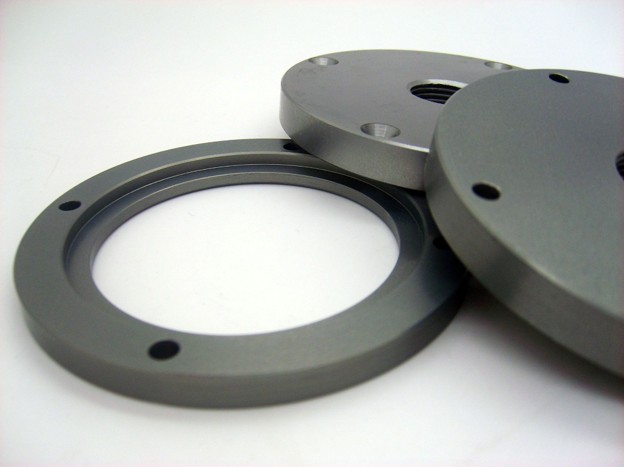
The flange decides this, not preference. Full face gaskets cover the entire flange surface including the bolt holes, which suits flat face connections and spreads sealing load evenly.
Ring face gaskets sit inside the bolt circle and seal only the inner portion, leaving the bolt holes uncovered.
They suit raised face flanges, use less material, and generally reach higher pressure classes than a full face equivalent.
Match the gasket to the flange face type you actually have. Fitting the wrong style is a surprisingly common cause of repeat leaks on otherwise sound joints.
When You Need a Metallic Gasket
Soft cut materials run out of capability at a certain point. Above roughly 450°C or beyond about 100 bar, you move into spiral wound, metal jacketed, RTJ and kammprofile territory.
These are standard in refineries, power stations and petrochemical plants for a reason. They handle thermal cycling and high bolt loads that would crush or extrude a soft gasket.
Be aware they change the joint, not just the seal. Metallic gaskets need higher bolt loads to seat properly, so confirm your flange and bolting can actually deliver it before specifying one.
Why Gaskets Actually Fail
Material choice gets the blame more often than it deserves. Incorrect bolt torque is the most common real cause, either uneven tightening that distorts the joint or insufficient load that never seats the gasket properly.
Reusing a gasket is the second. Once compressed, a soft gasket has taken a permanent set and will not seal the same way again, which makes reuse a false economy.
Flange surface condition matters too. Scoring, corrosion pitting, and residue from the previous gasket all create leak paths that no new gasket will bridge.
Thermal cycling finishes off anything marginal. A joint that holds at steady state can relax and leak once it has been through repeated heat-up and cool-down cycles, which is where the harder materials earn their cost.
Australian Standards You Will Encounter
Flange dimensions are the first place standards matter. Australian pipework commonly uses AS 2129 and AS 4087, while imported equipment often arrives on ASME or ANSI flanges, and older infrastructure may still be on BS 3063.
Confirm which standard your flange follows before ordering. A gasket cut to the wrong table will not line up on the bolt holes even if the nominal bore matches.
AS 4020 governs products in contact with drinking water, which is why EPDM is the default across Australian water infrastructure. For food contact, FDA 21 CFR 177.2600 is the reference most suppliers cite.
Food, Potable Water and Regulated Service
Regulated applications need compliance documentation, not just a suitable material. If you are sealing a potable water main or a dairy line, ask for the certification alongside the quote.
The usual food-grade options are white silicone, white EPDM, white nitrile and virgin PTFE. The white colouring is deliberate, since contamination shows against it during inspection.
Oxygen service is its own category with its own requirements. Do not substitute a general-purpose material into an oxygen line, because cleanliness and compatibility requirements are far stricter there.
When to Go Custom
Standard sizes cover most flange work, but plenty of sealing jobs are not flanges. Access panels, gearbox covers, irregular housings and obsolete equipment all need shapes nobody stocks.
Modern CNC cutting handles this from a drawing, a CAD file, or in many cases a worn-out sample.
Tolerances around ±0.1mm are achievable, with thicknesses commonly from 0.5mm to 50mm and single-piece diameters up to about 1600mm.
The old gasket is often the best brief you have. If you can send the failed part, a capable manufacturer can reverse engineer it without you producing a drawing at all.
Sourcing and Lead Times
Suppliers of industrial gaskets Australia wide fall into two camps: importers who stock and hold, and local manufacturers who cut to order on site. The distinction matters most when something fails unexpectedly.
Importers can be excellent on common stock lines and slow on anything unusual. A local manufacturer cutting in-house can often turn a custom part around in days rather than waiting on an overseas factory.
Industrial Experts sits in the second group, manufacturing in Truganina in Melbourne with in-house CNC cutting and no minimum order quantity, which matters when you need one emergency gasket rather than a production run.
Whoever you use, confirm dispatch cut-off times and interstate transit before you plan a shutdown around a delivery.
Ask about technical support too. A supplier who will interrogate your service conditions before quoting is worth more than one who simply takes the order.
Conclusion
Gasket selection is straightforward once you have the four variables written down. Temperature, pressure, media and application, then flange standard, then material.
The two things worth slowing down for are reading specification tables correctly and confirming compliance where the application is regulated. Both are cheaper to check now than to discover during a shutdown.
After that, most failures come down to installation rather than product. Torque it properly, do not reuse it, and clean the flange face first.
Industrial Gasket FAQs
What are the main types of industrial gaskets? Broadly, rubber, compressed fibre, PTFE, graphite, cork, and metallic. Metallic types include spiral wound, metal jacketed, RTJ and kammprofile.
How do I choose the right gasket material? Match it against four variables: operating temperature, operating pressure, chemical exposure and application type. Specifying on chemical resistance alone is the most common error.
What is the difference between full face and ring face gaskets? Full face gaskets cover the whole flange, including bolt holes, and suit flat face flanges. Ring face gaskets sit inside the bolt circle, suit raised face flanges, and generally handle higher pressures.
Can a gasket run at its maximum temperature and maximum pressure together? No. Those are separate ceilings, and pressure capability falls as temperature rises, so check the manufacturer’s combined data.
Which gasket material is best for water? EPDM is the standard choice for Australian water systems, and AS 4020 compliant grades are required for potable water contact.
Which material handles oils and fuels? Nitrile is the usual answer for oils, fuels and hydraulic fluids. Viton is specified where solvents or aggressive chemicals are also present.
What gaskets are food safe? White silicone, white EPDM, white nitrile and virgin PTFE are the common FDA-compliant options. Ask for documentation rather than assuming.
When do I need a metallic gasket? Generally above about 450°C or beyond roughly 100 bar, and anywhere thermal cycling would extrude a soft material.
Can I get a custom-shaped gasket made? Yes. CNC cutting works from a drawing, a CAD file or a physical sample, so a worn part is often enough to reproduce it.
Which flange standards apply in Australia? AS 2129 and AS 4087 are the common Australian tables, with ASME and ANSI appearing on imported equipment and BS 3063 on older systems.