Superstar Legacy: Over five decades of musical tradition in the Clinton Band
By Guest Columnist Dr. Renee Wilson
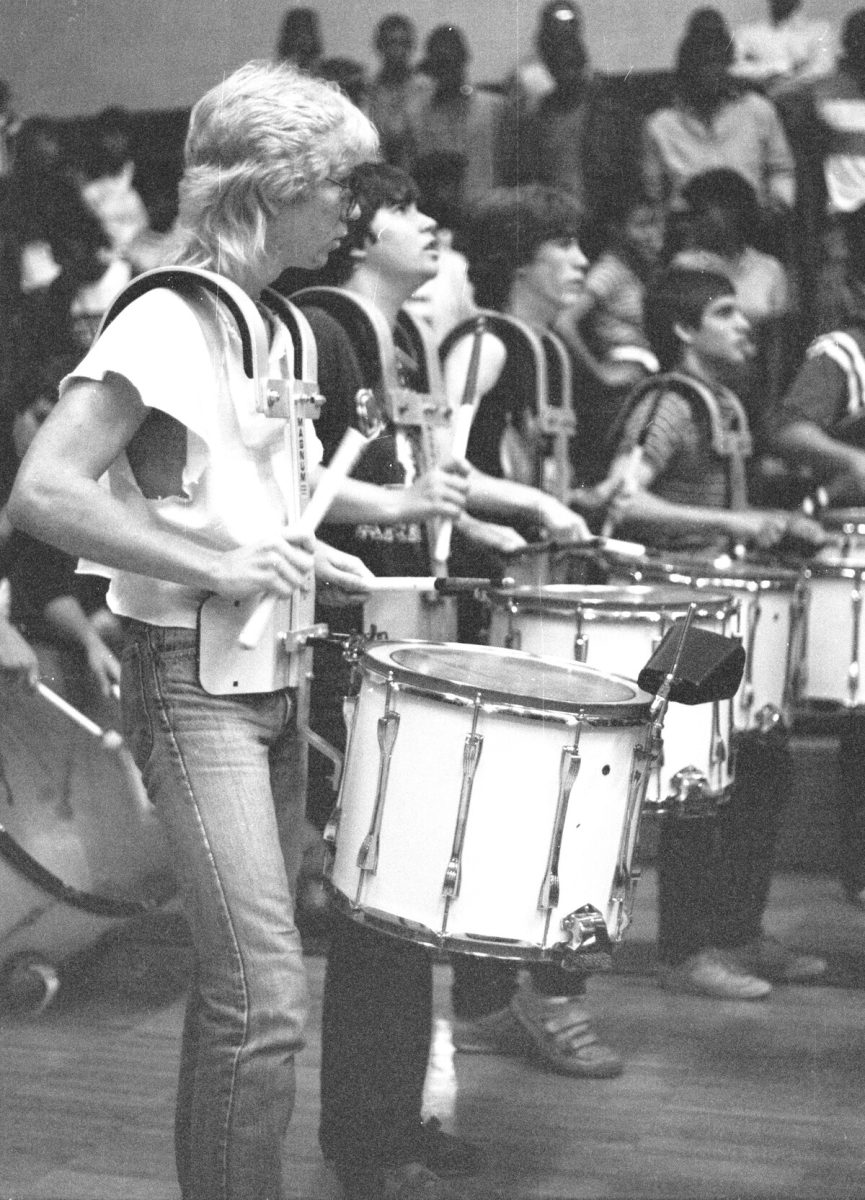
See the Slide Show Below, 54 Pictures thru the years.
He probably could not have imagined that after fifty years, the band would still be playing his arrangement. Yet, attend any Clinton High School (CHS) football game, and you’ll hear the familiar strains cranking up at the end of the third quarter. It is the song everyone waits to hear during the pep rallies. It is the song that sends recent band alumni to their phones to grab a recording for their own keepsake. It is a great tradition of the Clinton High School Band: revered almost as if it were another fight song.
Superstar.
The song, “Superstar,” was written by Andrew Lloyd Webber. Part of the concept album Jesus Christ, Superstar, the single was released in November 1969, nearly a year before the U.S. release of the album (October 1970). The concept album was transformed into a musical theater production, opening on Broadway in 1971, and then made into a movie in 1973.
You might wonder how this particular song made its way into the traditions of CHS bands, athletics and cheer.
George Stokes Neal, III graduated from Clinton High School in 1969. He played the baritone in the band when it was first under the direction of Tom O’Neal and then Ron Hooten. Stokes, as he is called by those who knew and loved him, began his college career at Ole Miss, but transferred to Mississippi College after a year to complete his Bachelor of Music Education degree.
Studying under Dr. Jimmy Sclater, Stokes gained skills in music theory, composition and arranging. He fell in love with Lloyd Webber’s “Superstar” and created an arrangement of it. The musical itself was controversial. According to his siblings, the fact that it was “different” and “edgy” contributed to Stokes’ desire to arrange its title song for marching band.
“Stokes didn’t mind living on the edge,” says brother, Don Neal.
“Superstar” was not written by Stokes. The song was composed (written) by Andrew Lloyd Webber and then arranged by Stokes. This clarification of terminology is important both in the world of music and intellectual property, and to Stokes’ family. His family is clear, furthermore, that it was not written specifically for the Clinton Band. It was written either as a school project or as an independent project during Stokes’ undergraduate years.
Stokes arranged “Superstar” so that it could be played by a marching band, and it was originally 8 minutes and 40 seconds long. It premiered at a CHS band concert and was later played during a football game. According to Stokes’ siblings, it seemed to be just the good luck charm that the football team needed during those years, as the players and fans began to associate the playing of “Superstar” with scoring touchdowns. The song, understandably, began to get plenty of play. It energized the crowd and the players and has continued to do so for over five decades.
“Superstar” is now played at the end of the third quarter, though CHS band director Gavin McAdams acknowledges that that may not always be helpful to the football team. For example, if the team is directly in front of the band at the end of the third quarter, the band playing could make it difficult for the team to hear instructions and communicate with one another. McAdams is sensitive to that, and wants the band to be an asset to the team. He also wants to be sensitive to the traditions and community expectations and recognizes the significance of “Superstar” to the Clinton community.
Robert Allen, Clinton Public School District (CPSD) Director of Fine Arts, former CHS Assistant Band Director, and Clinton Band alumnus, says that CPSD is a very special place for fine arts, and that “[‘Superstar’] is a part of that puzzle for a lot of people. They hear it, and they get in their feels a little bit, and I’m glad it’s still going.” He regards Stokes’ work as well-written, suggesting that it is this quality that makes the song memorable and singable years after graduation.
Sadly, many years ago, the original score and instrument parts were lost or destroyed. At some point in the early 2000s, students began to pass down “Superstar” aurally to underclassmen. Some students attempted to transcribe what they were playing so that future generations of band students would have sheet music to read, but there were many errors, despite their best efforts.
In 2009, when Allen returned to CHS as an assistant band director, he re-created Stokes’ arrangement based on what he remembered playing and what students were playing. Assistant Band Director Dustin Hazlett has provided minor edits, as well. The percussion parts continue to be passed down aurally to underclassmen, a typical practice for pep bands. Over time, the arrangement has been shortened to a more typical “pep band arrangement” length. Barbara Selby, Stokes’ sister, insists that this change has not altered the fundamental characteristics of Stokes’ arrangement.
Following student teaching with Howard Cohen at CHS, Stokes pursued many creative and musical ventures. He arranged music for other bands, including “Wayfaring Stranger” for the Hattiesburg High School band. He produced a video for MC entitled “In Service to God and Mankind” which featured the compositions of Sclater. He directed commercials and worked in print advertising as well, earning awards at the state level for his work.
Selby taught at Lovett Elementary during the time that James Sills was the CHS band director. He brought his group out to play for the students and always introduced the piece and its special relationship to their teacher.
Selby remembers “[h]e said ‘we play this at every football game, and I think you’ll recognize it,’ and, of course, they started it and all the little sixth graders went berserk because they had been to the football games. So, it’s meaningful to me that that is a legacy that [Stokes] left for the high school.”
Don Neal adds “I think it would be a hoot to my mom and my brother to know that they’re still playing it.”
EDITOR’S NOTE: Dr. Wilson is President, Kodály Mississippi and Associate Professor of Music at Mississippi Christian University. She has had two children who participated in the Clinton bands’ program.