Beyond the Puddle: What’s Really Happening Under Your Leaking Flat Roof
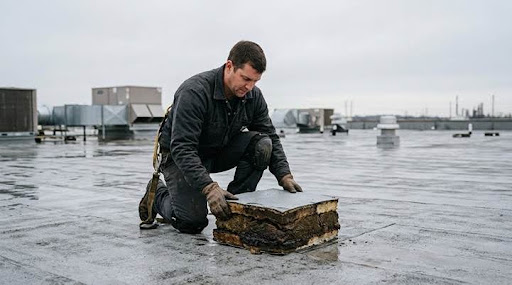
A core sample reveals the hidden water damage lurking beneath a commercial flat roof.
By a commercial roofing industry contributor.
That small, brown stain on a ceiling tile seems like a minor problem. It’s easy to ignore, especially if it only shows up after a heavy rain. But on a flat roof, that spot isn’t the real issue. It’s just the last sign of a much bigger problem. Water can get into the roof through a tiny split or hole. Common entry points include failed seams, punctures from foot traffic, or degraded flashing around vents and skylights. Then it can travel sideways for a long way, soaking the insulation and damaging the roof deck below. By the time you see a drip, the hidden damage can be huge.
The first step is a full diagnosis, not just finding the drip. This means tracing the water back to where it first got in. This careful check is key to any good flat roof repair. The goal is to fix the original leak, deal with any damaged materials, and stop a small problem from turning into an early and expensive roof replacement. Sometimes, local building codes decide if a roof can be repaired or must be replaced. For example, Chicago’s express permit program limits a roof repair to 25% of the roof area. If the damage is worse than that, the job becomes a recover or a replacement, which can bring stricter rules.
Quick answer: The costliest flat roof repair mistakes come from finding the wrong source of the leak, using the wrong patching materials, and waiting too long to fix it. A single drip often hides widespread wetness in the insulation and rot in the deck below. The right way to repair a roof involves finding the exact spot where water gets in, preparing the surface carefully, and using a material made to stick to the current roof.
What’s inside
- Why Do Small Leaks Turn Into Five-Figure Replacements?
- How Can You Tell a Good Repair Quote from a Bad One?
- Frequently Asked Questions About Flat Roofs
Why Do Small Leaks Turn Into Five-Figure Replacements?
A small repair can turn into a full replacement if the hidden damage is widespread. It can also happen if the repair area is larger than local building codes allow, which forces you to get a new roof.
The key is not the size of the drip you see, but how far the water has spread unseen. A small break in the roof’s top layer lets water into the insulation. Because flat roofs are nearly level, water doesn’t drain easily. Instead, it spreads out and soaks a large area of insulation. This trapped water rusts metal parts, helps mold grow, and can rot the wood or weaken the steel deck that holds up the whole roof. A tiny hole can end up damaging a huge section of the roof from the inside. This saturated area loses its insulating value. It also adds significant weight to the roof structure. The structure was not designed to hold this extra load.
Consider a common scenario. An HVAC technician accidentally drops a screw on the roof membrane. The puncture is tiny, almost invisible. But over the next few months, rain and melting snow seep through that small hole. The water saturates the insulation board below, spreading silently across a ten-foot area before it finds a seam in the roof deck to drip through. You only see a single water spot, but a large section of your roof’s core is already compromised.
Building codes often have clear rules about what counts as a simple patch versus a major project. This stops people from endlessly patching a roof that is truly broken. For example, the City of Chicago’s express permit program limits a roof repair to 25% of the roof area. If the damage covers more area, the job is permitted as a recover or a replacement, not a repair. This can mean you have to tear off the old roof and install a new one that meets today’s rules for saving energy and being structurally sound. Many areas have similar rules. That’s why a complete damage check is so important before any work starts.
Besides the risks to the building and the rules you have to follow, waiting to do repairs costs you money directly. Wet insulation doesn’t work as well to keep heat in or out. This is called losing its R-value. This makes your heating and cooling systems work harder to keep the building comfortable. A damaged roof can make your energy bills go way up. According to the U.S. Department of Energy, heating and cooling use more than half the energy in a typical home. Heating and cooling are also a major energy cost for commercial buildings, and a bad roof makes that cost go up.
❝ Taking a core sample is the only sure way to know what’s going on inside your roof. This means cutting a small, easy-to-fix square through all the roof layers down to the deck. It shows the type and thickness of the insulation, how wet it is, and if the deck is still strong. If a contractor suggests a fix without taking a sample, they are just guessing what the real problem is.
How Can You Tell a Good Repair Quote from a Bad One?
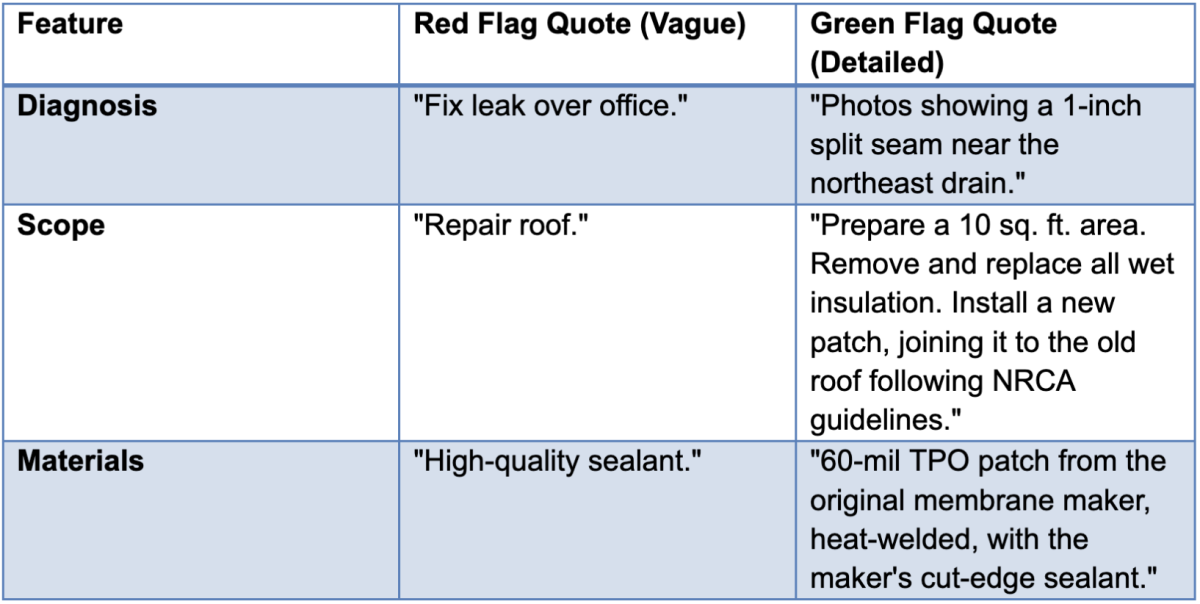
A good quote is more than a price. It should give a clear diagnosis with photos as proof, a detailed plan of the work, and an exact list of materials.
Choosing a quote just because it’s the cheapest is a common and costly mistake. A very low price often means the inspection wasn’t done well. This can lead to a repair that fails within a year. A professional check starts on the roof, not on the phone. The quote should have clear photos of the exact problem, like a cracked seam, a hole, or bad flashing around a pipe or vent. If the contractor thinks there is trapped water, they should suggest a core sample to check the insulation and deck. A quote without this proof is just a guess.
The “scope of work” describes the repair plan and must be very detailed. It should state the size of the repair area and the exact steps for preparing the surface. This is key for making the patch stick correctly. This includes cleaning the area of all dirt and debris. It may also involve using a special primer to ensure the new material bonds permanently to the old surface. A good plan also explains how wet insulation will be taken out and replaced. It should also describe how the new patch will be joined with the old roof. Good contractors often follow repair guides from groups like the National Roofing Contractors Association (NRCA). This helps make sure the fix is strong and will last a long time.
Watch out for unclear terms like “roofing cement” or “quality patch.” These are red flags. Using the wrong material can actually damage your roof. The quote must list the exact brand and product names for all materials. This lets you check that they will work with your current roof and that you get what you paid for.
A major red flag is a quote that creates a “material island.” This happens when a contractor uses a patch that is chemically different from your existing roof. For example, applying a generic asphalt-based sealant to a modern single-ply TPO roof is a recipe for failure. The oils in the asphalt can degrade the TPO membrane, causing it to become brittle and crack around the patch. The repair itself becomes the source of the next, bigger leak.
❝ Ask specifically about the warranty on the repair itself, not just the materials. A reputable contractor will guarantee their workmanship for a period of time, which shows confidence in their process. A materials-only warranty is useless if the patch was installed incorrectly and fails within a year.
This table shows what to look for:
Frequently Asked Questions About Flat Roofs
What is the best material for a flat roof repair?
The best material is one that is compatible with your existing roof system. You cannot use a one-size-fits-all approach. A TPO roof needs a TPO patch, and an EPDM roof requires an EPDM-specific repair kit. Using the wrong product creates a weak point. The different materials expand and contract at different rates with temperature changes. This stress will eventually break the seal between the patch and the roof, guaranteeing another leak. A professional quote will always identify your roof type and specify the correct, compatible repair materials.
Are temporary repairs a good idea?
Temporary repairs should only be used in an emergency to prevent immediate interior damage. Think of a plastic tarp or a temporary sealant as a bandage, not a cure. Leaving a temporary fix in place for too long can trap moisture. This can accelerate rot and mold growth underneath the patch. Always follow up with a professional inspection and permanent repair as soon as possible. A temporary patch is never a long-term solution.
About the author: This article was written by a representative from Integrity Pro Roofing, a company that provides commercial roofing services. Integrity Pro Roofing installs, maintains, and repairs flat and low-slope roofs for businesses. Learn more at Integrity Pro Roofing.
Read more: Torch-Down Roofing: Lifespan, Fire Safety, and How to Hire
Read more: Modern Roofing Options for Your Next Replacement
Read more: Raise the Roof Right: South Florida’s Commercial Roofing Experts