How Fast Can an E-Bike Go? What Everyday Riders Should Know About Speed and Performance
For most everyday electric bikes, assisted speed commonly falls around 20 to 28 mph, depending on the bike, its configuration, and the rules that apply where it is ridden. But the number on the speedometer tells only part of the story. Motor output, rider weight, hills, tires, battery condition, wind, and even riding position can all affect how quickly an e-bike reaches speed and how well it maintains that speed in real conditions.
That is why riders searching for the fastest ebike should look beyond a claimed top speed. A bike that accelerates smoothly, holds momentum on hills, brakes predictably, and remains comfortable on local roads may be more useful than one designed around a bigger speed number alone.
What Does E-Bike Top Speed Actually Mean?
When an e-bike lists a top speed, it is important to understand whether that number refers to motor assistance or the bicycle’s absolute physical speed.
An electric motor does not necessarily prevent the bicycle from moving faster once assistance stops. A rider descending a hill, for example, may exceed the assisted-speed limit through gravity and pedaling. The important specification is usually the speed at which the motor stops providing additional help.
Many commonly used U.S. e-bike classifications center on 20 mph and 28 mph assisted speeds. Mississippi law, for example, defines Class 1 assistance as ending at 20 mph, Class 2 motor assistance at 20 mph, and Class 3 pedal assistance at 28 mph. Mississippi’s statutory definition also specifies a motor of less than 750 watts.
For riders, that means advertised performance should always be considered alongside the rules that apply to the specific bike and location.
Does a Bigger Motor Always Make an E-Bike Faster?
No. A larger motor can improve acceleration and help an e-bike maintain momentum under heavier loads, but motor wattage does not determine top speed by itself.
A powerful motor becomes especially noticeable when starting from a stop, climbing a hill, carrying cargo, or riding into a headwind. Under those conditions, a lower-powered system may lose speed more quickly while a stronger one can continue providing useful assistance.
There is also a difference between rated and peak output. Rated power represents the motor’s normal output specification, while peak output describes additional power available during higher-demand situations such as acceleration or climbing.
That makes peak wattage useful for understanding short bursts of performance, but it should not be treated as a direct conversion to miles per hour.
A 1,000W peak motor does not automatically make a bike twice as fast as a 500W motor.
Why Can Two E-Bikes With the Same Top Speed Feel Completely Different?
Acceleration is one reason.
Two e-bikes may both provide assistance up to 28 mph, yet one may take noticeably less time to reach that speed. Hills can widen the difference further. A bike that easily maintains assistance while climbing can feel much more powerful than one that slows significantly under the same load.
Bike weight also affects the experience. Motors have to move the rider, bicycle, battery, accessories, and any cargo being carried. A heavier setup generally requires more energy to accelerate, particularly from a stop or on a climb.
Pedal-assist programming matters too. Some bikes provide gradual assistance, while others respond more aggressively. Neither approach is automatically better. For daily riding, predictable power delivery can be more valuable than sudden acceleration.
This is why real-world performance is better understood as a combination of acceleration, climbing ability, assisted speed, and control rather than one maximum-speed figure.
How Much Speed Do Everyday Riders Actually Need?
For many riders, 20 mph is already enough for neighborhood trips, errands, recreational rides, and shorter commutes.
A higher assisted speed can become more useful when trips involve longer stretches between stops. Covering several miles at a steady pace can reduce travel time, especially when compared with a conventional bicycle.
But faster is not always more convenient.
In areas with frequent intersections, pedestrians, driveways, and traffic, riders rarely maintain maximum assisted speed for long. Acceleration, braking, visibility, and awareness of surrounding traffic become more important.
The best speed for an everyday ride is therefore not necessarily the highest speed the bike can reach. It is the speed that remains appropriate for the road, weather, traffic, visibility, and rider experience.
How Do Tires Affect E-Bike Speed and Handling?
Tire design changes how a bike uses its available power.
Narrower road-oriented tires generally prioritize efficiency on smooth pavement. Wider tires add weight and rolling resistance, but they can provide a more planted riding feel when roads become rough or surfaces change.
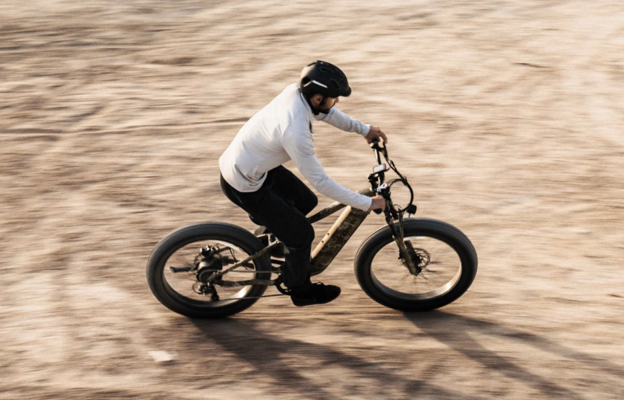
A fat tire electric bike is therefore not necessarily designed to win a pure pavement speed test. Its wider tires may make more sense for riders dealing with broken pavement, gravel roads, dirt paths, grass, or other mixed surfaces where stability matters alongside speed.
Tire pressure also changes the ride. Too little pressure can increase rolling resistance, while excessive pressure may reduce comfort and grip depending on the surface.
For everyday riders, the right tire is the one that suits the route—not simply the one that produces the highest speed under ideal conditions.
Does Suspension Matter When Riding Faster?
Suspension does not directly increase motor power, but it can change how manageable a bike feels when the surface becomes uneven.
At low speeds, a pothole or rough patch may be only uncomfortable. At higher speeds, the same obstacle can have a much greater effect on stability and rider control.
Front suspension helps absorb impacts reaching the front wheel and handlebars. Rear suspension can reduce additional movement through the frame and saddle. A full suspension ebike can therefore make sense when faster recreational riding regularly includes rough pavement, gravel, forest roads, or uneven trails.
The tradeoff is additional weight and complexity. Riders who stay almost entirely on smooth streets may prefer a simpler commuter setup.
Again, the fastest configuration on paper is not automatically the most appropriate one for every route.
What Does a Performance-Oriented E-Bike Look Like?
The Puckipuppy Boxer provides one example of a setup that balances assisted speed with mixed-terrain capability. It uses a 750W rated motor with 960W peak output, with throttle assistance listed at up to 20 mph and pedal assistance up to 28 mph; its 26 × 4-inch tires and dual-suspension system are aimed at riders who also encounter rougher surfaces.
The Boxer also pairs its performance with 180 mm hydraulic disc brakes and a 48V 20Ah removable battery rated for 40–80 miles, showing why speed is best considered alongside braking, terrain capability, and usable range rather than in isolation.
Does Battery Size Affect Top Speed?
Battery capacity and speed are related, but not in the simple way many shoppers expect.
A larger-capacity battery primarily gives the bike more stored energy. That usually matters more for range than maximum assisted speed.
Battery voltage, motor design, controller settings, and the overall electrical system all influence performance. Meanwhile, repeatedly riding at higher assistance levels typically consumes energy faster than cruising at a moderate pace.
This creates an important tradeoff for everyday riders.
A bike capable of higher speeds may shorten a trip, but constantly using the highest assistance level can also reduce the distance available between charges. Riders planning longer trips should therefore look at both speed and range instead of treating them as separate specifications.
Why Braking Becomes More Important as Speed Increases
The faster a bicycle travels, the more attention riders should give to stopping distance and brake control.
Traffic can change unexpectedly. A car door may open, a pedestrian can enter a crossing, or loose gravel may appear around a corner. More speed leaves less time to respond.
This is one reason performance-oriented e-bikes often pair stronger motors with hydraulic disc brakes and larger rotors. The goal is not simply to stop the bike eventually, but to give riders controlled braking when conditions change.
Tires matter here as well. Even strong brakes cannot create unlimited traction between the tire and the surface. Wet pavement, leaves, sand, and loose gravel can all reduce available grip.
A responsible speed is therefore always determined partly by conditions.
Do Local E-Bike Rules Change How Fast You Can Ride?
Yes. E-bike laws and access rules can affect both assisted speed and where a particular bike may be operated.
For readers in Mississippi, state law currently recognizes three electric-bicycle classes. Classes 1 and 2 stop providing motor assistance at 20 mph, while Class 3 pedal assistance stops at 28 mph. The state’s electric-bicycle definition specifies motors of less than 750 watts, and Class 3 bikes may face additional restrictions on certain bicycle or multi-use paths.
That makes it important not to assume that every product marketed as an e-bike fits the same legal category everywhere.
Motor rating, speed configuration, throttle operation, and local access rules should all be checked before riding on public streets, bike paths, or trails. Riders considering higher-output models should be particularly careful to confirm how local law treats that specific configuration.
Is the Fastest E-Bike Always the Better E-Bike?
For most everyday riders, no.
Maximum speed is useful information, but it should sit alongside range, braking, ride quality, tire choice, motor response, weight, and rider fit.
Someone traveling five miles through a neighborhood filled with intersections may gain little from additional top speed. Someone riding longer stretches on permitted routes may value higher assisted speed more. A rider crossing gravel or rough pavement may care more about stability and suspension than an extra few miles per hour.
The best performance comes from matching the bike to the route.
Instead of asking only, “How fast does it go?” ask a few more useful questions: How quickly does it reach a comfortable pace? Can it maintain assistance on hills? Does it remain controlled on the surfaces I ride? And can it stop predictably when something changes?
Those answers tell everyday riders much more about an e-bike than the biggest number on the speedometer.