Beyond the Big Three: How Multi-Process Welders Changed the Game
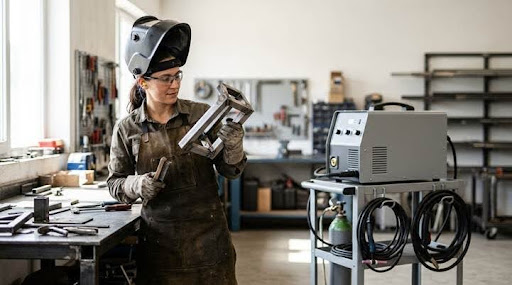
Modern welders offer the flexibility to tackle any project, from fabrication to repair.
By a welding industry contributor. Choosing a welding machine used to be simple. You had three main choices. You bought a machine for one type of welding and got good at it. Now, things are more complicated. Picking the wrong welder for your goals can mean wasting money on a machine that makes your job harder. New, powerful, and lightweight welders have made multi-process units better and cheaper than ever.
This changes how everyone, from a hobbyist to a small shop owner, should choose a welder. The choice isn’t just about which process is “best.” It’s about which mix of processes gives you the most value for the work you do now and in the future. It’s important to understand the pros and cons of a single-process machine versus a stick tig mig welder that does all three. For pros, this choice affects how fast they work and how much they can earn. This is a big deal, as the U.S. Bureau of Labor Statistics reports that skilled welders make an average of $25.31 per hour.
The technology inside is the real story. Old transformer welders were heavy, used a lot of power, and usually did only one process. New inverter welders use smart electronics to change the power. This makes them lighter, more efficient, and able to handle MIG, TIG, and Stick welding all from one machine.
Quick answer: For the most flexibility, a multi-process machine is a great choice. This is especially true if you are learning or work on many different kinds of projects. For special, high-detail production work, a single-process machine often works better and lasts longer for that one job. Stick welding is still the simplest and toughest process for repairs outdoors or on a job site.
What’s inside
- What’s the Real Cost of Choosing the Wrong Welding Process?
- How Do I Match a Welder to the Metal I Use?
- Frequently Asked Questions
What’s the Real Cost of Choosing the Wrong Welding Process?
The price of the welder is small compared to the long-term costs of wasted materials, slow work, and missed jobs. If you choose a process that doesn’t fit your main type of work, every project will take longer. It will also cost more in labor, which is usually the most expensive part of a welding job. A machine that speeds up your work pays for itself fast. A machine that slows you down costs you money over time.
The money differences are clear. MIG welding is fast. It’s great for long, clean production jobs where speed is important. TIG is much slower but gives you amazing control. This is key for thin or special metals where one mistake could ruin an expensive part. Stick welding is slower than MIG. But it can work on dirty or rusty surfaces. This can save a lot of prep time on repairs, turning a four-hour job into a one-hour job.
Imagine you run a small shop that builds custom iron railings. For the long, straight sections, MIG welding is perfect. You can lay down strong welds quickly, moving the project along. But for the detailed, decorative scrollwork, TIG is the better choice. Using MIG on those delicate parts could lead to burn-through and messy-looking joints. Choosing the right process for each part of the job saves time and delivers a higher quality product.
Being faster directly affects how much you can earn. A welder’s time is valuable. The U.S. Bureau of Labor Statistics reports a median pay of $53,750 per year for welders. Wasting a few hours a week on the wrong process or too much cleanup adds up to thousands of dollars in lost work. In comparison, the average yearly wage for welding machine operators was $47,120 in May 2023, according to the U.S. Bureau of Labor Statistics. The right tool helps a skilled welder create more value.
❝ A good rule for fabrication is that for every minute you spend welding, you might spend three minutes getting ready, setting up, and cleaning up. A process like MIG needs clean metal but is very fast, so it changes that ratio. TIG is very precise. It can greatly reduce the grinding and finishing you need to do on important joints after welding.
In the end, the right machine cuts down on the non-welding time that makes projects cost more. It reduces the need for grinding, fixing mistakes, and tough setups. When you look at a welder, think about more than its price. Consider how it will affect the whole job, from start to finish.
How Do I Match a Welder to the Metal I Use?
The type and thickness of the metal you use are the most important things to think about when choosing a welder. Multi-process machines are flexible, but each process is best for certain jobs. Understanding this helps you avoid fighting with your equipment. The goal is to pick a welder that makes your most common jobs easier, not just one that can do everything.
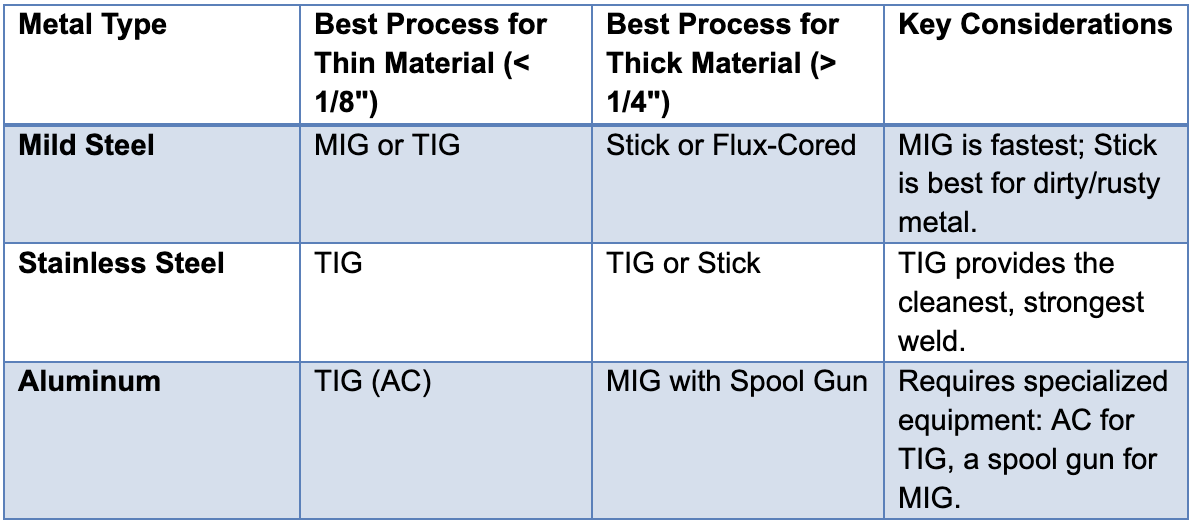
For making things with steel in a shop, MIG (Metal Inert Gas) welding is usually the fastest and best choice. It uses a wire that feeds automatically and a shielding gas. This lets you make long, clean welds with little cleanup. For very exact or good-looking welds on stainless steel or aluminum, TIG (Tungsten Inert Gas) gives you the most control. To TIG weld aluminum, you need a machine with an AC (Alternating Current) setting. This helps break through the tough outer layer on aluminum. Stick welding (SMAW) is the most flexible choice for repairs and outdoor work. The special coating on the welding rod protects the weld from the air and can burn through rust or paint on thick steel.
Here is a general guide for matching processes to common materials:
Besides the process, you need to check the machine’s power needs and how well it performs. A common mistake is buying a welder that your shop or garage wiring can’t handle. Many powerful machines need a 240-volt outlet, like the one for an electric stove or dryer. Smaller welders can run on a normal 120-volt outlet but won’t have enough power for thick metals.
A frequent error is attempting to MIG weld aluminum without the right setup. Standard MIG welders use a long torch cable to push steel wire. Aluminum wire is much softer and will bunch up and jam inside that liner. This problem, called bird-nesting, stops your work completely. You need a special spool gun, which is a small wire feeder built into the torch, to properly feed the soft aluminum wire.
❝ When checking a machine’s power, a good starting point is the one-amp-per-thousandth rule. You need about one amp of power for every 0.001 inch of metal thickness. For example, welding 1/4-inch (0.250″) steel needs a machine that can put out around 250 amps to get a strong weld.
❝ Insider Tip: Do not forget to factor in the cost of consumables. MIG welding requires shielding gas and spools of wire. Stick welding uses affordable rods. TIG welding needs tungsten electrodes, filler rods, and pure argon gas, which can be more expensive. Your most frequent jobs will determine your long-term operating costs.
Finally, check the duty cycle. This is the amount of time in a 10-minute period that a machine can weld before it has to cool down. A 30% duty cycle at 150 amps means you can weld for three minutes. Then, the machine needs to rest for seven minutes to cool off. This is very important for production work. It’s a standard rating to keep you safe and make sure the machine lasts. Ignoring the duty cycle can overheat and permanently damage your welder’s internal parts.
Frequently Asked Questions
Can you perform TIG welding with a basic stick welder? Yes, you can, but with major limitations. This process is called scratch start TIG. You use a special TIG torch that connects to your stick welder. You must scratch the tungsten electrode on the metal to start the arc. This method lacks the fine amperage control of a dedicated TIG machine. It also risks contaminating your weld with tungsten. It works for basic repairs but not for precision jobs.
Is a multi-process machine a compromise in quality? In the past, this was a valid concern. Early multi-process welders often did one thing well and the others poorly. Modern inverter technology has changed this. High-quality multi-process units now deliver excellent performance across all processes. For a small shop or serious hobbyist, they are not a compromise. However, for heavy industrial use running one process all day, a dedicated machine is often built to be more durable.
How does a machine switch between MIG and TIG? The machine’s internal software and electronics manage the power output. MIG welding requires a constant voltage power source. TIG and stick welding need a constant current source. A multi-process welder can switch between these modes. You will need to change the torch, connect the correct shielding gas, and change the settings on the machine’s front panel.
About the author
Welding Supplies from IOC, the online store of Indiana Oxygen Company, is a supplier of welding equipment, consumables, and safety products. The company provides equipment and expertise to welders, from hobbyists to industrial fabricators.
Read more: How Smart Buyers Find Professional Welding Gear Without Overspending
Read more: 7 Best Practices in the Welding Industry
Read more: Weather vs. Welding: Why Climate Matters in Laser Work