
Development moving ahead despite lack of visible activity
By Randy Bell
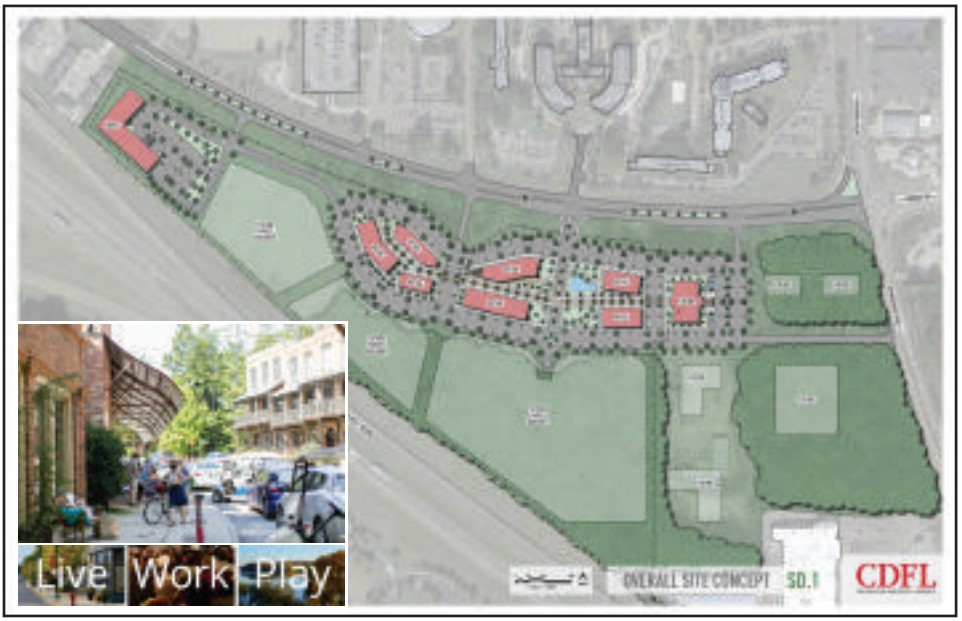
A draft concept plan for The Village at Mississippi College is shown, with the inset photo providing an example of what the streets and parking might look like, now that a utility easement variance has been granted.
After trees were cleared at the corner of Highway 80 and Springridge Road last year, some Clintonians may have expected an eagerly-awaited mixed use development to take shape quickly, even though officials were cautioning there was a lot of preliminary work to be done.
Ward 4 Alderman Chip Wilbanks, a member of a planning committee that’s overseeing the project, told the Board of Aldermen June 6 he had gotten a message from a constituent who was wondering about the status of the development, seeing no evidence of progress and questioning whether the project would be completed. But Wilbanks offered assurances that there’s plenty happening behind the scenes.
“There is a lot of work going on out there to prepare for what you will see,” Wilbanks said.
Mississippi College has partnered with developer Ben Walker and the City of Clinton to develop the property, aided by $8 million in State funding to build the infrastructure. The upscale project has been referred to informally as the “80/20 Project” because of its location between the highway and the interstate. But renderings submitted to the Board in support of a request for a dimensional variance for the project were entitled “The Village at Mississippi College.” MC’s Associate Vice President for Marketing and Communication Tracey Harrison says both are considered working names for the development, which has not yet been given an official name.
Wilbanks said it’ll be a “spectacular” development.
“You’re going to be very, very pleased and very, very proud of what’s going to happen there.” He’s asking the public to be patient. “It’s coming.”
The Board approved the variance so that developers don’t have to include a ten-foot utility easement on each side of their streets. Pickering Firm, Inc. of Flowood is handling the civil engineering for the infrastructure construction. Nat Whitten, a principal with the firm, explained that it’s part of the effort to create a small-town atmosphere for the development.
“The whole point of the town plan that the college is trying to accomplish is to push the buildings right up on the street, like they are in Olde Towne; so you have sidewalks like you have in Olde Towne that are right up on the curb.”
But Whitten said that wouldn’t be possible if an easement is required.
“That really wouldn’t allow them to get that pedestrian-oriented feel that they want. [The easement] takes up space on each side of the right of way, which is contrary to the concept that this developer and the college want to accomplish with an Olde Towne feel—kind of a new urbanist program. I think the objective of that is to make you want to get out of your car and walk around. When you have a big, wide street and plenty of room on each side, it’s easier to drive.”
The street design will include parallel parking spaces.
“That’s another thing that inhibits traffic flow and makes people want to get out and walk,” Whitten said.
But there’s a downside to the cozy streetscape: the utilities that typically would be located on the easement adjacent to the street will now be under the street.
“Normally, you have them beside the road,” said Ward 2 Alderman Jim Martin, “so, if you have a problem, you dig it up, and it’s not that big of a deal. Here, they’re going to be under the road, so, when there are problems, you’re going to have to dig up the road to get to it. That’s going to run up costs and [create] inconvenience. But maybe that’s a trade-off. I just raised the question, so we’d make sure we knew what we’re getting into.”
Whitten told the Board, “It is going to be more difficult to deal with utility repairs under the pavement. But I guess that’s a normal practice that we have here in Olde Towne [when utility repairs are needed.] So it’s going to be just like that.”
He said the public will soon see plenty of activity on the property.
“We’re working on the [infrastructure] design now,” Whitten said. “Now that we have approval for the dimensional variance, we can proceed on finalizing our design plans. And, once we get that, the project’s construction manager, which is Century Construction, will advertise for bids.”
“You’ve got to get permits from the City, you’ve got to get permits from the Department of Environmental Quality, the Corps of Engineers and MDOT,” explained Whitten. “Hopefully, the permits are issued and the bids come in about the same time. You’re looking at [around] Labor Day to start construction, maybe. You’ll be seeing streets, water, sewer and storm sewer go in.”
