Beyond the Mood Board: The Real Math of Furnishing a Home

The true value of a piece of furniture is often found in the details of its construction.
By a design industry contributor.
It’s easy to get lost in the dream of a perfectly designed room. It’s much harder to face the budget. To give you an idea, households in the Denver metro area have average yearly spending of $94,236, according to the U.S. Bureau of Labor Statistics. Furnishing a home is a big investment within that budget, and the cost often surprises people.
The difference between a pretty picture online and the real bill can be a shock. To make a good plan, you first need to understand what affects the cost: materials, where it’s made, how it’s built, and how long it takes to get. A good first step is to look at high-quality contemporary furniture stores denver. This helps you set realistic expectations for the price of long-lasting furniture. This research helps you base your project on what you can really afford before you get too far.
Housing is already the biggest single expense for people in the area. Data from the U.S. Bureau of Labor Statistics shows it uses up 35.5% of the average budget for households in the Denver area. Careful planning for the items that fill that home helps make sure the money you spend improves your life for years to come, instead of causing regret.
Quick answer: To furnish a home successfully, you should treat it like any other big project. This means making a budget in stages based on real prices, knowing the big difference in delivery times between custom and in-stock items, and planning the order you buy things to avoid expensive mistakes.
What’s inside
- How much should you realistically budget for furniture?
- What specific questions reveal a showroom’s quality and service?
- What are the true timelines for custom vs. in-stock pieces?
- Frequently Asked Questions
How much should you realistically budget for furniture?
There is no single magic number. A good budget is made by deciding which rooms are most important and understanding the real cost of quality. A common mistake is to use a vague percentage of your home’s value. A better way is to plan your budget for each room, starting with the rooms where you spend the most time. This connects your budget to how you really live.
This is a big investment. According to the U.S. Bureau of Labor Statistics, the average Denver-area household spends $33,407 per year on housing. This large category covers rent or mortgage, utilities, and the furniture that makes a house feel like home. When you remember that total average household spending is $94,236 a year, it’s clear that choices about furniture have a big effect on your money. A detailed budget stops you from making quick, emotional purchases that could hurt your plans or your finances.
A practical way to start is to list every room you plan to furnish. Then, rank them by importance. The living room, main bedroom, and dining area are often at the top of the list. These high-use rooms are the best places for investment pieces that are durable and have a timeless style. Guest rooms or home offices that are used less can be furnished with less expensive items. This step-by-step plan puts your money where it will make the biggest difference every day.
❝ A useful rule of thumb is the 60/30/10 split. Plan to spend 60% of your total furniture budget on the three rooms you use most. Use 30% for the next three most important rooms. The final 10% can cover the other, less-used areas. This guide helps you make careful choices about where quality matters most.
Finally, research the different levels of furniture quality. Costs are based on materials, how a piece is built, and where it comes from. A solid wood dining table made in North America will have a different price and last longer than a mass-produced piece made with a thin wood layer. Knowing these differences helps you mix and match. You can invest in a high-quality sofa and pair it with more affordable side tables. This helps you get a stylish look without spending top dollar on every single item in the room.
What specific questions reveal a showroom’s quality and service?
You can judge true quality by looking past the surface. You need to check how it’s built, what it’s made of, and the store’s service policies. The price tag isn’t always the best guide. You need to know what to look for and what to ask, whether you are looking at a piece in person or online. This means looking into the details that decide how an item will hold up over years of use.
Start with the piece itself. For items like dressers or tables, ask how the joints are put together. Are drawers built with strong dovetail joints, or are they just held together with glue and staples? For furniture with fabric, like sofas, do a “sit test.” Does the frame feel solid and heavy? A good frame is usually made from kiln-dried hardwood, which stops it from bending out of shape. When you press on the arms and back, you should feel firm padding over a strong frame, not an empty space or a shaky arm.
Besides your own inspection, you can look at well-known industry standards. Many of these standards are for office furniture, but they are a good sign of how long something will last in a home. The Business and Institutional Furniture Manufacturers Association (BIFMA) sets strict standards that companies choose to follow for product safety, materials, and performance. A piece that meets these standards has been tested to copy years of use. This gives you more confidence that it will last a long time.
A quick reference can help you spot the difference between furniture built to last and pieces designed for short-term use.
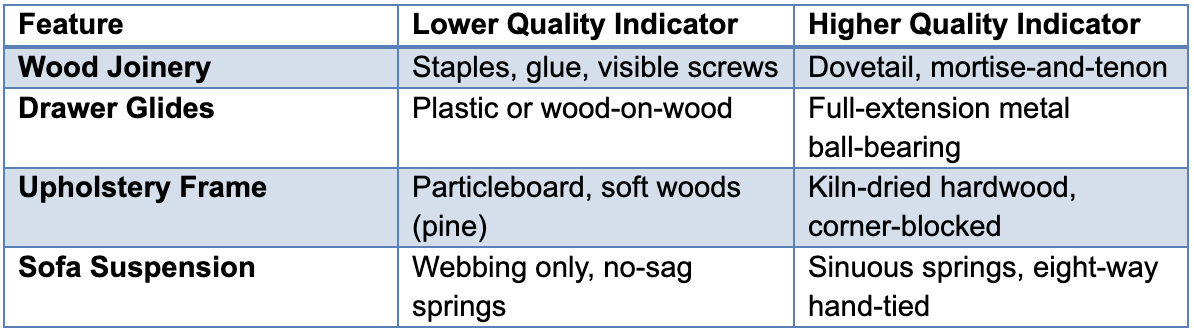
Finally, check the service that comes with the product. Ask for details on the warranty for both the frame and the fabric. Ask about the delivery process. Does it include assembly, putting it in the room, and taking away all the packaging? A clear and complete return policy for non-custom items is also a sign of a trustworthy seller who stands behind their products.
❝ Ask a salesperson a simple question: “Can you tell me how this piece is constructed?” A helpful salesperson should be able to tell you about the frame material, the joints, and the spring system without pausing. If they can only talk about the color or fabric, it’s a sign to look closer.
What are the true timelines for custom vs. in-stock pieces?
The delivery time for in-stock furniture depends on shipping and handling, often taking days or weeks. Custom pieces are on a building schedule that usually takes months. Knowing this difference is key to planning any design project and avoiding months of frustration with an empty room.
In-stock furniture is already built and sitting in a warehouse. The main factor is its location. If it’s in a local warehouse, delivery can sometimes happen within a week. If it’s at a warehouse farther away, the timeline gets longer to allow for shipping to the local delivery team. The process is simple: scheduling a truck and crew. Delays can happen, especially during busy moving seasons, but the timeline is usually predictable.
Made-to-order furniture runs on a totally different schedule. The moment you place an order, you are starting a special building process. The estimated delivery time, often 12 to 20 weeks or more, isn’t random. It is based on a series of separate steps in the building process, and any of them can cause delays.
First, your order is processed and sent to the workshop. The maker then sets aside the specific materials, like the wood for the frame, the cushion filling, and your chosen fabric or leather. If that specific fabric is out of stock at the factory, your project has to wait. Once all the materials are ready, your piece gets in line to be built. It waits its turn behind other custom orders. The actual building has several stages: frame construction, spring system installation, and finally, the skilled work of cutting, sewing, and applying the fabric.
❝ When a showroom gives you a delivery estimate, ask where they usually see delays. Is it a certain fabric from a European factory? Is it shipping and customs? An experienced seller will know their supply chain’s common weak spots and can give you a more realistic picture than the standard estimate.
After it’s built, the piece must be shipped. Furniture made in North America travels by truck. Items from Europe or Asia add weeks for ocean travel, customs, and then local shipping. This overseas part of the trip is often the hardest to predict. Knowing about this multi-step process is very important for planning your project. It lets you plan other work, like painting or flooring, around a realistic delivery time for your main furniture. Always get the estimated timeline in writing, but build extra time into your personal project schedule.
Frequently Asked Questions
Is it worth using a store’s in-house interior design service? Yes, especially if the service is free with a large purchase. A professional designer makes sure the size and layout of the room are right before you buy. They can create a floor plan that works well together, preventing costly mistakes like buying a sofa that’s too big for the room or a rug that is too small. This service also gives you access to more fabric and finish samples than you could find on your own.
How can I successfully mix investment furniture with more affordable items? Put most of your money into the main pieces you use every day. This includes your sofa, main bed frame, and dining table. These items are the foundation of the room’s purpose and style. You can then choose more affordable pieces for side tables, extra accent chairs, or decorative lights. The key to a look that fits together is to stick with a consistent color scheme or type of material to tie the different items together.
What is the real difference between American-made and European furniture? Besides looks, the main differences are often in size and delivery times. European designs, especially from Italy or Scandinavia, often have a slimmer, lower-to-the-ground look. American-made modern furniture can be bigger in size, which is often better for larger rooms. Delivery times for European pieces are usually longer and less predictable, as they have to include ocean shipping and customs.
What does “white glove delivery” actually include? This is a top-level service that is much more than a standard curbside drop-off. A white glove team brings the furniture into your home, unpacks it, does any needed assembly, and places it where you want it. Importantly, they also take away all the boxes, foam, and other packaging. For large, heavy, or fragile items, this service is very important for preventing damage to the furniture and your home.
Should I choose my furniture or my art first? If you already own a large piece of art, you can definitely design the room around it, using its colors and feeling as a guide. However, for a new space, it is often more practical to choose your big, useful furniture first. This sets up the room’s layout and main colors. You can then choose art that goes well with the room and fits the available wall space, treating it as the final, personal touch.
The Bottom Line on Furnishing Your Space
The process of furnishing a home is less about finding one perfect item and more about making a series of smart choices. The main choice isn’t just about style versus price. It’s also about getting something now versus getting exactly what you want. An in-stock piece meets an immediate need. A custom order creates your exact vision, but it takes much longer and the schedule can change. Figuring out which you need for each item is the first key step.
The second is changing your focus from how it looks in the store to how it’s made. By asking specific questions about joints, frame materials, and spring systems, you look past the surface to judge how long an item might last. This changes you from just a shopper to a smart buyer. In the end, a well-furnished home is a collection of smart choices, not just pretty things. It’s an investment in your daily life, based on knowing what makes quality last.
About the author
Robert Zimmerman and Mike Mordeson are the co-founders of Element Home, a contemporary furniture showroom and art gallery located in Denver’s Cherry Creek North neighborhood since 2003. The company offers professional interior design services and a special collection of furniture and lighting from American, European, and Canadian makers. The gallery shows work from more than thirty well-known artists, and the team offers white glove delivery and installation for all pieces, helping clients create a complete vision for their homes.
Read more: Dining Room Upgrades That Can Make Every Meal Feel More Special
Read more: Moving Into a New Home? 10 Decorating Decisions to Make First
Read more: Why Draper Furniture Stores Are a Go-To for Multi-Generational Homes